
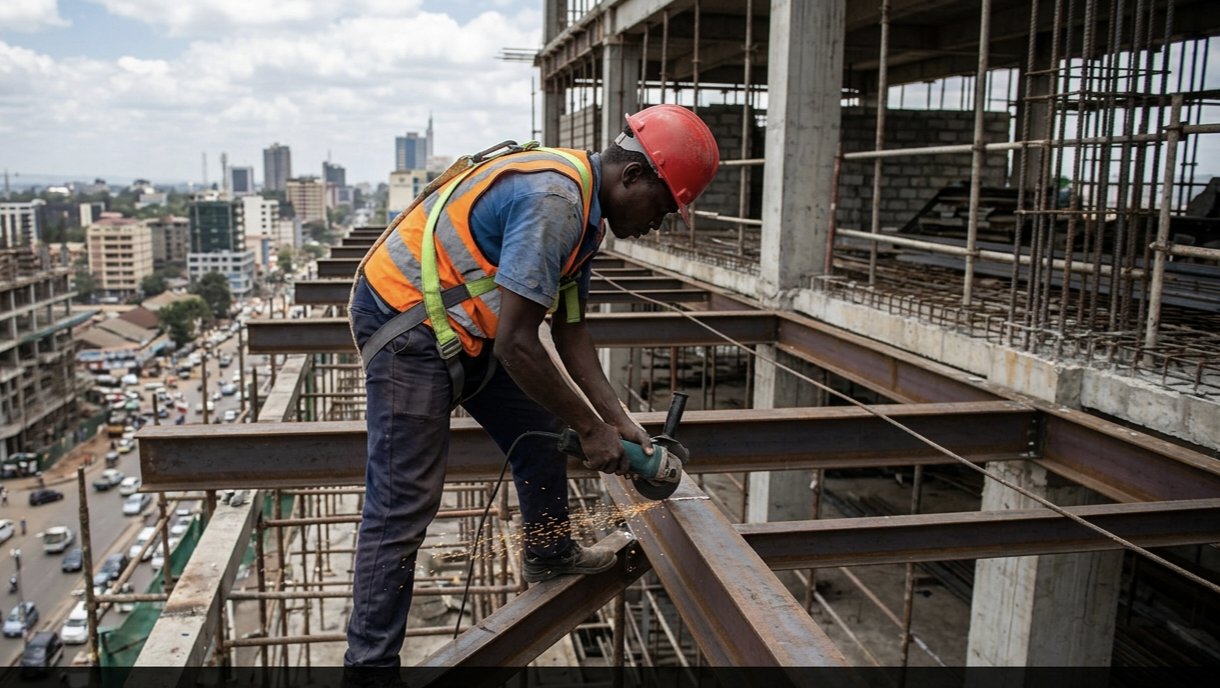

Globally, a construction worker dies every ten minutes.
The International Labour Organization (ILO) estimates that at least 60,000 fatal accidents occur on construction sites every year, accounting for roughly one in five of all workplace deaths worldwide. Construction employs approximately 7 percent of the global workforce but absorbs a disproportionate share of its fatalities. No other industry matches that ratio.
The four leading causes of death on construction sites are consistent across most countries. Falls from height, being struck by objects or equipment, electrocution, and being caught between machinery or collapsing structures account for nearly two-thirds of all fatalities. They are known collectively as the Fatal Four by occupational safety bodies, and they have remained the same for decades. The technology available to prevent them has improved significantly. The rate at which workers are dying from them has not.
Developing countries bear the heaviest burden. The ILO estimates that construction sites in developing nations are up to ten times more dangerous than those in industrialised countries. Africa and Asia record fatal occupational accident rates four to five times higher than Europe. Africa accounts for 11.8 percent of global work-related mortality, a figure that does not reflect its share of the global workforce.
Kenya sits near the top of the regional risk table. Research published in the World Journal of Advanced Research and Reviews in 2025 found that Kenya records 64 deaths per 100,000 construction workers, compared to South Africa's 25 per 100,000. The Directorate of Occupational Safety and Health Services (DOSH) recorded 237 construction site accidents over four years period in Nairobi alone, resulting in 32 fatalities. More than 70 percent of those killed or seriously injured were men under the age of 40.
The majority of Nairobi's construction companies allocate less than one percent of project budgets to health and safety. The law requires every site to have a designated safety officer. Research found these officers were almost non-existent even on major sites. DOSH itself, the body responsible for enforcement, has operated at roughly a third of its required staffing capacity.
Falls from height and being struck by falling objects account for 64 percent of all recorded construction accidents in Nairobi. About a third of those accidents occur during the two busiest hours of the working day, between 10 and 11 in the morning and 3 and 4 in the afternoon, when pressure to maintain output is highest.
The contrast with countries that have actively invested in construction safety is sharp. The United Kingdom, through its Construction Design and Management (CDM) Regulations, has achieved a fatality rate of 1.62 deaths per 100,000 workers, roughly a quarter of the European average and a fraction of Kenya's figure. The European Union reduced its construction fatality rate by approximately 40 percent over two decades through mandatory framework directives.
In the United States, where Construction Safety Week ran from May 4 to 8, 2026, industry bodies this year launched a five-year plan under the theme All In Together, acknowledging that despite decades of safety investment, serious injury and fatality rates have not meaningfully declined. The plan focuses on identifying high-energy, high-hazard activities before they result in death rather than investigating after the fact.
The construction sector's fatality problem is not a knowledge problem. The causes are known. The solutions exist. What remains missing, across most of the world and acutely in Kenya, is consistent enforcement, adequate resourcing of safety regulators, and a project culture that treats worker safety as a line item rather than an afterthought.
Comments (0)
Leave a Comment
No comments yet. Be the first to share your thoughts!