
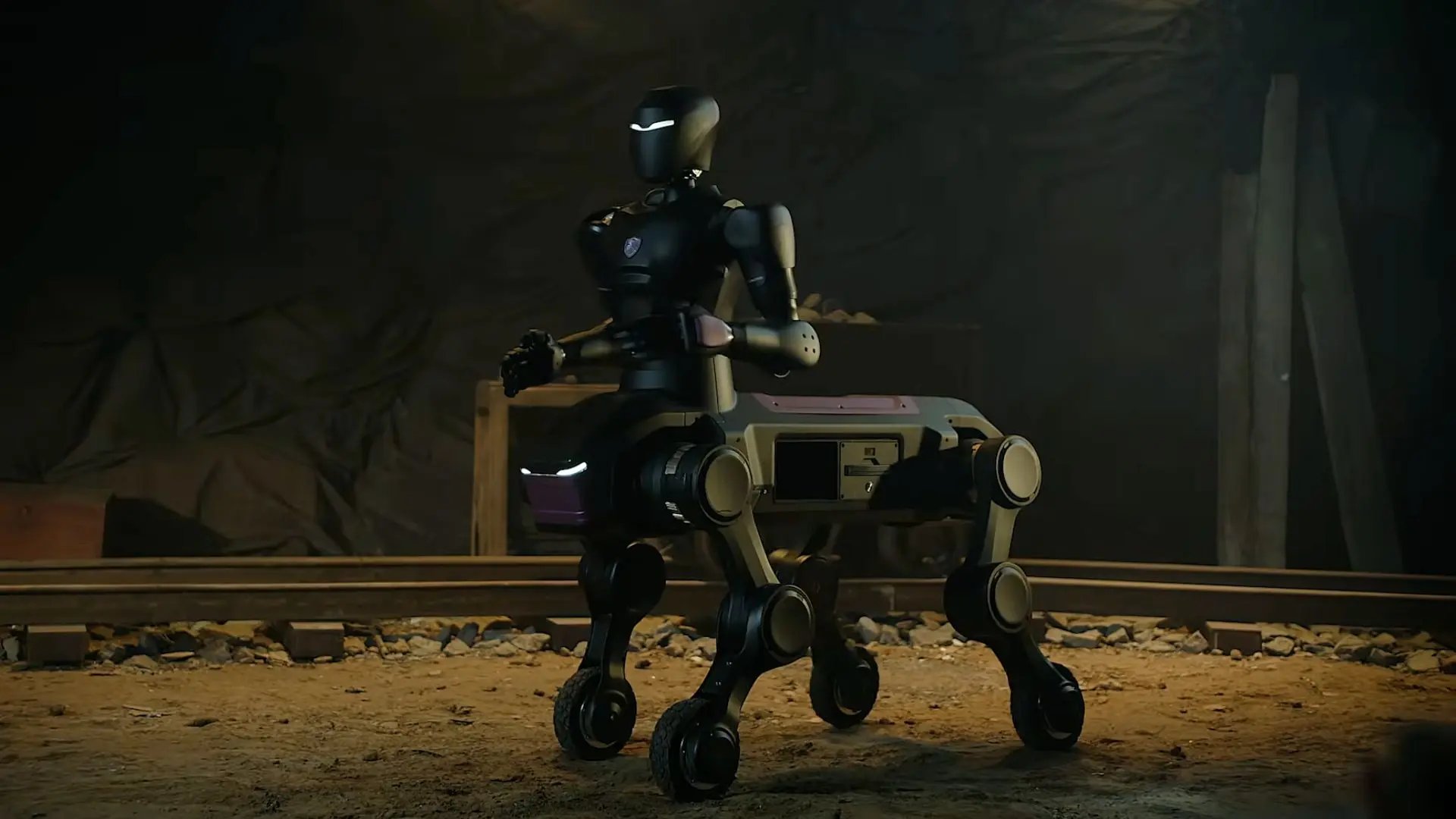

Shanghai-based robotics firm Run Robotics unveiled a wheel-leg hybrid machine at the World Artificial Intelligence Conference (WAIC) in Shanghai. The unit combines a four-wheeled mobility chassis with a humanoid upper body.
The machine features a split-body configuration designed to navigate challenging terrains. It targets applications in firefighting, emergency rescue, and hazardous industrial environments.
Traditional wheeled systems often struggle with stairs or loose debris on active job sites. Conversely, bipedal humanoid robots consume substantial power, which limits their operational runtime during extended field operations.
To address these limitations, the machine utilizes a hybrid approach. Its four-wheel lower chassis allows rapid movement across smooth surfaces, while its articulated legs traverse rugged ground with ease.
Active suspension is integrated into each leg mechanism. This system absorbs sudden impacts, and, it maintains stability across uneven terrain without requiring the machine to pause.
An independent joint locking mechanism provides operational durability. If a wheel suffers severe damage, the machine shifts its center of gravity, and, it walks out of danger.
The platform supports a dynamic payload ranging from 100 to 120 kilograms while moving across difficult ground. For stationary tasks, it handles a static load up to 210 kilograms.
System-level explosion-proof construction permits safe operation in volatile locations. Target environments include high-temperature steelmaking plants, long-distance oilfield pipeline inspections, and radiation zones.
The upper body features dual robotic arms equipped with multidimensional force sensors. These components allow the unit to clear debris, operate valves, and assist rescue workers.
More than 95 percent of the core components are produced domestically within China. This high degree of localized manufacturing supports supply chain independence for specialized equipment.
Perception relies on an Artificial Intelligence (AI) foundation model coupled with advanced sensors. The head assembly combines Light Detection and Ranging (LIDAR) sensors, binocular vision, and depth cameras.
This perception suite builds real-time spatial understandings of complex surroundings. The software identifies high-temperature pipelines, pressure gauges, obstacles, and personnel, and, it plans autonomous transit routes.
Run Robotics Chief Executive Officer (CEO) Zhou Bin stated that the machine represents a practical product iteration. He explained that it resolves long-standing industry bottlenecks regarding operational capability and field deployment.
The unit was listed among top innovations showcased at the Shanghai exhibition. It demonstrates how autonomous platforms are transitioning from laboratory prototypes into industrial applications.
Run Robotics plans to complete a dedicated assembly line in the fourth quarter of 2026. The firm has already secured initial real-world commercial orders from industrial clients.
Industrial operators in hazardous sectors continue to seek automated tools to reduce risks to human crews. Deploying specialized units protects personnel, and, it maintains productivity during emergency incidents.
The hybrid design bridges the gap between speed and terrain capability. As field trials expand, similar platforms may soon see broader adoption across global infrastructure projects.
Engineers designed the upper chassis to accept interchangeable tools and sensory modules. This modular structure allows technicians to reconfigure the machine quickly, and, it supports diverse field assignments.
Emergency response teams require rugged machinery capable of entering unstable structures. By combining heavy payload capacity with precise control, these units offer practical support during recovery operations.
Comments (0)
Leave a Comment
No comments yet. Be the first to share your thoughts!