
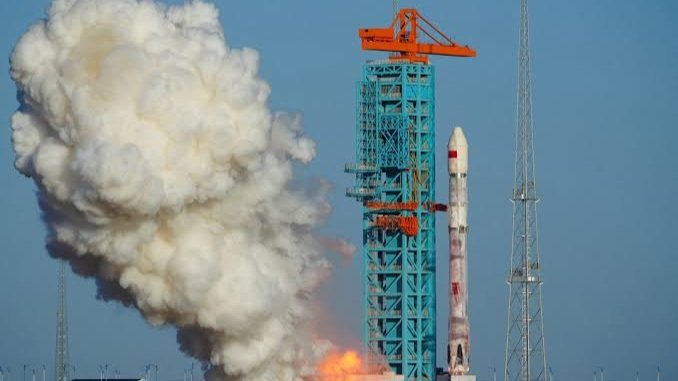

Beijing-based commercial aerospace startup Beijing LandSpace Technology Corporation (LandSpace) successfully completed vertical landing test of its orbital-class rocket booster, according to Chinese state media reports.
The development positions the firm alongside Space Exploration Technologies Corp. (SpaceX) and Blue Origin Enterprises, LLC (Blue Origin) as one of the few private entities to achieve vertical recovery of orbital-class booster hardware.
State broadcaster China Central Television (CCTV) released footage showing the first-stage vehicle descending vertically before executing powered touchdown sequence at designated landing pad site.
The booster controlled its descent using grid fins and vectoring rocket engines, which stabilized craft during high-speed atmospheric re-entry phases.
LandSpace has been developing methane-liquid oxygen propulsion systems for its Zhuque series launch vehicles, targeting reduced launch costs through hardware reusability.
Traditional orbital launch systems discard first-stage boosters into oceans or unpopulated land areas, requiring entirely new hardware manufacturing for subsequent missions.
By recovering first-stage booster, company aims to refurbish and reuse primary structural components, avionics, and main engines, which represent major percentage of total launch costs.
SpaceX pioneered commercial booster recovery with its Falcon 9 rocket, while Blue Origin demonstrated similar capability with its New Shepard suborbital vehicle and New Glenn architecture.
Commercial satellite operators increasingly favor launch providers offering reusability, which provides predictable flight schedules alongside lower price points per kilogram payload delivered to Low Earth Orbit (LEO).
The successful test recovery marks expanding commercial aerospace capabilities within China, where several private startups are competing against established state-owned defense contractors for commercial payload delivery contracts.
LandSpace previously made history in 2023 by reaching orbit with methane-fueled launch vehicle, beating international commercial rivals to operational orbit using liquid methane propellant systems.
Engineering teams will evaluate structural integrity, thermal protection degradation, and engine performance metrics on recovered hardware before scheduling full flight integration tests.
Industry analysts note that operationalizing reusable rocket fleets requires extensive refurbishment protocols, rigorous static fire testing, and streamlined safety certification workflows.
LandSpace plans to integrate reusable first-stage architecture into upcoming commercial satellite launches scheduled over coming operational cycles.
Global commercial launch sector continues transitioning toward fully or partially reusable vehicle architectures to handle growing demand for mega-constellation deployments.
Comments (0)
Leave a Comment
No comments yet. Be the first to share your thoughts!