
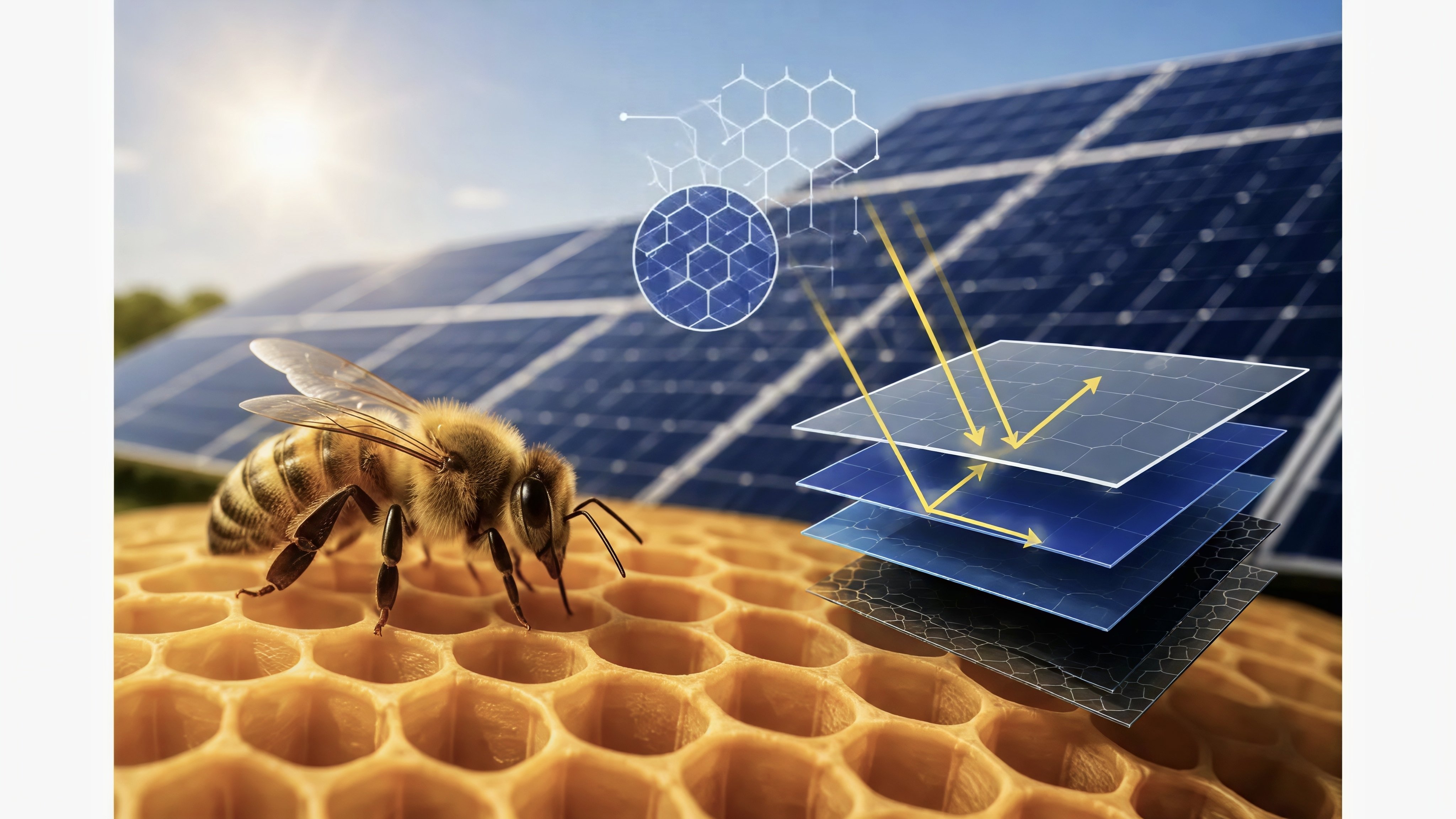

Researchers have redesigned solar panel structure around the geometry of a bee honeycomb, aiming to fix a long-standing flaw in how conventional panels handle sunlight that hits them at an angle. The work was published in the journal Advanced Materials Technologies.
Traditional solar panels are flat, which limits how efficiently they capture light outside of solar noon. As the sun moves across the sky, its rays strike a flat panel more obliquely, and much of that light simply reflects off the glass surface and is lost rather than absorbed.
To address that, researchers built a concave, three-dimensional module using tetrahedron-shaped units arranged into a honeycomb lattice, echoing the same hexagonal cell pattern bees use to build hives with minimal material and maximum strength. The tilted cell walls create angled surfaces that recapture light a flat panel would otherwise reflect away.
According to the study, the honeycomb-structured modules delivered 28 percent greater power output than flat photovoltaic cells of the same size, without requiring any moving parts or expensive solar-tracking motors to follow the sun's position through the day.
The structure also behaves as a mechanical metamaterial, giving it shock-absorbing properties and enough flexibility to be mounted on curved surfaces rather than only flat rooftops. Researchers say that flexibility could open the technology to uses beyond conventional solar installations, including curved building facades, vehicle surfaces and aerospace equipment.
The underlying principle borrows directly from how bees construct comb. Honeycomb cells use the least amount of wax needed to enclose a given volume while remaining structurally strong, a geometric efficiency that has previously informed lightweight panel designs in aviation, packaging and acoustic engineering.
Applying that same hexagonal logic at solar-cell scale represents a shift from treating solar panels purely as flat electrical components toward treating their physical structure as part of the engineering problem, alongside the materials used to build the underlying photovoltaic cells themselves.
The approach remains at the research stage, and further work would be needed to test durability, manufacturing costs and performance at commercial scale before honeycomb-structured panels could compete with conventional flat panel installations.
Comments (0)
Leave a Comment
No comments yet. Be the first to share your thoughts!