
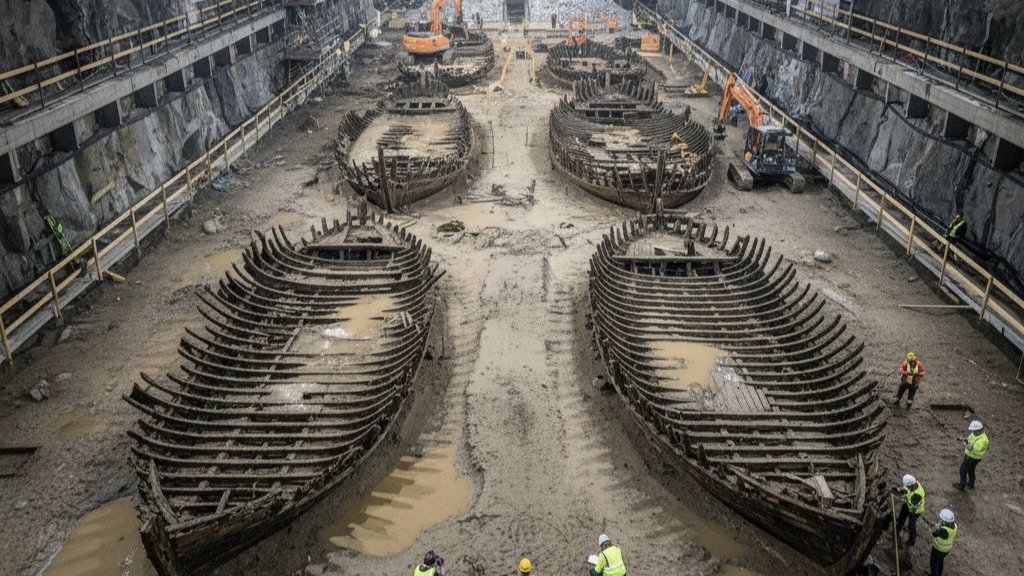

Construction crews building the Varberg Tunnel, part of a railway upgrade along Sweden's west coast, have uncovered six shipwrecks dating from the Middle Ages to the 17th century. The wrecks surfaced near the city's historic centre, once the site of a medieval harbour and its defences.
Archaeological teams from Arkeologerna, working with the Bohuslän Museum, Visual Archaeology and Cultural Environment Halland, identified four of the wrecks as originating from the Middle Ages or Late Middle Ages, one from the 17th century, and one that remains undated.
Elisabet Schager, project manager at Arkeologerna, said large infrastructure projects along Sweden's west coast are increasingly turning up shipwrecks. Areas that once formed harbours or lay underwater during the Middle Ages and early modern period now sit beneath modern city streets.
Wreck 2, dated to the 1530s, stands out as the best preserved of the six, with a continuous hull structure unusual for its age. It was built using clinker construction, an overlapping-plank technique common across northern Europe that produced a distinctive ribbed, stepped hull form.
Wreck 6 differs sharply in style, built as a caravel with planks laid edge to edge rather than overlapping. Made of oak, it is the only wreck with a preserved rabbeted keel, a grooved design that points toward Dutch shipbuilding traditions, though its timber has not yet been precisely dated.
Wrecks 3 and 4, both dated to the 14th century, are flat-bottomed vessels typical of medieval trade, well suited to navigating shallow harbours and river mouths. Researchers hope further analysis will reveal more about regional trade networks during that period.
Archaeological surveys of the site began in 2019, ahead of construction on the Varbergstunneln project, which is backed by Swedish infrastructure authority Trafikverket. The broader West Coast Line railway upgrade has grown substantially in cost since planning began, reflecting the scale of the wider construction programme surrounding the discovery.
Schager described the ongoing work as still unfolding, saying researchers expect to uncover more details about the ships and the maritime history they represent as documentation continues.
Comments (0)
Leave a Comment
No comments yet. Be the first to share your thoughts!