
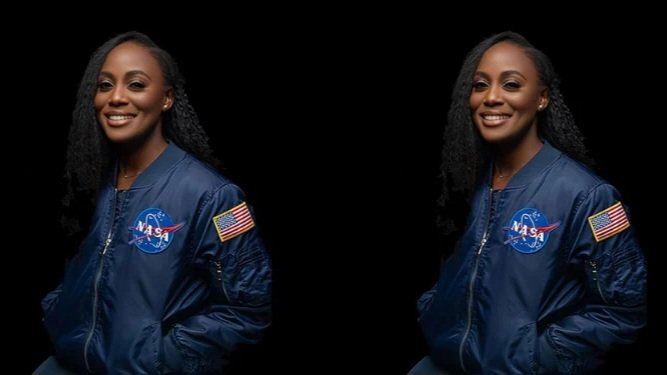

Wendy Okolo stands as a prominent figure in modern aerospace engineering, a field where she has rapidly ascended to a position of leadership within the National Aeronautics and Space Administration. Her journey, which involves achieving a doctorate in aerospace engineering at the age of 26, has positioned her as a key player in the development of advanced flight systems. Currently, Okolo serves as an aerospace research engineer at the NASA Ames Research Center, located in California’s Silicon Valley, where she manages complex technical portfolios.
Her academic foundations were laid at the University of Texas at Arlington, where she completed her undergraduate and doctoral degrees. During her time as a student, she did not merely focus on theoretical applications but engaged in practical, high-stakes research. She served as the president of the Society of Women Engineers, demonstrating early on a commitment to leadership and the advancement of underrepresented groups in technical fields. Her doctoral research focused on fuel-saving methods for aircraft, a critical area of study for both commercial aviation and space exploration.
At NASA, Okolo has taken on roles that require deep technical expertise in control systems and flight dynamics. She has worked as a special assistant to the executive leadership of the Space Technology Mission Directorate, often referred to as STMD. In this capacity, she provided technical insights that helped guide the agency’s long-term goals in space exploration technology. Her work often involves the intersection of high-speed flight and autonomous control systems, which are essential for the next-generation of space vehicles.
The recognition for her work has been extensive. She was a recipient of the BEYA Modern-Day Technology Leader Award, a prestigious honor that recognizes professionals who are shaping the future of engineering. Furthermore, she received the NASA Ames Early Career Special Achievement Award, which is given to employees who show exceptional promise and deliver high-impact results early in their tenure at the agency. These accolades highlight her ability to translate complex mathematical models into functional solutions for some of the most challenging problems in aerospace.
Beyond her technical duties, Okolo is frequently cited as a role model for young women and minorities pursuing careers in Science, Technology, Engineering, and Mathematics. Her career path reflects a shift in the demographic makeup of top-tier research institutions, where diversity is increasingly viewed as a driver of innovation. By reaching such high levels of academic and professional success at a young age, she has become a symbol of what is possible within the global engineering community.
Okolo’s current research continues to push the boundaries of how aircraft and spacecraft are controlled during critical phases of flight. As NASA looks toward more ambitious missions, including sustained lunar presence and eventual Mars exploration, the work of engineers like Okolo becomes indispensable. Her focus on reliability and efficiency in flight controls ensures that the hardware sent into orbit, or across the solar system, operates with the highest degree of precision.
In a professional landscape that often requires decades of experience to reach senior research positions, Okolo’s rapid rise is a testament to her technical proficiency and dedication. She remains a central figure at the Ames Research Center, contributing to the ongoing legacy of NASA as a leader in global aerospace development. Her story is not just one of personal achievement, but a reflection of the evolving nature of engineering leadership in the twenty-first century.
Comments (0)
Leave a Comment
No comments yet. Be the first to share your thoughts!