
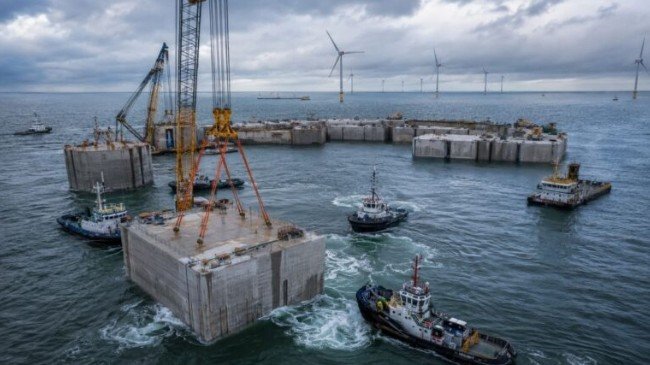

Belgium is taking a bold step toward a cleaner energy future by constructing the world’s first artificial energy island in the North Sea. Located about 45 kilometers off the country’s coast, the ambitious project aims to transform offshore wind power integration in Europe. At the heart of the development is the plan to sink 23 massive concrete caissons, each weighing roughly 22,000 tons, to form the island’s protective outer structure and foundation.
These giant caissons will act as offshore electrical walls, shielding the island while housing critical energy infrastructure. Once installed on the seabed, they will create a ring shaped barrier designed to withstand harsh North Sea weather, including powerful storms and strong waves. This engineering approach reflects lessons learned from decades of offshore construction and coastal defense projects across Europe.
The artificial island is part of Belgium’s Princess Elisabeth energy hub, a project designed to centralize offshore wind connections and improve the efficiency of transmitting renewable electricity to the mainland. Instead of linking individual wind farms directly to shore, the island will serve as a collection point where electricity is converted and redistributed through high voltage connections.
This centralized hub model is expected to reduce infrastructure duplication and lower long-term energy costs. By consolidating connections, fewer cables will be needed to run back and forth between wind farms and the mainland, minimizing environmental disruption on the seabed. It also simplifies maintenance and allows for future expansion as more offshore wind farms are built.
Belgium’s North Sea already hosts several offshore wind farms, making it one of Europe’s leaders in marine renewable energy. However, increasing demand for clean electricity and the push for energy independence have accelerated plans for more large scale projects. The artificial energy island is intended to unlock the next phase of offshore wind development by creating a flexible and scalable power hub.
The construction process itself is a major engineering undertaking. Each concrete caisson must be carefully built onshore, floated out to sea, and precisely positioned before being sunk into place. Engineers must account for seabed conditions, tides, and weather windows, making the installation process both complex and time sensitive.
Once completed, the ring of caissons will enclose a central platform that will host electrical substations, conversion equipment and interconnection systems. These facilities will convert alternating current generated by wind turbines into high voltage direct current, which can travel longer distances with lower energy losses. This technology is key to efficiently transmitting electricity across borders.
The project is not only about Belgium’s domestic energy needs. The island is designed as a future international energy hub, capable of linking power grids across neighboring countries such as the Netherlands, Germany, Denmark, and the United Kingdom. This cross-border connectivity will help stabilize European energy supplies and enable electricity trading between nations.
Energy security has become a major priority across Europe in recent years, particularly after disruptions in global fuel supply chains. By investing in offshore wind and shared grid infrastructure, Belgium hopes to reduce dependence on imported fossil fuels while strengthening regional cooperation. The artificial energy island represents a practical step toward a more resilient and integrated European power network.
Environmental considerations have played a key role in the project’s design. Engineers and marine scientists are working together to minimize impacts on marine ecosystems during construction and operation. The caissons themselves may even create new habitats for marine life, similar to how artificial reefs develop around offshore structures.
The project also reflects a broader shift in how countries approach renewable energy infrastructure. Instead of building isolated projects, governments are increasingly developing large scale hubs capable of supporting multiple energy sources and cross-border connections. This integrated approach is expected to accelerate the transition to clean energy while reducing long term costs.
Belgium’s energy island could become a model for similar projects around the world. As offshore wind technology expands and countries seek innovative solutions to meet climate goals, the concept of artificial energy hubs may become more common in coastal regions with strong wind resources.
Construction of the caissons and supporting infrastructure will take several years, with the island expected to play a major role in Europe’s renewable energy network by the end of the decade. Once operational, it will help deliver large volumes of clean electricity to millions of homes and businesses across the region.
The vision behind the project extends beyond engineering and energy production. It represents a commitment to innovation, collaboration and long term sustainability. By harnessing the power of the North Sea in a new way, Belgium is helping shape the future of renewable energy infrastructure in Europe and beyond.
Comments (0)
Leave a Comment
No comments yet. Be the first to share your thoughts!