
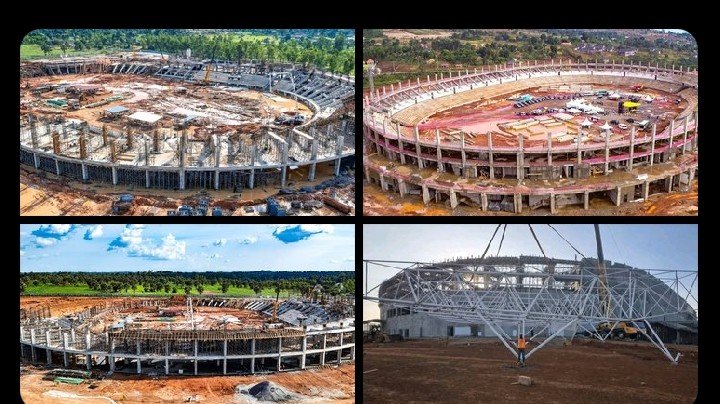

Uganda is making significant strides in improving its sports infrastructure, with the construction of another large capacity stadium complementing its existing facilities. Apart from the Hoima Stadium, the country is now building the Akii-Bua Olympic Stadium in Lira City. As of February 2026, the stadium is approximately 30 percent complete, marking a steady progression in preparation for major sporting events.
The Akii-Bua Olympic Stadium is planned to accommodate 30,000 spectators and is seen as a critical venue for Uganda’s co-hosting of the 2027 Africa Cup of Nations (AFCON), alongside Kenya and Tanzania. The project, valued at UGX 470 billion (roughly Ksh 17 billion), reflects Uganda’s commitment to improving its sporting venues ahead of one of Africa’s biggest football tournaments. With 30 percent of the construction completed, the stadium is on track to play a central role in the tournament’s matches when it kicks off.
Uganda’s investment in stadiums is not limited to the Akii-Bua Olympic Stadium. The country already has the Mandela National Stadium, which boasts a seating capacity of 60,000, making it one of the largest stadiums in East Africa. Adding Hoima Stadium and the ongoing Lira project will bring the country’s total top-tier stadium capacity closer to global standards and provide multiple venues for both national and international events.
The government of Uganda has emphasized the importance of these facilities not only for hosting major events like AFCON but also for nurturing local talent. Larger stadiums provide opportunities for youth development, local leagues, and community engagement. Facilities such as the Akii-Bua Olympic Stadium are expected to include modern training grounds, seating arrangements that prioritize spectator comfort, and spaces suitable for both sporting and cultural events.
In comparison, Kenya’s stadium infrastructure is still growing. While the country has made progress with facilities like the Moi International Sports Centre in Kasarani, which holds 60,000 spectators, and the Nyayo National Stadium, there are still challenges with smaller counties lacking adequate venues for professional level matches. Many Kenyan counties still rely on stadiums that are either outdated or partially completed, limiting the country’s ability to host large scale international events. This contrast highlights Uganda’s focused approach to expanding and modernizing its stadium network.
The timing of these constructions is strategic. Hosting the AFCON requires venues that meet strict CAF standards, including seating, lighting, locker rooms, and media facilities. By ensuring that Lira City’s stadium is ready on time, Uganda not only secures its position as a co host but also strengthens its ability to attract other international sporting events. Beyond football, stadiums of this size and quality can host athletics competitions, concerts and community gatherings, contributing to local economic growth.
While Tanzania is also involved in co-hosting AFCON, Uganda’s approach seems particularly systematic. The country has multiple venues either completed or under construction, ensuring that travel between host cities is manageable and that match schedules can be accommodated without overstretching facilities. For local football fans, this also means increased accessibility to live games and a chance to experience international-level competitions within their own regions.
The cost of these developments is substantial, but the long term benefits are expected to justify the investment. Beyond the immediate boost from hosting international events, there is potential for tourism growth, increased local business activity and a rise in national pride. Additionally, young athletes will have better opportunities to train and compete in facilities that meet international standards, which could elevate the overall level of sports performance in Uganda.
As the Akii-Bua Olympic Stadium continues to take shape, attention will increasingly turn to completion timelines and the quality of the finished structure. With 70 percent of the project reportedly financed and construction moving steadily, the stadium appears well-positioned to be ready in time for AFCON 2027. Combined with the Mandela Stadium and Hoima Stadium, Uganda will have a robust infrastructure capable of supporting both domestic and international sports, placing it ahead of several neighboring countries in terms of stadium readiness and capacity.
In conclusion, Uganda’s efforts to expand its stadium network reflect a clear commitment to sports development and international event hosting. The Akii-Bua Olympic Stadium in Lira City, alongside existing venues, demonstrates that the country is investing in infrastructure that will serve both athletes and spectators for years to come. While regional neighbors may still be developing similar facilities, Uganda’s forward looking approach positions it as a significant player in East African sports infrastructure, with the upcoming AFCON providing an ideal opportunity to showcase its progress.
Comments (0)
Leave a Comment
No comments yet. Be the first to share your thoughts!