
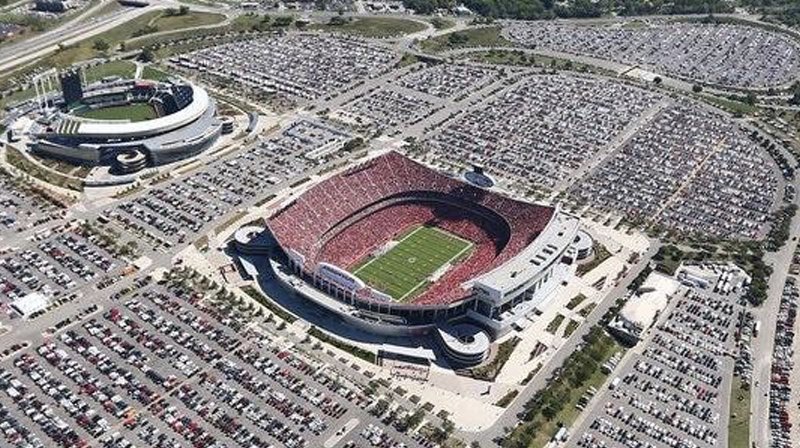

An aerial view of Kansas City's Truman Sports Complex shows GEHA Field at Arrowhead Stadium and Kauffman Stadium sitting side by side, encircled by acres of surface parking that dwarf the stadiums themselves. The layout reflects planning assumptions from the early 1970s that are now being reconsidered.
Built in the early 1970s, the complex was considered ahead of its time when new venues typically doubled as multipurpose stadiums for cost reasons. Arrowhead and Kauffman were instead built as separate, dedicated venues for football and baseball, a design choice architects Kivett and Myers helped popularize nationally.
The complex sits at the intersection of Interstate 70, Interstate 435, Blue Ridge Cutoff and Raytown Road, a location built around vehicle access from the outset. Traffic inside the site is managed through a mandatory counter-clockwise flow, with concrete barriers directing thousands of cars during major events.
Arrowhead alone seats 76,416 people, making it the largest sports facility by capacity in Missouri, while Kauffman seats 37,903. Parking capacity across the shared site runs into the tens of thousands of spaces, with additional lots such as Lot O added in recent years to handle overflow demand on game days.
That car-first layout is now up for reconsideration. Both the Kansas City Chiefs and the Kansas City Royals have confirmed they will leave Truman Sports Complex by 2031, with the Chiefs relocating to a new domed stadium in Wyandotte County, Kansas, and the Royals yet to announce a new site.
Jackson County, which owns the complex, has launched a task force to plan the site's future. Interim County Executive Phil LeVota described the sports complex as a generational asset the county intends to keep from falling into blight once both teams depart.
The task force, made up of 10 to 15 business leaders, developers and community stakeholders, has 90 days from its April 15 launch to draft a redevelopment proposal, backed by a second task force with a five-year mandate for long-term oversight.
For planners elsewhere, the site offers a case study in how much land single-purpose, car-dependent sports venues consume relative to the buildings they serve, and how expensive that land becomes to repurpose once the original use disappears.
Comments (0)
Leave a Comment
No comments yet. Be the first to share your thoughts!