
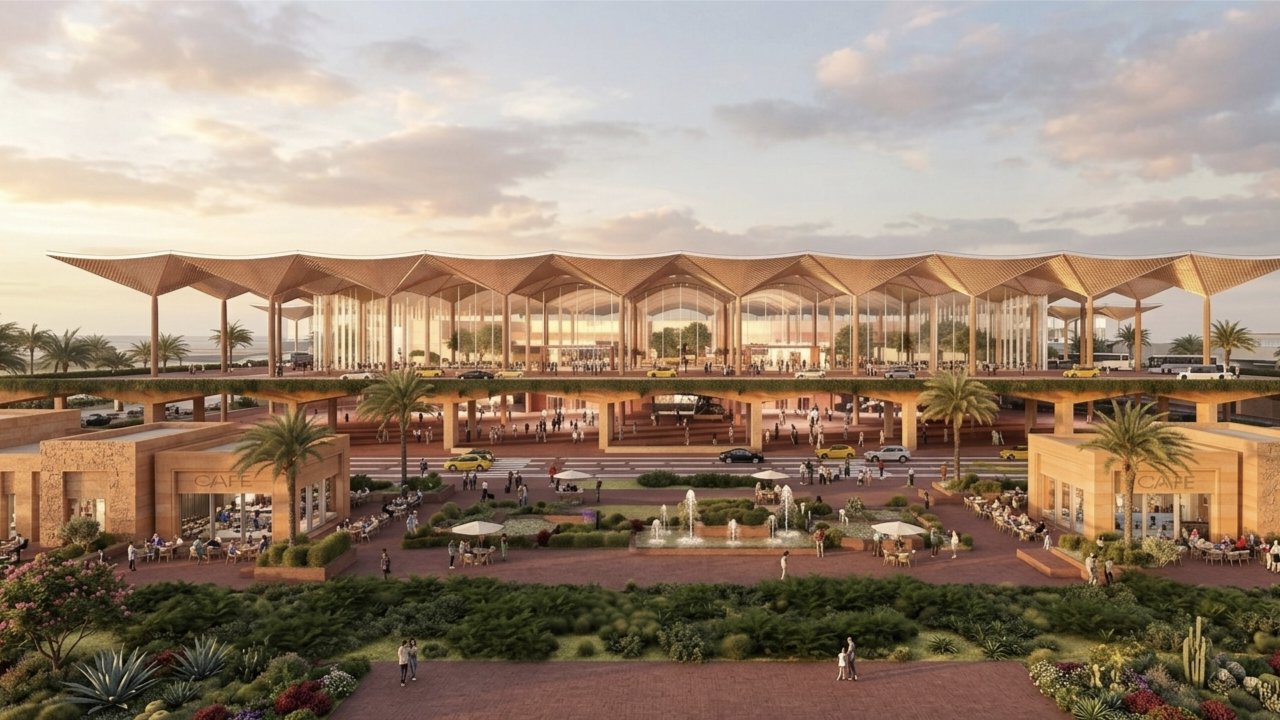

N'Djili International Airport has served Kinshasa since 1953. It has a 4,700-metre runway, one of the longest on the continent, and a terminal that has not kept pace with the country it represents. That is about to change.
Skidmore, Owings and Merrill (SOM), the firm behind some of the world's most complex aviation projects, has unveiled a full replacement of N'Djili's terminal operations, commissioned by Congolese private developer Infrarose. Construction is underway. Completion is targeted for the first quarter of 2028.
The project is estimated at $570 million and covers a two-level terminal spanning 50,000 square metres. It is designed to handle up to five million passengers annually by 2037, with long-term capacity expandable to 9.1 million by 2050. The masterplan also includes a new runway and updated airside infrastructure.
The terminal's most distinctive feature is its roof. Formed from a grid of square modular hyperbolic paraboloids, known in engineering as hypars, the canopy creates a rippling surface that filters natural daylight into the terminal below. The geometry was drawn directly from traditional Congolese basketry, the woven patterns of which share the same mathematical logic as the hypar module. The structure minimises material use while allowing the terminal to expand in phases without disrupting operations.
The wider material palette draws from the Democratic Republic of the Congo's (DRC) landscape. Mineral-toned finishes referencing native earth and stone run through the interior, grounding the building in its setting without resorting to decorative gesture.
The project targets Leadership in Energy and Environmental Design (LEED) Gold certification and incorporates climate-responsive design strategies and low-embodied-carbon building systems throughout.
What makes this project unusual in the African context is its funding model. N'Djili's expansion is being driven entirely by local private enterprise through Infrarose, without the multilateral development financing that typically underwrites major airport projects on the continent. SOM principal Derek Moore described the brief as balancing cultural identity, operational efficiency and future-ready design, adding that the firm brought its full global aviation experience to the project.
A complementary expressway connecting the city centre to the airport was approved by the DRC Council of Ministers in October 2025, with construction beginning in January 2026. The road will run from Triumphal Boulevard through Sendwe, Limete and Lumumba Boulevard, ending at the airport. A 1.2-kilometre elevated structure in the Tshangu area is among the engineering components of that corridor.
N'Djili currently serves as the DRC's primary international gateway, handling the majority of the country's passenger and cargo traffic. Air Congo, the national carrier, is headquartered there.
When the terminal opens, Kinshasa will have a building that looks like it belongs to the city it serves.
Comments (0)
Leave a Comment
No comments yet. Be the first to share your thoughts!