
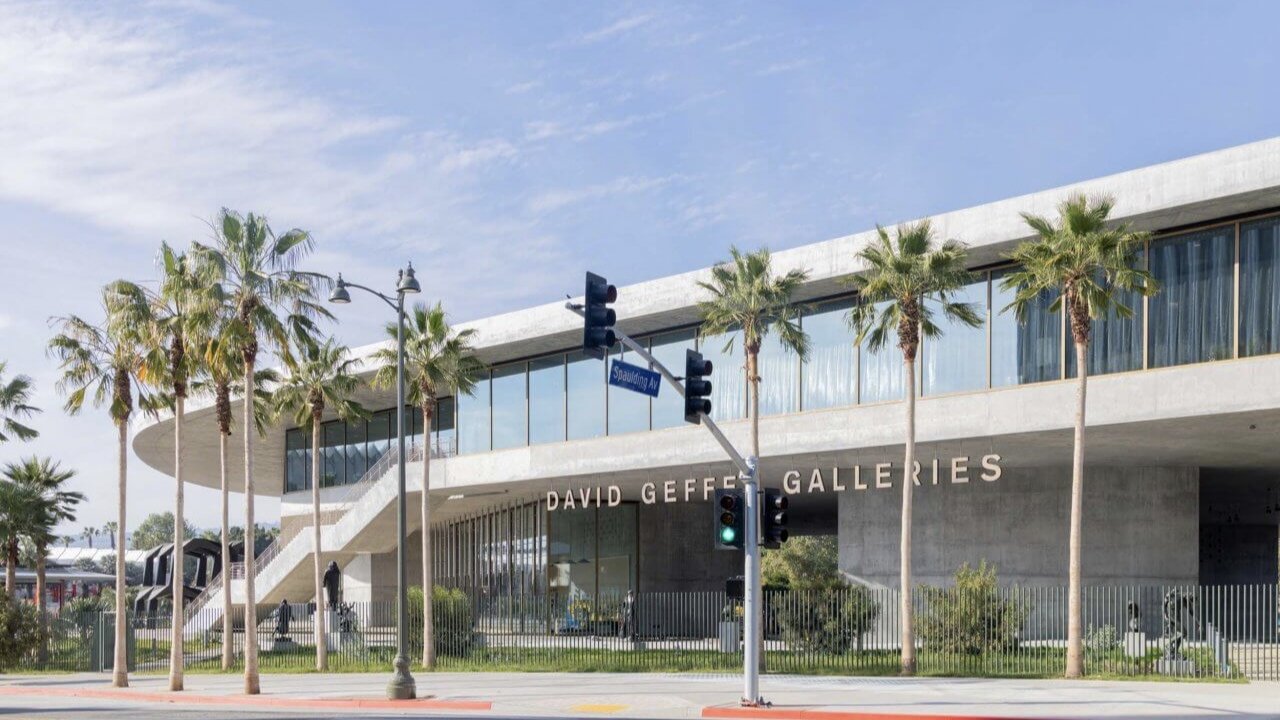

It took 20 years, four demolished buildings, and one of the most debated architectural commissions in recent American history. On April 19, 2026, the David Geffen Galleries at the Los Angeles County Museum of Art (LACMA) finally opened.
Designed by Swiss architect Peter Zumthor, the building is a 275-metre-long curved arc of glass and concrete that stretches along Wilshire Boulevard and crosses it entirely, sitting nearly nine metres above street level. It is Zumthor's first completed building in the United States, a remarkable fact given that he won the Pritzker Architecture Prize in 2009 and has spent decades building acclaimed structures across Europe.
The structure replaces four ageing buildings on the LACMA campus that were demolished to make way for it. In their place is a single continuous exhibition floor of 10,220 square metres, organised as 26 galleries on one level with no prescribed route. Art spanning 6,000 years and 155,000 objects is arranged without giving precedence to any culture, tradition or era. Visitors are free to move through the galleries as they choose, following their own curiosity rather than a fixed chronological path.
Seven ground-level pavilions support the elevated floor and house a 300-seat theatre, education facilities, restaurants, cafes and a museum store. Between them, publicly accessible plazas open to the street, extending the campus into the surrounding neighbourhood. The ground plane itself, titled Feathered Changes, is a commissioned artwork by artist Mariana Castillo Deball that references the ecological history of the site.
Outside, Jeff Koons's Split-Rocker, a 37-foot living sculpture composed of more than 45,000 flowering plants, blooms in the plaza. Pedro Reyes's Tlalli, an 18-foot stone carving, stands against the facade. Alexander Calder's Three Quintains has been reimagined within a new pool designed by Zumthor himself.
LACMA's total exhibition space has grown from 12,080 square metres in 2007 to approximately 20,440 square metres with this opening. Earlier phases of the campus transformation included the Broad Contemporary Art Museum in 2008 and the Resnick Exhibition Pavilion in 2010, both by Renzo Piano.
The building's sustainability credentials are considerable. More than 95 percent of construction and demolition waste was diverted from landfills. Water use has been minimised through climate-adapted planting and high-performance fixtures.
LACMA holds more than 150,000 objects and remains the largest art museum in the western United States. The new Metro Wilshire/Fairfax subway station, opening across the street in May 2026, will give the campus its first direct rail connection to the rest of Los Angeles.
Twenty years is a long time to wait for a building. Los Angeles will decide whether it was worth it.
Comments (0)
Leave a Comment
No comments yet. Be the first to share your thoughts!