
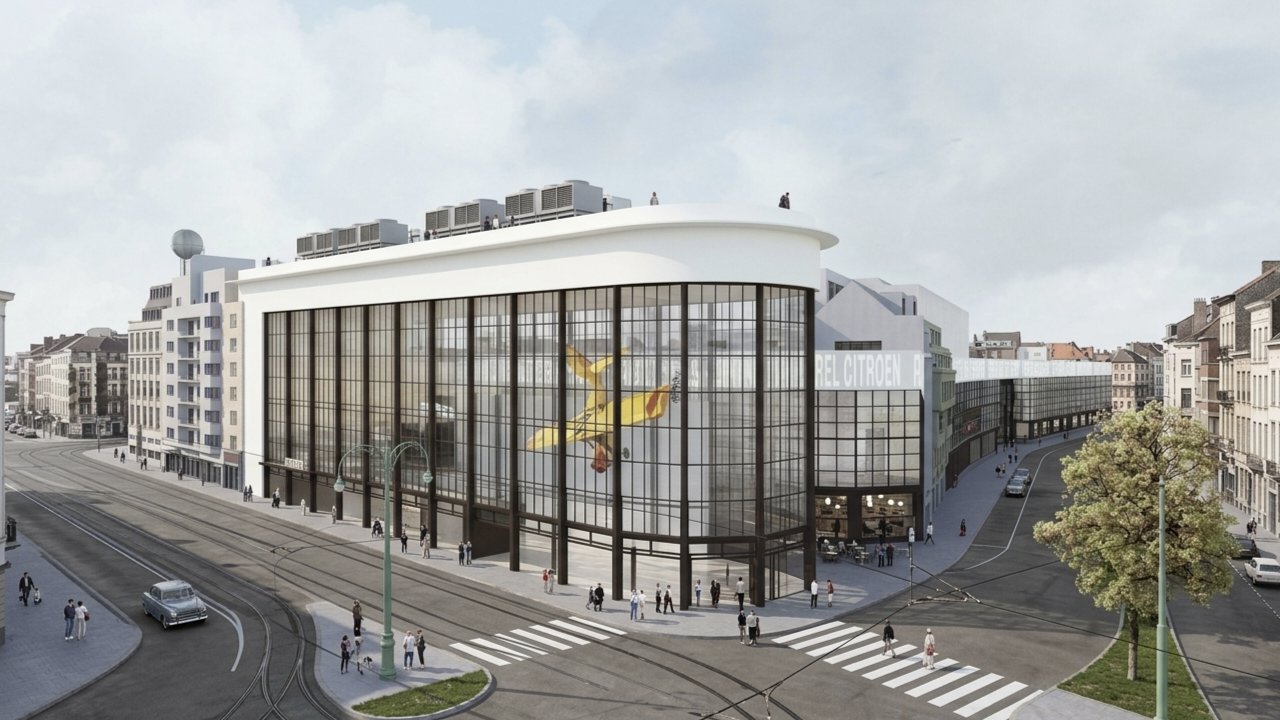

In the early 1930s, car tycoon André Citroën commissioned a building on the banks of the Brussels canal that his architects described as a cathedral for cars. Concrete, steel and glass rose into a 21-metre showroom that was, for a time, the largest garage in Europe. Cars rolled in, cars rolled out, and the building hummed with industrial purpose for decades.
Citroën left in 2014. On November 28, 2026, the building opens as Kanal-Centre Pompidou, Europe's largest new museum development.
The transformation has been executed by Atelier Kanal, a consortium of three architecture practices: noAarchitecten from Brussels, EM2N from Zurich, and Sergison Bates architects from London. The €230 million project, funded entirely by the Brussels-Capital Region, covers 40,000 square metres across five floors of gallery space, performance halls, a film auditorium, workshops, community areas, a library, an in-house bakery, a rooftop restaurant and bar open until midnight, and a 700 square metre indoor playground designed by Turner Prize-winning British collective Assemble. The playground takes the form of an imaginary landscape of hills, volcanoes and distant planets, open to anyone aged four and above.
The museum's opening programme includes ten exhibitions. The centrepiece is a 350-work show drawn primarily from the collection of the Centre Pompidou in Paris, which is itself closed for renovation until 2030. The partnership between Kanal and the Pompidou, formalised in 2017, runs until five years after Kanal's opening. Under the agreement, Kanal pays the Pompidou €2 million annually to bring its collection and curatorial expertise to Brussels. Works by Henri Matisse, Pablo Picasso, Piet Mondrian, Alberto Giacometti, Sonia Delaunay and Lygia Clark will be shown alongside contemporary artists from Brussels and the wider international scene.
The opening programme also addresses the building's own history directly. One exhibition revisits a 1925 Citroën-sponsored colonial propaganda expedition to Africa in which a Mangbetu woman from north-eastern Congo was used as the campaign's visual symbol. The show examines how artists of African descent have reclaimed and subverted that imagery ever since.
Brussels has never had a dedicated museum of modern and contemporary art. The city has an active artistic ecosystem, a central location one hour and twenty minutes from Paris and fifty minutes from Rotterdam, and a long-standing gap at the institutional level. Kanal is the attempt to fill it.
The BBC named it one of the six most anticipated museum openings in the world in 2026. Architecture critic Aaron Betsky described the early images of the redesigned factory as promising, comparing the industrial building to a cathedral or castle, and arguing that the renovation does justice to its heritage.
When the former showroom opens its facade to Sainctelette Square on November 28, the building that once moved cars will begin moving something else entirely.
Comments (0)
Leave a Comment
No comments yet. Be the first to share your thoughts!