

The South African government has authorized the nationwide deployment of thousands of military personnel to support law enforcement agencies, following a wave of intense anti-immigration demonstrations that triggered localized violence across major urban centers.
President Cyril Ramaphosa informed the national assembly that three thousand four hundred and five members of the South African National Defence Force (SANDF) would be deployed, providing critical operational reinforcement to the South African Police Service (SAPS).
According to official communications from the presidency, the military deployment commenced on June 28, and it is scheduled to continue until July 31, under an approved budget allocation.
The massive deployment follows an unofficial June 30 deadline, which was issued by citizen-led anti-migration pressure groups demanding that undocumented foreign nationals immediately leave the country, or face mass demonstrations.
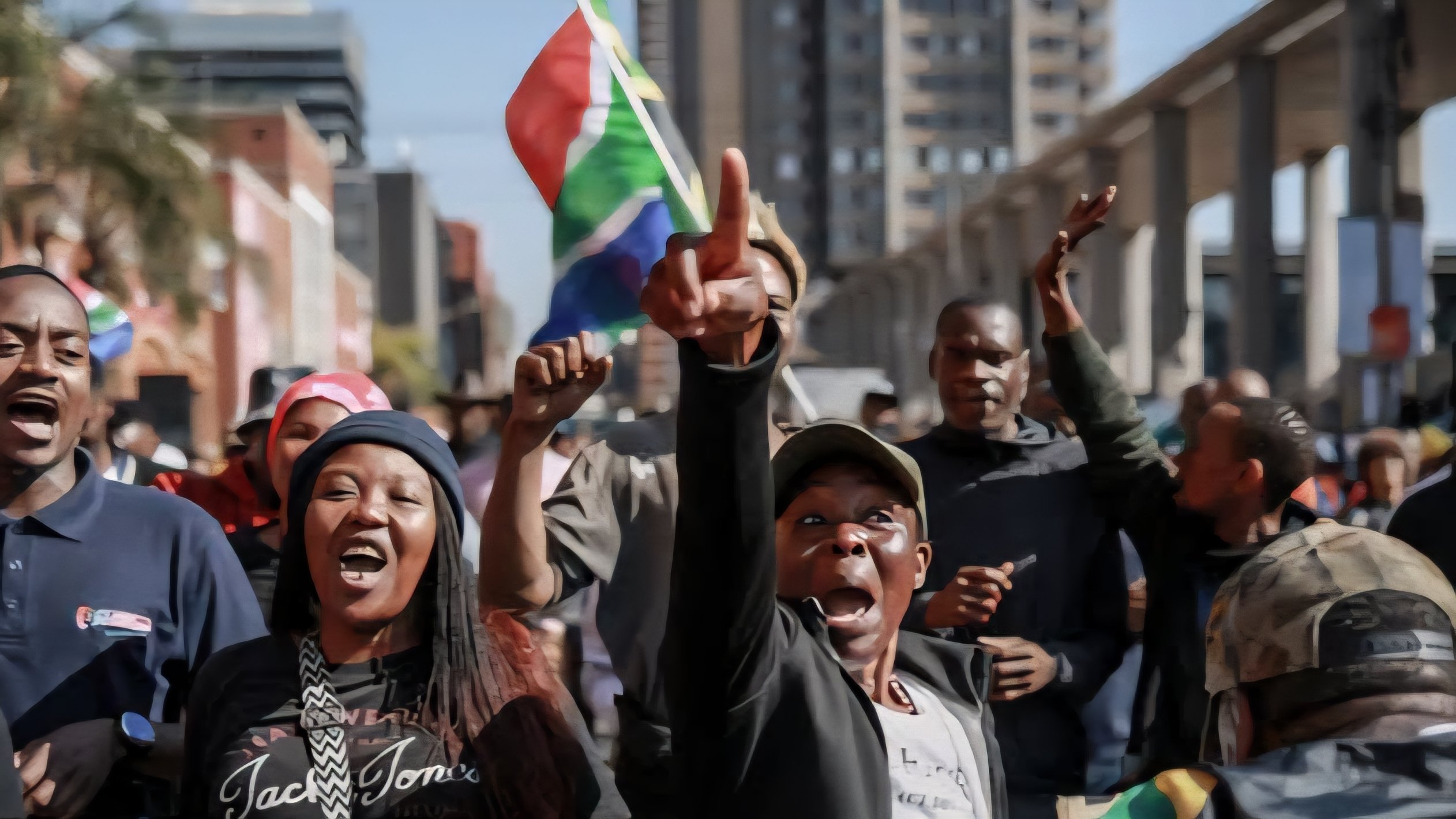
Tensions escalated significantly on Tuesday, when thousands of demonstrators draped in national flags took to the streets across multiple cities, with several groups carrying wooden weapons, while chanting slogans through commercial zones.
Many initial public gatherings remained entirely orderly, but several demonstrations rapidly descended into targeted violence, including the extensive vandalism of foreign-owned retail shops across vulnerable urban neighborhoods.
Security forces responded by arresting more than nine hundred individuals nationwide, charging them with public violence, robbery, immigration violations, and the unlawful harboring of undocumented migrants, according to police statements.
Soldiers have established visible patrols in inner-city Johannesburg, particularly within high-density suburbs like Hillbrow and Yeoville, where large communities of foreign nationals live alongside local residents, in volatile conditions.
Business owners in the Johannesburg Central Business District (CBD) chose to shut down operations entirely, as convoys of military vehicles and police units patrolled streets to prevent a recurrence of historical civil unrest.
Similar preventive measures were deployed in Durban, where municipal infrastructure was heavily guarded by regional police units to protect logistics corridors and commercial hubs from potential disruption by marching crowds.
Organizers representing the anti-immigration movement, including the March and March organization, have warned that they intend to coordinate public demonstrations every Thursday, to keep pressure on state immigration departments.
The ongoing unrest has drawn substantial international criticism, forcing neighbouring countries, including Malawi, Ghana, and Nigeria, to begin emergency repatriation operations for their citizens currently stranded in South Africa.
Humphrey Malomo, a local security analyst, noted that the sudden influx of displaced families at processing facilities has created a severe humanitarian bottleneck at various regional deportation holding centers.
Critics argue that foreign nationals are frequently used as convenient scapegoats for the country's high unemployment rate, although statistical data from government departments indicates that immigrants represent only four percent of the population.
With local government elections scheduled to take place later this year, the complex issue of regional migration has become a highly politicized flashpoint among competing political factions.
President Ramaphosa strongly condemned the growing lawlessness, stating that the right to protest is constitutionally protected, but it does not permit citizens to threaten or intimidate others.
The deployment aims to prevent a repeat of historical anti-foreigner riots, ensuring stability as security agencies remain on high standby for further potential eventualities throughout the month.
Comments (0)
Leave a Comment
No comments yet. Be the first to share your thoughts!