
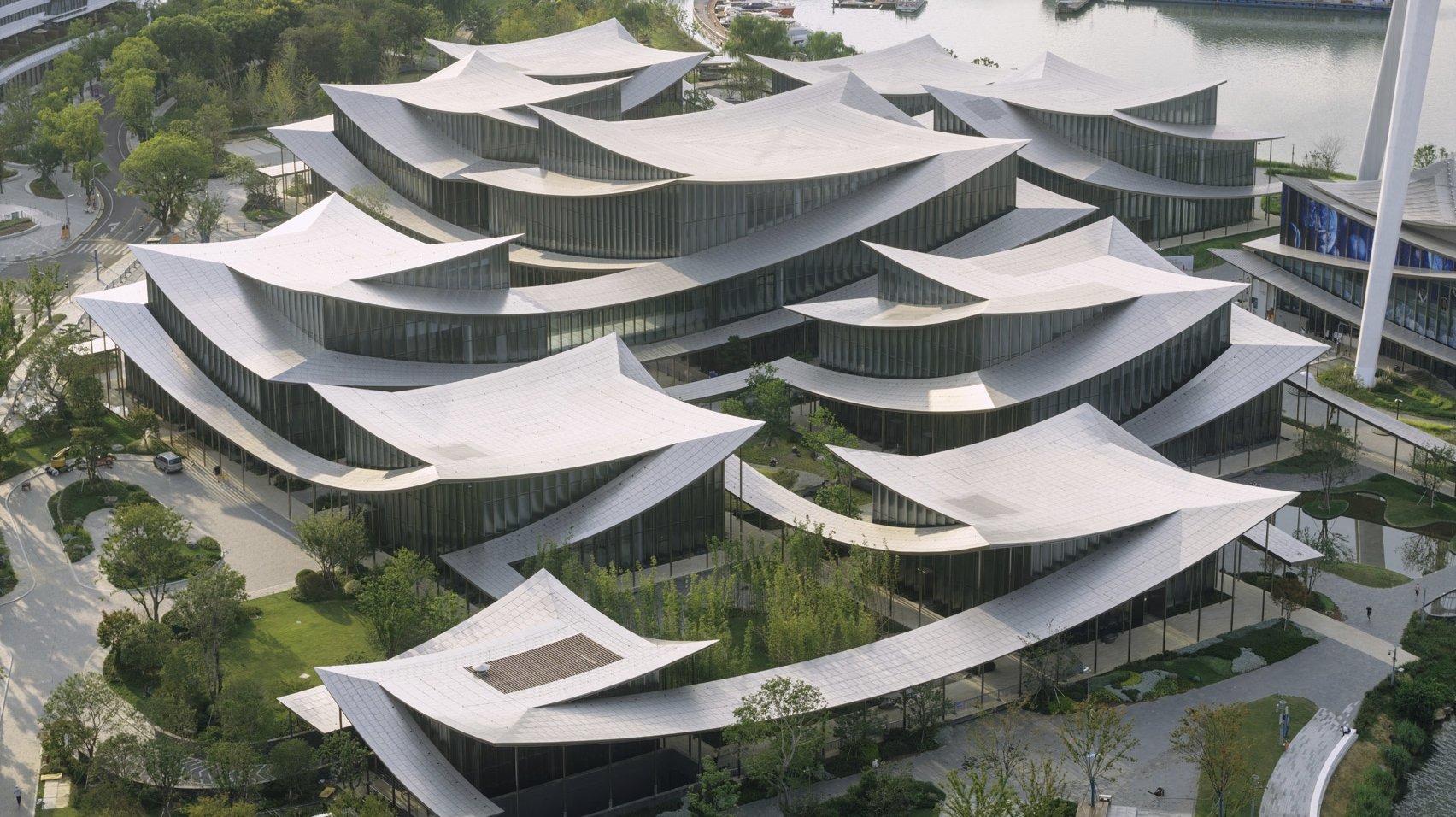

Suzhou has been famous for its classical gardens for over a thousand years. Bjarke Ingels Group (BIG) just built one that holds art.
The Suzhou Museum of Contemporary Art, known as Suzhou MoCA, sits on the banks of Jinji Lake in Suzhou, China, and opens officially to the public this year. Commissioned by the Suzhou Harmony Development Group and designed by BIG in collaboration with ARTS Group and Front Inc., the complex covers 60,000 square metres and is organised as twelve interconnected pavilions under a single continuous roof.
The design draws directly from the lang, a traditional covered corridor found in Suzhou's historic gardens, used for centuries to guide visitors through layered landscapes of water, rock and plants. BIG reinterpreted that element at museum scale, stretching it across a 310 by 200 metre lakefront site and splitting it into pavilions rather than a single building. The result, when seen from above, reads less like a museum and more like a classical garden that happens to contain galleries.
Ten pavilions are complete. The remaining two are being built now, extending over Jinji Lake via covered walkways, connecting the main structure to the water.
The facades are clad in curved glass and warm-toned stainless steel, materials chosen to reflect the surrounding sky, water and landscape throughout the day. The roof surface, also stainless steel, ripples gently across the site, its soft curves referencing the profile of traditional tiled eaves. Four of the twelve pavilions house the primary exhibition galleries. The remaining eight contain a multipurpose hall, theatre, restaurant, entrance foyer and supporting spaces. Pavilions connect both above the ground and underground through bridges and tunnels, giving the museum flexibility to reconfigure circulation depending on the season or exhibition.
The museum partially opened with an inaugural exhibition called Materialism, curated by BIG and on view through March 8, 2026. The show explored how materials, from stone to recyclate, shape architectural design, using large-scale models of over twenty BIG projects. The seating throughout the galleries was fabricated from the same materials on display, making the exhibition itself a physical argument for its own content. The grand public opening will follow this summer.
On sustainability, the project targets China's Green Building Evaluation Label (GBEL) 2-Star certification, integrating passive shading, natural ventilation and locally sourced materials throughout the build.
The site sits adjacent to the Suzhou Ferris wheel, a 120-metre observation wheel on the lakefront. Ingels has noted that the museum's layout only becomes fully legible when viewed from the gondolas above, the pavilion roofs forming a pattern across the ground that mirrors the logic of a traditional garden maze.
Comments (0)
Leave a Comment
No comments yet. Be the first to share your thoughts!