
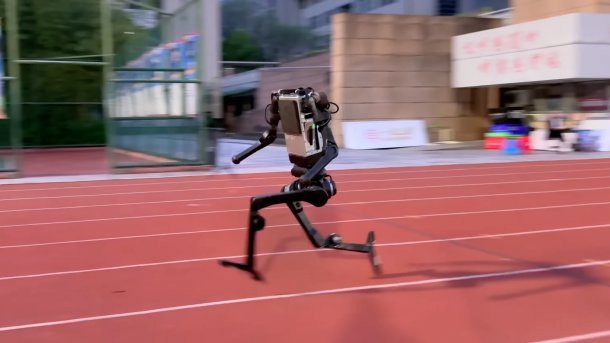

Chinese robotics developer Unitree has published video footage demonstrating a new bipedal humanoid reaching a top running speed of 12.66 metres per second alongside a two-metre vertical jump.
The performance metrics were achieved within a three-month development window, according to company statements released alongside the clip. The manufacturer tied the top speed measurement directly to a leg length of 0.85 metres on the prototype frame.
Video footage distributed by the firm shows the unit executing dynamic jumps and high-speed runs on athletic track surfaces.
The vertical clearance claim positions the machine ahead of established human jumping benchmarks, while the forward velocity surpasses the peak speed recorded by top human sprinters.
The announcement marks a rapid progression in bipedal hardware iteration for the Hangzhou-based firm. Earlier public demonstrations from the company showed previous platforms hitting top speeds near 10 metres per second, reflecting continuous adjustments to dynamic balance algorithms and high-torque motor modules.
Industry observers note that while video demonstrations highlight raw physical agility, technical details regarding payload, surface grip conditions, and power supply duration remain unspecified in the public release.
Detailed testing parameters are typically needed to assess how such dynamic control systems translate into commercial or industrial applications.
Unitree indicated that development work on the platform remains ongoing, with further software updates and structural adjustments planned in the coming months.
The hardware capability offers insight into broader advancement in high-power electric actuators, lightweight frame engineering, and real-time motion control systems across the bipedal robotics sector.
Comments (0)
Leave a Comment
No comments yet. Be the first to share your thoughts!