
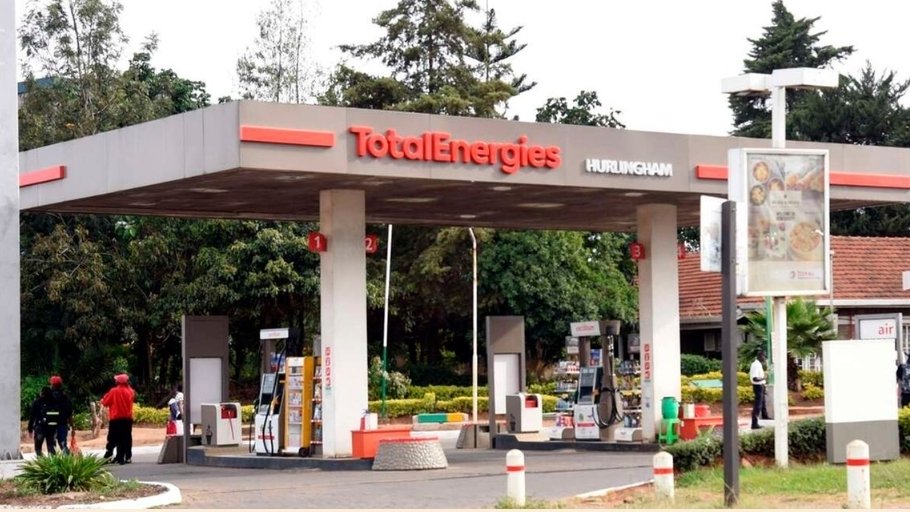

TotalEnergies Marketing Kenya now generates solar power at more than half of its fuel stations nationwide, as the French-owned oil marketer steps up efforts to cut its reliance on the national grid.
Company disclosures show that 154 of its stations were running on solar systems as of December 2025. With 285 outlets recorded by May 2026, that works out to roughly 54 percent of its network.
The rollout forms part of a broader strategy to lower electricity bills from Kenya Power, secure steadier supply during outages and reduce the company's carbon emissions over time.
Fuel station canopies, which shield fuel pumps from weather, are increasingly being fitted with rooftop solar panels across the industry, since they offer large unused surface area for installation without disrupting station operations.
TotalEnergies Marketing Kenya operates filling stations across the country that combine fuel retail with convenience stores, car washes and other services, making electricity a significant recurring operating cost.
TotalEnergies did not disclose how much it has saved in electricity costs from the 154 solar-powered stations, leaving the financial scale of the shift to investors' interpretation.
TotalEnergies joins a growing list of large Kenyan businesses turning to solar and biomass power to cut costs and shield operations from grid disruptions, including the blackouts that periodically affect industrial users.
Other companies that have invested in their own solar generation include Bio Food Products, Maisha Mabati Mills, Simba Cement, Unilever Tea Kenya, British American Tobacco, Africa Logistics Properties, Bidco, Mabati Rolling Mills, Centum Real Estate and Devyani Food Industries.
Beverage maker Coca-Cola last year received regulatory approval to install solar plants at its facilities in Embakasi, Nairobi, and in Kisumu, with combined generation capacity of 3.98 megawatts.
Kenya's national grid has faced periodic disruptions in recent years, a factor that has pushed commercial and industrial users toward independent power generation as a hedge against outages.
The shift carries consequences for Kenya Power, which relies heavily on industrial and commercial customers for revenue. These customers accounted for 64 percent, or Sh148.2 billion, of its electricity sales in the year ended June 2025.
Kenya Power has previously warned that a large-scale move by industries toward alternative energy sources could weaken its earnings, given how central commercial and industrial clients are to its income base.
Data from the Energy and Petroleum Regulatory Authority show that TotalEnergies held a 14.01 percent market share as of December 2025, with Vivo Energy leading the sector at 20.56 percent and Rubis Energy Kenya at 13.77 percent.
Kenya's broader energy mix remains dominated by geothermal and hydropower generation, though solar and wind capacity have expanded steadily over the past decade, both at utility scale and increasingly on individual commercial properties.
EPRA data is published periodically to track market share shifts among Kenya's fuel retailers, offering a benchmark for how solar adoption and other strategic moves affect competitive positioning across the sector.
Comments (1)
Leave a Comment
George Michieka
Jul 08