
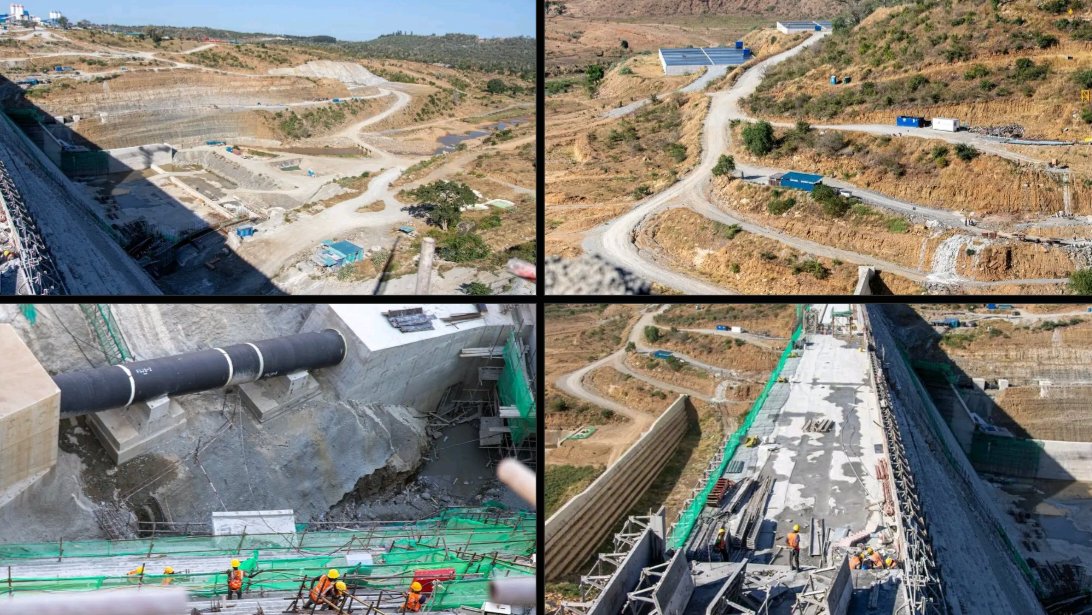

The Ministry of Water, Sanitation and Irrigation (MWSI) is nearing the completion of civil works on the Mwache Dam project. Construction activities on the site have entered their final structural phases.
Project oversight is managed through the Kenya Water Security and Climate Resilience Project (KWSCRP). Primary construction works on the facility are being executed by Sinohydro Corporation Limited contractors.
Financial documentation places the total cost of the infrastructure development at Ksh 20 billion. Capital expenditure covers major wall construction, excavation works, and associated raw water intake infrastructure.
Engineering crews on site have executed extensive earthworks and concrete pours along the dam structure. Recent progress photos show active equipment operating across top crest surfaces and outlet pipeline zones.
Contractors are finishing primary spillway concrete slabs along the main reservoir structure. Technicians have also mounted large-diameter steel pipes into the base valve chamber to handle future water flow.
Work on secondary drainage channels and slope stabilization works remains active around the perimeter. Heavy earthmoving machinery is actively leveling access tracks adjacent to the newly constructed concrete embankments.
The infrastructure development will store bulk water reserves to serve domestic and commercial users in coastal regions. State agencies expect the facility to supply key urban centers across Kwale and Mombasa counties.
Engineers are conducting structural safety assessments as concrete works near total completion. Monitoring instruments installed within the main wall will measure structural performance during future reservoir filling operations.
Surfacing operations on upper service roadways across the crest are currently underway. Civil teams are laying protective layers to prevent surface erosion and ensure safe vehicle passage for maintenance crews.
Subcontractors have completed mounting heavy steel gate assemblies at the primary intake structure. Technical staff are conducting mechanical calibration tests to ensure smooth operation under operational water pressure conditions.
Auxiliary buildings housing control equipment and power systems are also reaching structural completion. Operational staff will use these facilities to manage daily water releases and track internal reservoir pressure sensors.
Site supervisors confirm that all major concrete pours for the downstream plunge pool are complete. Workers are installing energy dissipation blocks designed to reduce water velocity during heavy spillway discharge events.
The project represents one of the largest water storage investments currently underway within the coastal regional corridor. State planners designed the facility to improve long-term water security across surrounding urban centers.
Crews are applying specialized protective coatings to exposed metallic pipe sections near the outlet works. Painting and sealing operations will guard critical mechanical components against corrosion from environmental exposure.
Site clearing and environmental restoration tasks are progressing along finished construction zones. Contractor vehicles are removing temporary formwork and excess soil deposits from the immediate downstream river channel.
Government inspection teams continue regular site visits to evaluate engineering compliance against approved design standards. Official handovers will proceed once testing procedures on all mechanical intake valves are finalized.
Local authorities are preparing downstream distribution networks to connect with main bulk supply outlets. The physical completion of major dam structures marks a transition toward final system testing and operational readiness.
Engineers expect initial filling activities to begin following final regulatory approvals from state water inspectors. Project managers remain focused on completing remaining electrical connections and site safety fencing.
Contractors continue to coordinate with regional utility providers to integrate raw water intake channels with local treatment facilities. Final operational clearance will depend on satisfactory performance during initial hydrostatic pressure tests.
Comments (0)
Leave a Comment
No comments yet. Be the first to share your thoughts!