
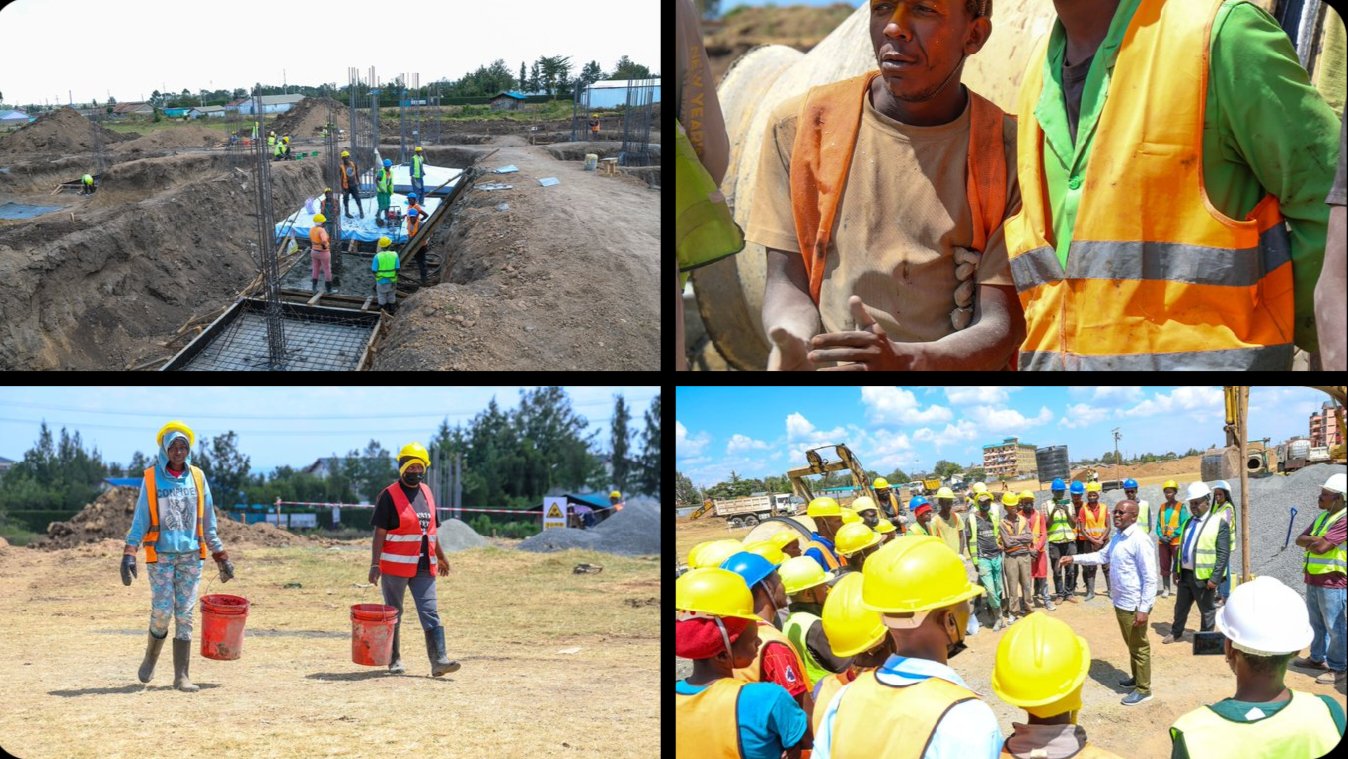

Construction at Nanyuki Stadium in Laikipia County has progressed with the completion of critical excavation works for the western pavilion.
State Department for Defence (SDD) Principal Secretary Dr. Patrick Mariru conducted an on-site inspection to review the ongoing structural activities.
Contractors are currently executing concrete blinding works and casting the necessary column bases at the primary arena location.
The building project commenced in April 2026, following an executive order issued directly by President Ruto to upgrade regional facilities.
Government administrators have confirmed that supervision remains under defence authorities, who established a strict delivery deadline for December 2026.
The development plans specify a modern 10,000-seater facility designed to support local sports talent, and host national football events.
A standard football pitch will form the centerpiece of the new sports venue, providing an updated surface for competitive matches.
Athletes will gain access to an eight-lane tartan running track, which surrounds the inner playing field to accommodate track events.
The design incorporates three VIP lounges, two dedicated changing rooms for players, spectator ablution blocks, and specialized equipment storage spaces.
A massive structural roof canopy will extend over the entire stadium area, shielding spectators and participants from weather elements.
Additional site upgrades involve the construction of a secure perimeter wall and a dedicated ring road surrounding the stadium property.
Workers are also installing cabro-paved parking lots alongside the comprehensive mechanical and electrical systems required for modern operations.
The origin of this development traces back to a public directive issued by President Ruto, when he visited the region.
Laikipia County Woman Representative Jane Kagiri had earlier petitioned the national government to prioritize local athletic facilities, but needed executive backing.
President Ruto responded to these appeals by committing national resources, highlighting that the county has a long history of producing exceptional athletes.
The state then directed Dr. Mariru to coordinate with county leadership, who would guarantee the project began on schedule.
The Ministry of Defence (MoD) has increasingly taken on civic infrastructure roles, applying military-style project management to civilian public works.
Defence officials held strategic planning sessions earlier this year at Defence Headquarters (DHQ) in Nairobi to coordinate with Laikipia political leaders.
Lawmakers representing Laikipia East, Laikipia North, and Laikipia West participated in those consultative meetings to align the design with local needs.
The collaborative planning phase ensured that land allocations, local security, and logistical transport routes were resolved before heavy machinery arrived on site.
This infrastructure push aligns with broader state efforts to revamp sporting facilities nationwide, although funding remains closely monitored.
The military oversight model is also being utilized for similar stadium projects in other counties, including proposed facilities in Busia County.
By utilizing engineering units and strict supervisory protocols, the government aims to prevent the project delays, which historically affected civic works.
Local leaders note that the stadium will provide a safe space for youth engagement, keeping young people away from regional security vulnerabilities.
The integration of specialized tartan surfaces and modern amenities represents a structural upgrade from the previously dilapidated field.
With excavation finalized, structural steel fixers and concrete mixers are dominating the landscape as the western pavilion begins to rise.
Subsequent phases will see the expansion of seating terraces and the installation of the specialized electrical grids for facility operations.
Dr. Mariru expressed confidence in the technical team, noting that the adherence to engineering specifications remains a top priority during construction.
Comments (0)
Leave a Comment
No comments yet. Be the first to share your thoughts!