
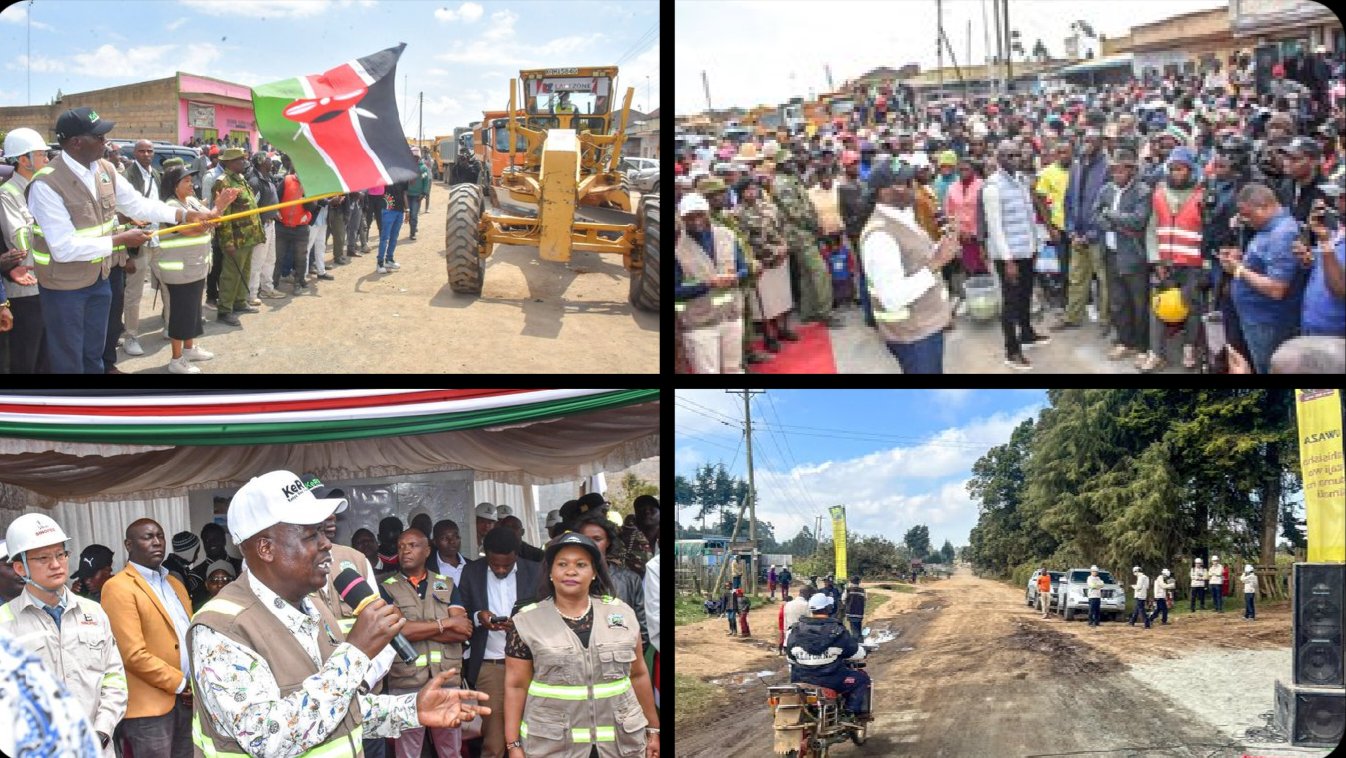

The national government has commenced the modernization of local transport infrastructure in Nyandarua County. The initiative focuses on paving key rural pathways that connect agricultural zones. Roads and Transport Cabinet Secretary Davis Chirchir led the delegation that commissioned the construction works on the network.
The development targets the Kwa Haraka to Kinamba corridor, which spans 23 kilometres. This link serves multiple agricultural communities, but it has historically faced seasonal disruptions due to weather. The structural upgrade will establish a reliable bitumen surface, which will replace the existing earthen path.
Cabinet Secretary Davis Chirchir was accompanied by Tourism Cabinet Secretary Rebecca Miano, and Principal Secretary for Roads Eng. Joseph Mbugua. The officials gathered along the rural corridor, where they met local residents and administrators. The leadership highlighted the importance of completing the infrastructure without delays.
The project falls under the management of the Kenya Rural Roads Authority (KeRRA). This agency oversees the network of secondary and rural routes across the nation. The field launch involved deploying heavy earthmoving machinery, which included graders and support trucks, to signal the start of earthworks.
Local transport operators and farmers attended the event, which took place along the active corridor. The current condition of the route slows down the movement of fresh produce, although it remains a critical artery for local businesses. The new asphalt surface aims to provide smoother traffic flow.
Engineering teams have already completed preliminary site assessments along the alignment. The construction schedule includes extensive grading, drainage installation, and base reinforcement before the final bitumen layer is applied. These steps ensure that the finished road can withstand heavy commercial vehicles, which haul agricultural products.
Agricultural logistics form the economic core of Nyandarua County. Farmers frequently experience losses when transit times lengthen due to damaged road surfaces. Paving this section will reduce vehicle wear and tear, while it will also lower the total cost of moving commodities to external markets.
Tourism Cabinet Secretary Rebecca Miano emphasized that rural accessibility directly influences regional connectivity. Improved transport paths allow for better integration between trading centers, which can support local entrepreneurship. The upgrade also provides alternative routes for commuters moving through the central region.
The technical specifications provided by KeRRA indicate that the project will meet standard bitumen specifications. Contractors are required to build standard drainage ditches, which protect the road edges from erosion. Proper water management is essential in this high-altitude region, because heavy rainfall often damages unpaved soils.
Principal Secretary Eng. Joseph Mbugua stated that the ministry will closely monitor the execution of the contract. Strict adherence to the engineering timeline is required, so that the public benefits from the project promptly. Quality control inspectors will conduct regular field evaluations during each phase of work.
The local community welcomed the deployment of heavy machinery, which was displayed during the official launch ceremony. Residents noted that improved infrastructure enhances safety, especially during rainy seasons when visibility and traction drop. The upgraded route will also ensure that emergency services can reach villages quickly.
National funding allocations for the development of rural roads have expanded in recent fiscal cycles. The Ministry of Roads and Transport prioritizes projects that directly unlock economic potential in rural areas. Paving this corridor aligns with broader state efforts to improve national grid connectivity.
The project connects several trading centers, which include Kageraini, Rwanyambo, and Karangatha. These intermediate hubs serve thousands of residents, who depend on small-scale commerce and retail trade. Paving the link will create a continuous corridor between Kwa Haraka and Kinamba, which stabilizes regional business operations.
Contractors are expected to engage local labor for manual tasks, which provides short-term employment during the construction phase. This approach injects capital into the local economy, while it also fosters community ownership of the infrastructure. The project represents a targeted capital investment in Nyandarua.
Comments (0)
Leave a Comment
No comments yet. Be the first to share your thoughts!