
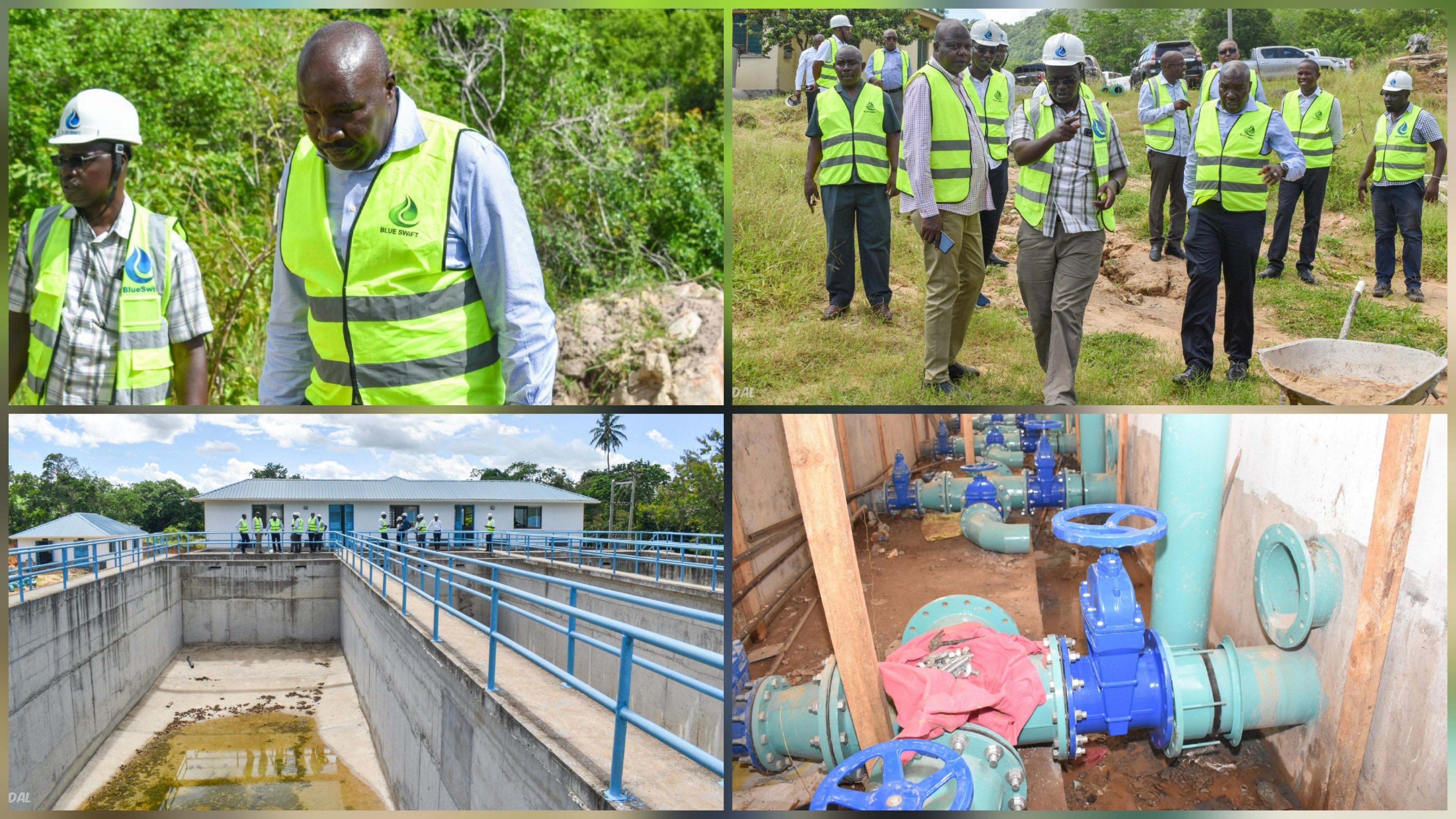

The Ministry of Water and Sanitation has confirmed that the Kwale Urban Water Supply Project is now 91 percent complete following a high-level site inspection. Principal Secretary for Water and Sanitation, Julius Korir, led the delegation to assess progress at the Marere Water Treatment Plant and its linked infrastructure.
Accompanying the Principal Secretary were Water Secretary Samuel Alima and Hamoud Mguza, the Chief Executive Officer of the Coast Water Works Development Agency. The visit focused on the technical readiness of the facility, which is central to the government's strategy for expanding water access in the coastal region.
Once the remaining works are finalized, the Marere Water Treatment Plant will have the capacity to process and distribute 9,000 cubic meters of water every day. This output is expected to stabilize the reliability of supply for Kwale Town and the surrounding areas, addressing long-standing shortages in the county.
Engineering teams on site are currently focused on the final associated works required to integrate the treatment plant into the wider distribution network. The project forms a critical part of the national commitment to deliver potable water to expanding urban populations.
Departmental data indicates that approximately 150,000 residents will benefit directly from the improved infrastructure upon commissioning. The Ministry noted that the project is a major priority for supporting socio-economic growth in Kwale County by providing safe and clean water for domestic use.
During the tour, Principal Secretary Korir emphasized the necessity of meeting quality standards and ensuring the timely delivery of the remaining project phases. The inspection serves as a final check on the civil works and mechanical installations before the facility begins full-scale operations.
The Coast Water Works Development Agency has been tasked with overseeing the final testing phases to ensure the 9,000 cubic meter daily target is met. These developments align with broader efforts by President Ruto to modernize water infrastructure and increase the national percentage of households with piped water.
As the project moves into the final nine percent of its construction schedule, focus has shifted to the integrity of the supply lines. Local authorities expect the completed works to reduce the reliance on untreated sources and improve public health outcomes across the beneficiary zones.
Comments (0)
Leave a Comment
No comments yet. Be the first to share your thoughts!