
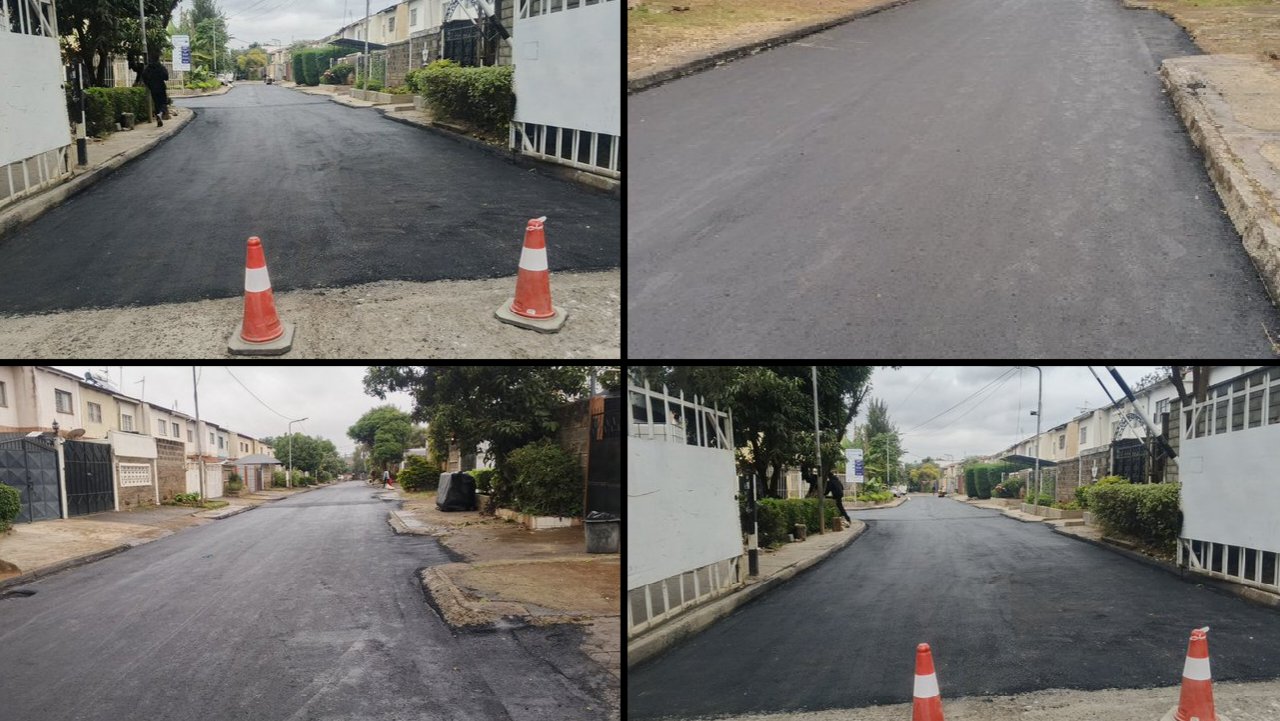

A recent neighborhood infrastructure update in Nairobi has sparked professional debate among civil engineering enthusiasts. Lang'ata Member of Parliament (MP) Felix Odiwuor, widely known as Jalang'o, announced the completion of the Dam Estate Phase 2 road paving project within his constituency.
The politician shared images of the newly laid asphalt on social media, celebrating the development under his local development agenda. While the smooth black surface received praise from some quarters, observers with engineering backgrounds immediately noted critical structural omissions.
Technical analysts pointed out that the newly paved surface completely lacked defined road shoulders and dedicated drainage channels. This omission led to warnings that the project could face premature structural failure.
In road construction, asphalt concrete acts as a wearing course designed to protect lower structural layers from environmental damage. Bitumen, the binding agent in the mixture, is naturally hydrophobic, which ensures that water does not easily penetrate the road surface.
The primary purpose of this waterproof layer is to prevent water ingress into the underlying compacted base. These lower layers bear the structural load of vehicular traffic.
Civil engineers explain that when a road lacks adequate drainage and shoulders, water naturally pools at the edges of the pavement. Without a clear path to exit, moisture easily finds its way into the lower gravel and soil foundations.
This moisture accumulation leads to compaction loss within the sub-grade materials. When supporting soil layers become saturated, they lose density and load-bearing capacity, which inevitably triggers total road foundation failure.
The lack of drainage infrastructure is a recurring challenge in many localized estate road rehabilitation projects across Kenyan urban centers. Often, fast-tracked paving works focus primarily on laying the visible asphalt layer without allocating necessary resources for side drains.
Experts emphasize that a road without drainage is essentially a temporary surface. Water remains the single greatest enemy of long-term pavement longevity.
For estate roads like those in Dam Estate, heavy vehicular movement can accelerate damage if the base is compromised. Potholes, edge cracking, and deep ruts usually appear within a few seasons, if water is allowed to sit along the pavement edges.
Public structural critiques of local infrastructure projects have become more common. Observers argue that understanding civil engineering fundamentals is necessary for public officers overseeing capital expenditure.
Professional bodies such as the Engineers Board of Kenya (EBK) frequently advocate for strict adherence to standardized design manuals. These guidelines explicitly mandate integrated drainage systems for all categories of paved public roads, including minor estate linkages.
Proper implementation ensures that taxpayers do not repeatedly fund the rehabilitation of identical road segments. Investing in stone-pitched drains during the initial paving phase remains the most cost-effective approach.
Whether the constituency oversight team will address these drainage concerns in subsequent phases remains an open question for the residents. For now, the smooth asphalt at Dam Estate serves as a visual improvement, though its long-term durability hangs in the balance.
Comments (0)
Leave a Comment
No comments yet. Be the first to share your thoughts!