
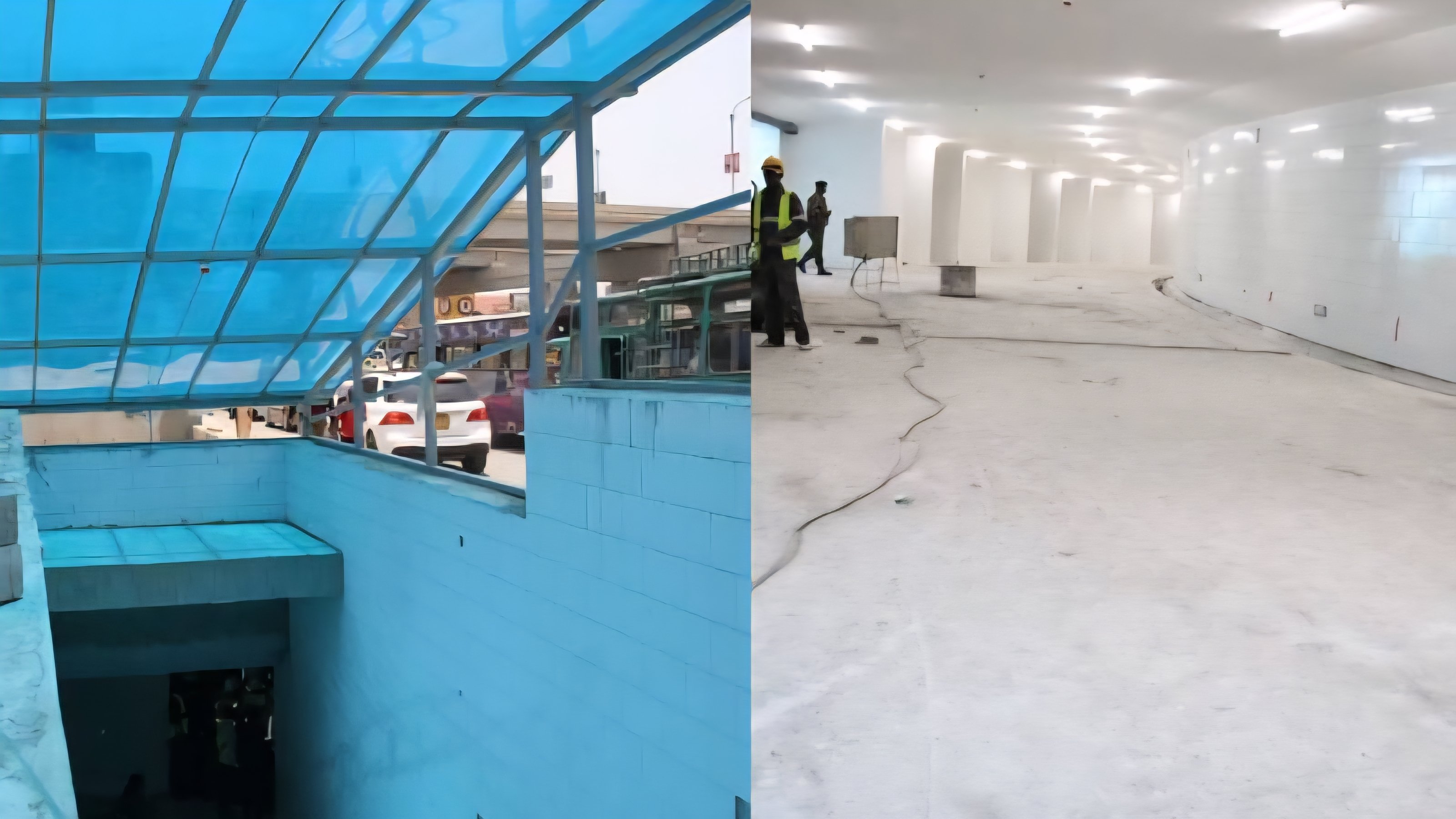

Construction of the Green Park pedestrian underpass at the busy intersection of Uhuru Highway and Haile Selassie Avenue has reached its final stages. The Kenya National Highways Authority, known as KeNHA, reports that the Sh2 billion infrastructure project is now 99% complete. Despite the high level of structural readiness, authorities have indicated that the facility will not be fully operational for public use until June 2026.
This specific junction serves as a critical node connecting Mombasa Road, Ngong Road, Uhuru Highway, and Haile Selassie Avenue. For years, the area has presented a logistical bottleneck for the city, reflecting a growing population that has outpaced existing ground-level infrastructure. The morning and evening peak hours see heavy commuter volumes moving between the Nairobi Railway Station and the Upper Hill commercial district, often resulting in dangerous interactions between pedestrians and high-speed vehicular traffic.
Engineers designed the underpass to address these safety concerns, citing data that suggests approximately 21,000 people cross this specific section of the road daily. By moving foot traffic below the road surface, the project aims to improve overall traffic flow at the roundabout while significantly reducing the risk of pedestrian accidents. The facility features 13 separate exits and seven lifts, which were included specifically to ensure the underpass remains accessible for persons with disabilities.
Beyond its primary function as a transit corridor, the underpass incorporates a commercial element designed to leverage the high human-traffic volumes. There are 39 retail shops built into the structure, which KeNHA intends to use for income generation. Management of these spaces will be handled by a private contractor, who is yet to be procured. Officials have suggested that if this integrated commercial model proves successful, it could be replicated at other major junctions across the city.
Early in the construction phase, which began in December 2023, public concerns were raised regarding the security of underground tunnels and the potential for flooding during Nairobi’s rainy seasons. In response, KeNHA has detailed the technical measures taken to mitigate these risks. The design includes comprehensive lighting and a network of CCTV cameras monitored by security personnel. Furthermore, police officers will be stationed within the facility to maintain order and safety.
To address the threat of flash floods, the project features a specialized drainage system. Manholes have been strategically placed throughout the underpass to collect runoff water into a central point, from where it is pumped out into the city’s main drainage network. This mechanized approach is intended to prevent the waterlogging that has historically affected subterranean structures in the capital.
As the project enters its final commissioning phase, the focus shifts toward the procurement of the management firm and the final fit-out of the commercial stalls. The Sh2 billion investment represents one of the most expensive pedestrian-focused interventions in the city’s recent history. While the physical structure is almost entirely finished, the remaining one percent of work involves the fine-tuning of systems and administrative arrangements that will lead to the mid-2026 unveiling.
The completion of the Green Park underpass is expected to bring a new level of efficiency to the Haile Selassie roundabout. For the thousands of workers who trek into the city every day, the opening will mark the end of navigating one of Nairobi's most congested surface crossings. As June 2026 approaches, the site stands as a nearly finished testament to the city's shift toward multi-level urban transport solutions.
Comments (0)
Leave a Comment
No comments yet. Be the first to share your thoughts!