
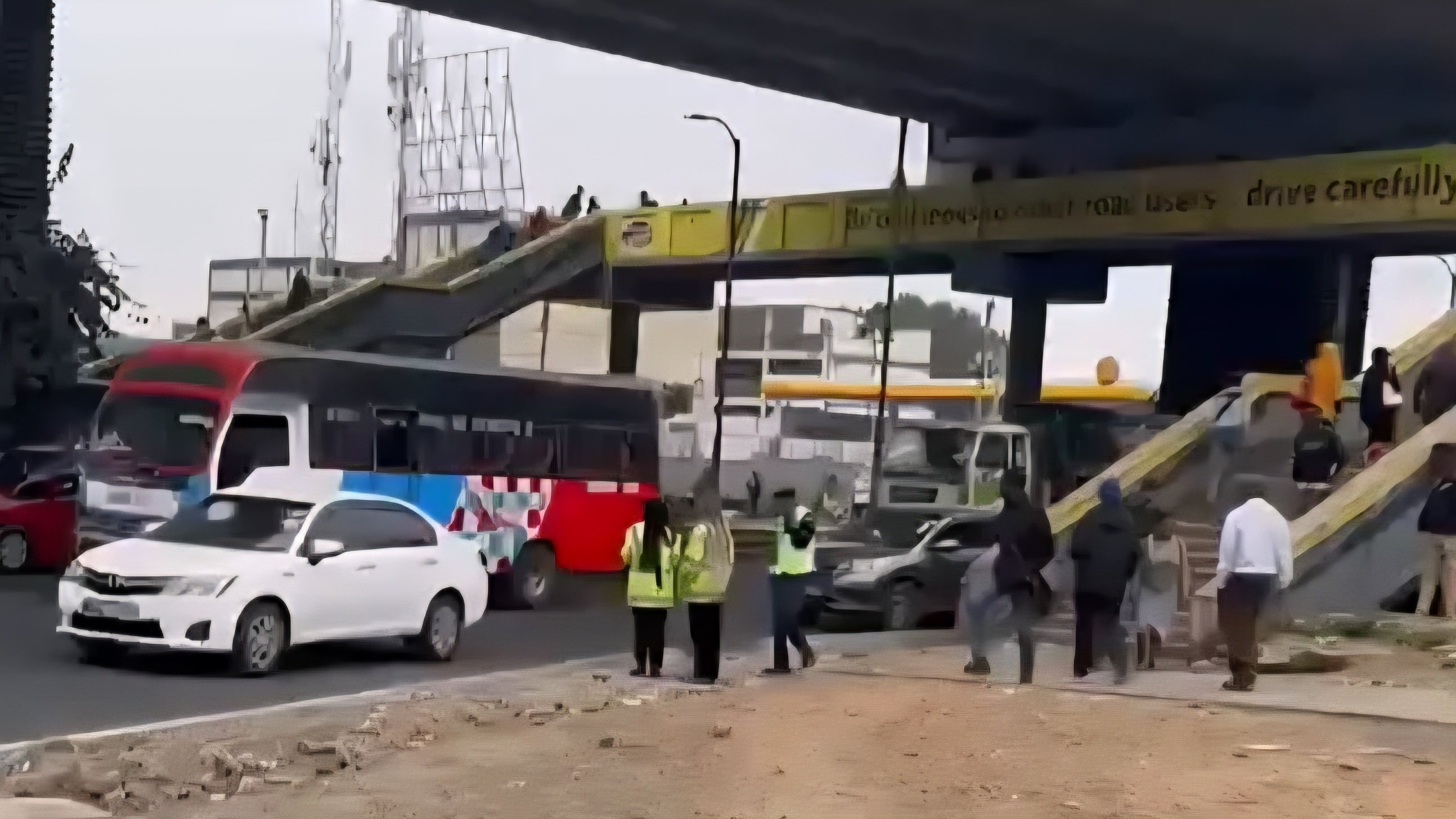

The National Transport and Safety Authority (NTSA) has intensified enforcement operations targeting individuals who bypass overhead crossing structures along major arterial corridors in Nairobi.
Working in coordination with the National Police Service (NPS), transport safety officers have taken hundreds of violators into custody across the city.
Speaking during an ongoing multi-agency drive, NTSA Assistant Director Brenda Sawe confirmed that authorities apprehended over 250 offenders within ten days.
The sweeps focus on busy transport corridors including the Thika Superhighway, Waiyaki Way, and Mombasa Road, where individuals routinely risk crossing active lanes of vehicular traffic.
The enforcement exercise aims to alter public behavior and reduce high fatality rates on urban highways. Official statistics indicate that foot passengers account for nearly 38 percent of overall traffic fatalities recorded nationally, highlighting a persistent vulnerability in urban transport corridors.
Under existing traffic legislation, crossing beneath or near designated elevated walkways constitutes an offense punishable by law.
Law enforcement officers are arraigning individuals in court on charges of willful obstruction of free-flowing traffic, with court fines ranging between KSh 500 and KSh 5,000.
Joint operations have targeted several high-density transit nodes across the capital, including Allsops, Nyayo Stadium, Buruburu Interchange, and General Motors (GM).
Transport officials reported apprehending dozens of individuals in single-day operations at these critical locations, where multi-lane carriage lanes present substantial risk to foot traffic.
Despite heavy police deployment, urban planning experts and commuters note that structural barriers complicate full compliance across the network.
Many pedestrians cite security vulnerabilities, hawker encroachments, poor lighting, and inconvenient physical placement as primary reasons for avoiding certain elevated crossings.
Elderly citizens and individuals carrying heavy loads also encounter significant physical difficulty navigating steep stairways at existing installations.
Furthermore, localized neglect on specific spans has enabled informal settlements and traders to restrict pedestrian movement, creating bottlenecks that push foot traffic back onto dangerous road surfaces.
Transport safety officials maintain that strict legal enforcement will continue alongside public awareness campaigns until compliance levels improve.
Authorities emphasize that utility of multi-million shilling civil engineering infrastructure remains essential to achieving zero preventable road deaths across Kenya's urban road network.
Comments (0)
Leave a Comment
No comments yet. Be the first to share your thoughts!