
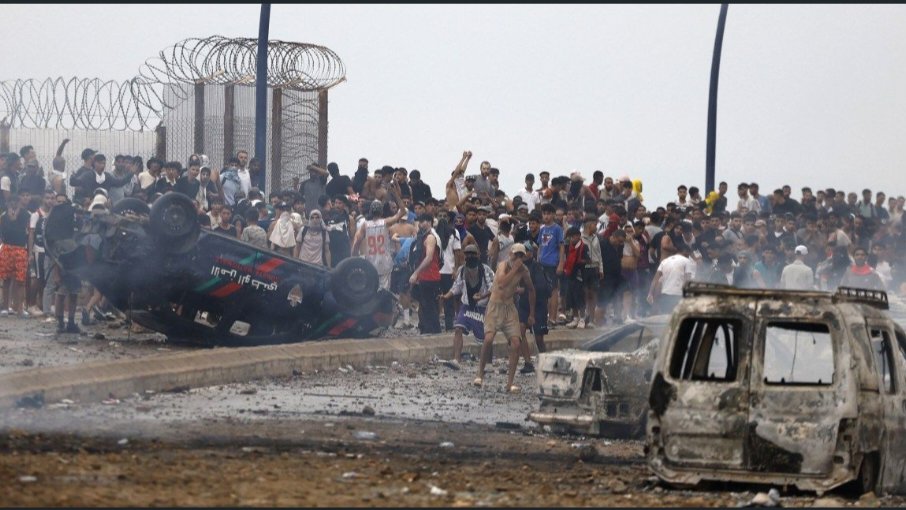

Spanish security forces mobilised along the perimeter fence separating Morocco from North Africa after tens of thousands of migrants crossed into Spanish territory. The rapid arrival of people overwhelmed local border control installations, when authorities scrambled to secure the perimeter.
Officials from Spain's Interior Ministry (IM) reported that roughly 50,000 individuals entered the enclave of Ceuta between Thursday and early Friday. Security barriers along the frontier were bypassed, which prompted immediate emergency responses from regional enforcement teams.
Border infrastructure faced severe strain as crowds filled the coastal corridor. Police units struggled to manage the perimeter, although additional forces were dispatched to reinforce key entry points.
The sudden movement of people across the boundary created immediate operational challenges for municipal facilities. Authorities noted that existing physical barriers, which include double fences and surveillance posts, could not contain the volume of individuals arriving simultaneously.
By Friday afternoon, nearly half of those who had entered began moving back into Moroccan territory. Officials confirmed that approximately 25,000 people voluntarily crossed back over the boundary, because conditions inside the territory became unsustainable.
The rapid exodus occurred primarily because the small territory was completely overrun, which left basic services unable to cope. Arriving individuals found no available food or water supplies, so many decided to turn back toward the Moroccan frontier.
Security experts observe that border enclaves rely heavily on integrated fencing, sensors, and quick-response teams to manage perimeter integrity. When thousands approach physical barriers simultaneously, standard physical containment structures can become overwhelmed despite modern engineering controls.
Spanish authorities continue monitoring physical infrastructure along the coastal border wall. Engineers and maintenance teams have been tasked with inspecting structural damage to fences and gates, while patrol units remain stationed along vulnerable segments of the boundary.
The European Union (EU) monitors external land boundaries through joint security frameworks and specialized infrastructure funding. Events at North African enclaves highlight the ongoing technical challenges of maintaining secure border perimeters across complex geographic terrain.
Logistical assets and transport vehicles were positioned near key access points to assist remaining civil security teams. Authorities emphasized that restoring order around public works and transit routes remains the immediate operational focus for regional command centers.
Moroccan border units also established secondary checkpoints along roads leading toward the enclave. Coordination between neighboring border agencies remains essential when managing high-density movements along shared physical infrastructure.
Local administration figures in Ceuta reported that municipal infrastructure is being cleared of debris following the surge. Operations crews are working double-shifts to repair damaged perimeter fencing, clean public roadways, and restore normal civil utility services.
Heavy machinery and temporary utility stations have been deployed to assist frontline personnel. Ministry representatives stated that border engineering reviews will determine whether structural upgrades or heightened barrier walls are necessary to prevent similar breaches in future operations.
Civil defense units have also established temporary medical points and triage zones near perimeter gates. Field emergency teams are addressing minor injuries, while maintaining coordinate efforts with local municipal healthcare facilities.
The Guardia Civil (GC) reinforced seaside breakwaters where several individuals attempted aquatic bypass routes. Patrol vessels were deployed along marine approach lines to deter illegal sea crossings and ensure maritime safety along the coastline.
Construction crews from public works departments have begun erecting temporary concrete barriers along exposed access roads. These physical reinforced blocks serve to stabilize compromised fence sections, while long-term structural repairs are evaluated by defense engineers.
National security reviews are now underway to evaluate perimeter defense protocols. Government agencies aim to strengthen physical barrier designs, while maintaining continuous surveillance along the entire coastal border line.
Comments (0)
Leave a Comment
No comments yet. Be the first to share your thoughts!