
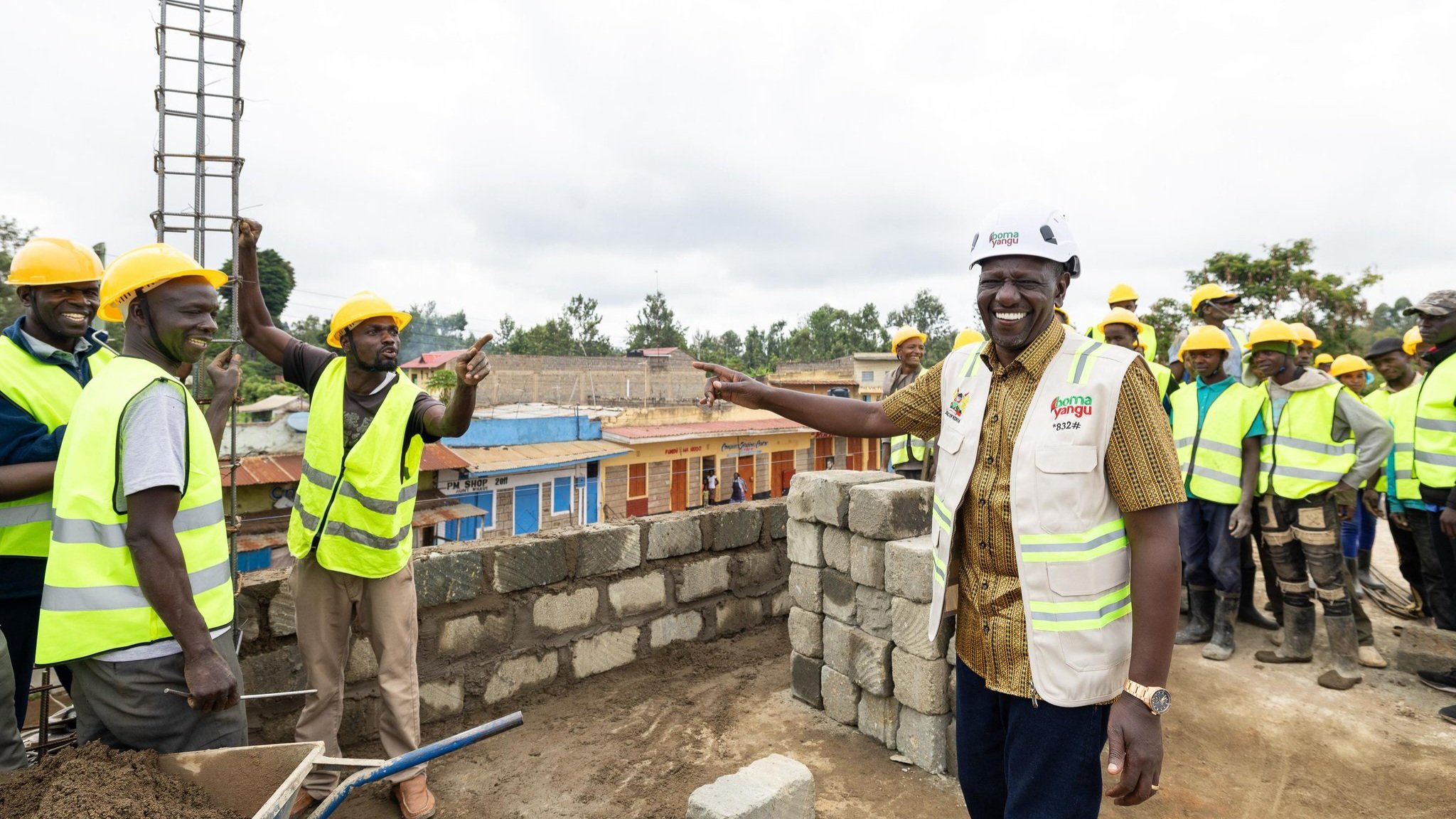

President William Ruto has intensified the government’s infrastructure push in Murang’a County, conducting a whirlwind tour to inspect, launch, and hand over several critical market projects.
The visit centered on the ambitious nationwide 600-market program, with the President committing to the delivery of 25 modern markets specifically within Murang’a.
At Ciumbu, President Ruto inspected the ongoing works at the modern market site to assess the quality of construction and adherence to timelines.
The President then moved to Kangari, where he officially launched the Kangari - Gacharage Road, a transport artery expected to improve the movement of goods to nearby trading hubs.
While in the same area, he oversaw the formal handover of the Kangari modern market, a facility designed to provide a sheltered environment for hundreds of local vendors.
Dairy farmers in the region received a boost when President Ruto handed over a new milk cooler, intended to reduce post-harvest losses and improve the local cold chain.
In Kabati, the President laid the foundation stone for another modern market, signaling the start of a project that forms part of the wider regional trade network.
The tour also included an inspection of the Sabasaba modern market, where construction is currently in an advanced stage.
These projects represent a shift toward formalizing trade in rural and peri-urban areas by replacing open-air stalls with permanent, multi-storey structures.
Standard designs for these markets typically include features such as paved walkways, proper drainage systems, and dedicated sections for different types of produce.
Security is also a primary focus, with many of the new designs incorporating lockable stalls and perimeter fencing to protect the investments of small-scale entrepreneurs.
The 25 markets planned for Murang’a are part of a broader strategy to decentralize economic activity and reduce the congestion found in major urban centers.
By providing clean and organized spaces, the government aims to bring more informal traders into the formal economy, which helps in revenue collection at the county level.
The President noted that the 600-market project is a cornerstone of the national development agenda, targeting every county across the country.
Local leaders who accompanied the President emphasized that the completion of these markets would significantly lower the cost of doing business for residents.
Construction of such facilities usually involves a partnership between the national government and county administrations, particularly regarding land acquisition and utility connections.
The Ministry of Lands, Public Works, Housing and Urban Development remains the lead agency in overseeing the technical execution of these market builds.
Work on the remaining sites in Murang’a is expected to continue through the year, as contractors face pressure to meet the high demand for finished stalls.
Comments (0)
Leave a Comment
No comments yet. Be the first to share your thoughts!