
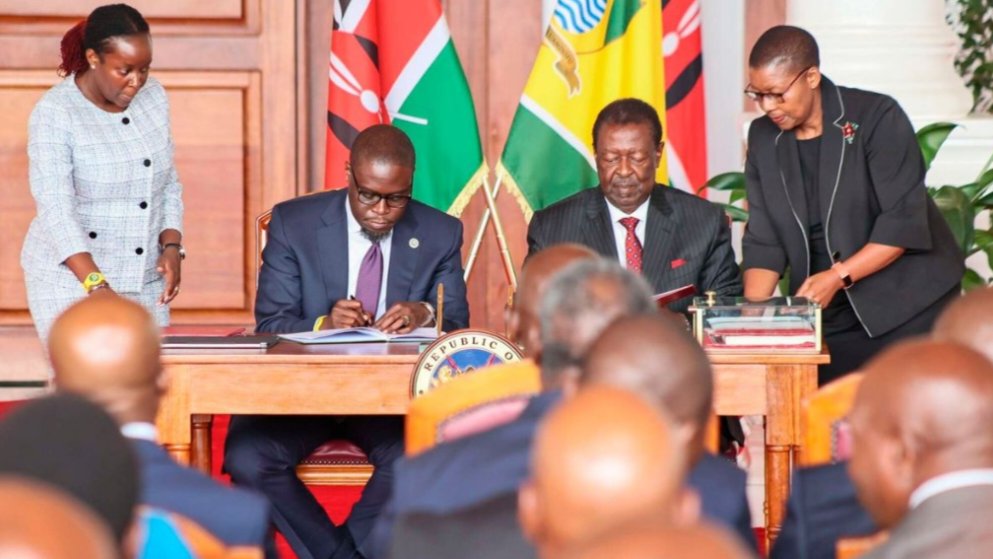

A Senate committee in Kenya recommended the temporary suspension of a Sh80 billion cooperation agreement signed between the National Government and the Nairobi City County government. The decision follows a review that raised legal questions regarding oversight and financial management.
Prime Cabinet Secretary Musalia Mudavadi and Nairobi Governor Johnson Sakaja signed the pact in February at State House. President William Ruto witnessed the signing, which establishes a framework for managing infrastructure projects across the capital city.
The Senate Standing Committee on Devolution and Intergovernmental Relations cautioned that the document lacks legislative oversight. Lawmakers noted that the framework does not mandate progress reports to either the Senate or the Nairobi City County Assembly.
Financial clarity remains a primary concern for the committee. While public statements mentioned an Sh80 billion commitment, the written agreement omits this figure, leaving execution costs uncertain.
Additionally, senators highlighted that Sh270 million was allocated in national budget estimates for city roads instead of being structured as conditional grants. They warned this setup blurring administrative boundaries risks undermining local authority principles.
Appearing before lawmakers, Governor Sakaja defended the partnership, arguing that the capital city requires additional funding to manage infrastructure demands. He stated that Nairobi generates significant revenue, yet county resource allocations remain inadequate.
Data from the Kenya National Bureau of Statistics (KNBS) indicates that Nairobi produces over a quarter of the country's economic output. Government officials contend that this unique economic position demands direct national support for urban upgrades.
The agreement establishes a two-tier governance structure comprising a Joint Steering Committee (JSC) and an Implementation Committee. The policy committee is chaired by Mudavadi, while Governor Sakaja heads the operational team.
Priority target areas under the deal include road rehabilitation, expansion of Non-Motorised Transport (NMT) corridors, and modernized solid waste management facilities. Improved water sanitation systems, market upgrades, and street lighting installations are also targeted.
During public hearings, Mudavadi stated that the framework does not constitute a transfer of functions under the Constitution of Kenya. He emphasized that the partnership aligns with existing legislation governing urban areas and intergovernmental relations.
Critics among lawmakers maintain that joint committees could complicate operational accountability when executing projects. They argue that procurement leadership remains ambiguous, making asset ownership unclear once construction works conclude.
The Senate panel instructed both levels of government to address these administrative gaps before proceeding. The committee required a full progress report within 60 days to resolve legal and operational concerns.
Nairobi faces severe challenges regarding aging drainage systems and persistent traffic congestion. Severe seasonal flooding has regularly disrupted transportation networks, highlighting the urgent need for coordinated infrastructure investment across the capital.
Previous attempts at managing city services through central government intervention, such as the former Nairobi Metropolitan Services (NMS), left significant lingering debt. County officials maintain that the current cooperation agreement avoids past errors while securing much-needed capital funding.
The Senate recommended halting execution until all parties define specific financial responsibilities. Urban planning experts expect the outcome of this dispute to influence future intergovernmental construction partnerships across Kenya.
Comments (0)
Leave a Comment
No comments yet. Be the first to share your thoughts!