
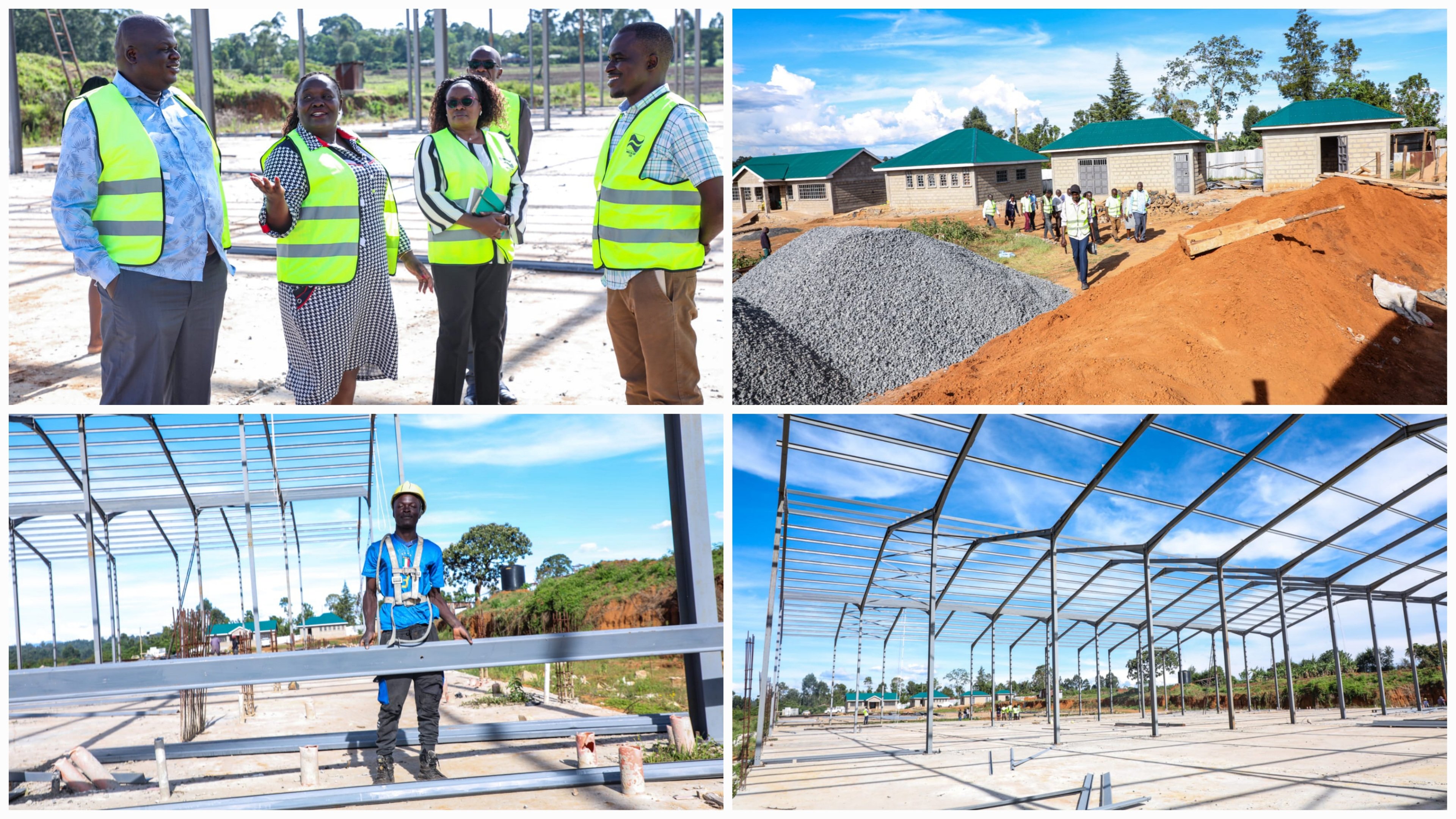

Structural assembly is currently underway at the site of the Kakamega County Aggregation and Industrial Park in Likuyani Sub-County, where the facility is beginning to take its final form. Governor Fernandes Barasa recently inspected the progress at Sinoko Ward, noting that the project remains a priority for the county administration.
The Sh500 million development is being executed through a co-funding agreement between the County Government of Kakamega and the National Government. Under this framework, both levels of government have committed Sh250 million each to establish the industrial hub, which is designed to support local agricultural value addition.
Site images show that the main warehouse structures are now being framed with heavy-duty steel portals. The installation of these frames follows the completion of foundation works and floor slabs. Workers are currently securing the roofing trusses, while masonry work on auxiliary administrative and support buildings within the park has reached the lintel stage.
The project is part of a broader national rollout of County Aggregation and Industrial Parks, known as CAIPs. These hubs are intended to provide farmers with facilities for collection, storage, and primary processing. By centralizing these activities, the government aims to reduce post-harvest losses that frequently affect the productivity of the locals.
In Likuyani, the facility will serve as a specialized center for grading and packaging farm produce. The design includes cold storage areas for perishable goods and processing zones where investors can set up machinery for manufacturing. This infrastructure is expected to bridge the gap between rural production and formal markets.
During his visit, Governor Barasa emphasized that the acceleration of these works is necessary to ensure the facility is operational within the projected timelines. The county has highlighted industrialization as a key pillar for job creation, particularly for the youth in the northern regions of Kakamega
The Ministry of Investments, Trade and Industry continues to provide technical oversight for the project. Regular monitoring visits by state officials, including representatives from the State Department for Industry, have been conducted to ensure the construction adheres to the required industrial standards.
While the physical shells of the buildings are now visible, the next phase of development will involve the installation of utilities, including specialized electrical fittings and water supply systems required for industrial operations. Once the structural work is finalized, the focus will shift to the internal fit-out of the processing zones.
This development in Likuyani coincides with similar infrastructure pushes across the country, as President Ruto has recently categorized 2026 as a critical year for the completion of key agricultural and industrial projects. The successful delivery of the Sinoko site remains central to Kakamega’s strategy for regional economic growth.
Comments (0)
Leave a Comment
No comments yet. Be the first to share your thoughts!