
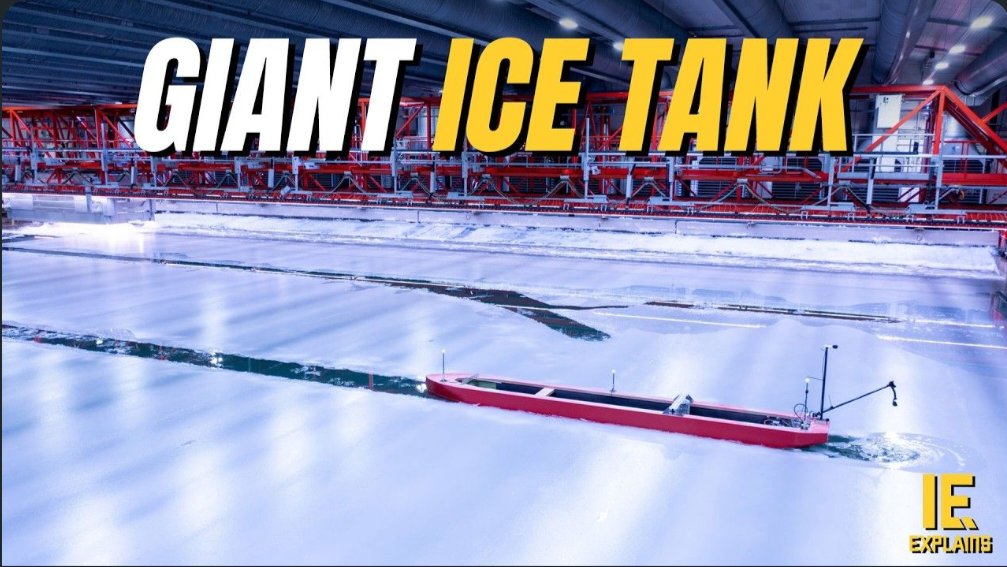

Deep inside a windowless warehouse in Espoo, Finland, researchers are growing ice upside down in a controlled indoor environment. The temperature inside the room is maintained at -12°C, creating a highly specific environment designed to solve pressing structural problems of the climate age.
Known as the Aalto Ice and Wave Tank (AIWT), the 40-meter by 40-meter facility is the largest ice tank by surface area globally. While there are only about five or six major ice tanks operating on the planet, this specific facility stands out because it can freeze a solid ice sheet and simultaneously generate a complex, multidirectional wavefield.
The urgency of the work increases as the Arctic region warms four times faster than the rest of the planet. Although sea ice is retreating, the opening of these waters means more cargo vessels, tankers, and container ships are entering icy zones they were not originally designed to handle. Furthermore, developers are placing offshore wind turbines into frozen seas, multiplying engineering challenges faster than solutions can be developed.
Arttu Polojärvi, an associate professor of ice mechanics at Aalto University, has spent 20 years working at the facility. He noted that even with less ice overall, the expansion of maritime activity creates more opportunities for structural failures or hazardous ship entrapments.
To simulate the Arctic accurately, the tank cannot use standard tap water, which creates ice crystals that are too strong for model ships to break. Instead, a massive orange bridge moves across the tank, spraying a fine mist of water mixed with 0.3 percent ethanol into the freezing air. These tiny droplets freeze on impact, forming microscopic seed crystals that grow downward into a uniform layer between 2.5 and 7.5 centimeters thick.
This process creates scaled ice that replicates the mechanical properties of real sea ice at a 1-to-30 ratio. Model ships, measuring roughly five liters in volume, are tested at the largest scale possible to ensure data can be translated accurately into real-world structural load predictions.
Testing helps engineers understand what happens when ships turn or get stuck in moving ice fields. When a vessel becomes trapped, drifting ice pushed by winds and currents can build up pressure quickly enough to puncture a steel hull, causing catastrophic damage.
While the facility produces uniform ice sheets to validate computational models, real sea ice contains structural impurities, age differences, and salinity variations. To bridge this gap, researchers use the clean tank results to calibrate discrete element modeling (DEM) software, allowing them to simulate individual ice floes across expansive sea areas.
Other international facilities also contribute to this global field. The Hamburg Ship Model Basin (HSVA) ice tank in Germany focuses on resistance and propulsion, while the National Research Council (NRC) ice tank in Canada tests offshore platforms against pack ice. In the United States, the Naval Surface Warfare Center (NSWC) tests military vessels, and Russia’s Krylov State Research Center (KSRC) designs nuclear-powered polar icebreakers.
Comments (0)
Leave a Comment
No comments yet. Be the first to share your thoughts!