
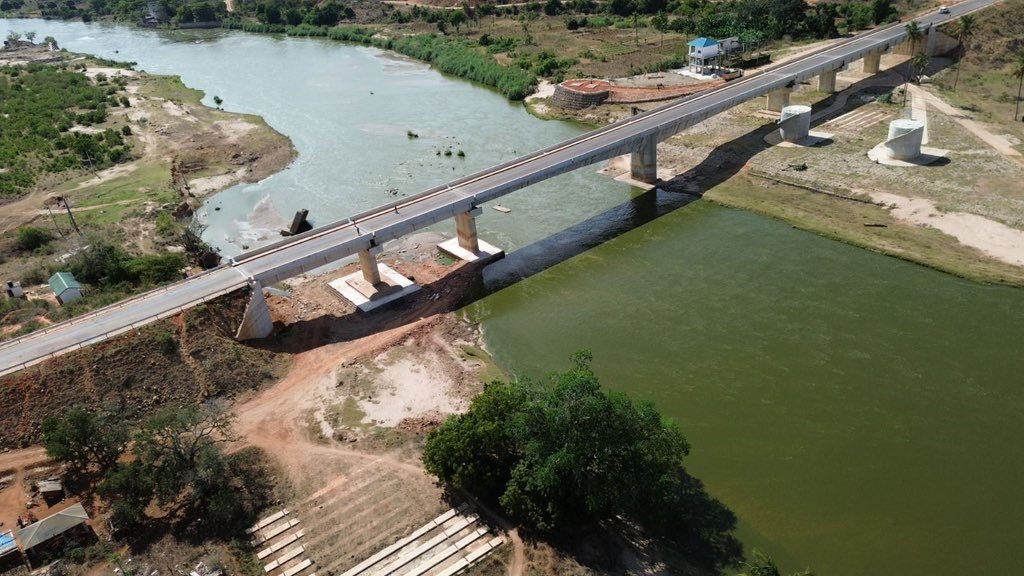

The State Department for Roads has spotlighted the Baricho Bridge in Kilifi County as a key achievement in local infrastructure, marking it as the country's first cantilevered box girder bridge. Spanning 241 meters over River Sabaki, the structure was designed and supervised entirely by Kenyan engineers, underlining a shift toward homegrown expertise in handling demanding projects like this one.
Built at a cost of Sh2.3 billion, the bridge connects remote communities on either side of the river, which has long posed challenges due to its width and seasonal flooding. River Sabaki, also known as the lower reaches of the Athi-Galana River system, flows from central Kenya to the Indian Ocean, passing through arid landscapes in Kilifi. For years, locals relied on risky canoe crossings or lengthy detours of up to 120 kilometers to move goods and people between Baricho and Langobaya areas. The new crossing cuts that distance to just three kilometers, offering a safer, all-weather route.
Construction on the Baricho Bridge began several years ago, with the China Number Ten Engineering Group handling the build under contract from the Kenya Rural Roads Authority. Progress hit 70 percent by mid-2021, with completion initially targeted for 2022, though delays pushed the timeline forward. A substantial completion inspection occurred in late 2025, confirming the bridge's readiness for use. The project also included approach roads: 5.33 kilometers from the Baolala junction to the bridge and 2.48 kilometers from the bridge to Baricho village. These additions ensure smooth integration into the existing road network.
What distinguishes the Baricho Bridge is its design as a cantilevered box girder. A box girder is essentially a beam with a hollow, rectangular cross-section, typically made from prestressed concrete or steel, which provides exceptional strength while keeping weight down. This shape allows it to resist bending and torsion forces effectively, making it suitable for long spans over water or uneven terrain. In Kenya, similar box girder designs appear in structures like the Nyali and Mtwapa bridges, but Baricho stands out as the first to employ a cantilevered approach in its construction, and notably, the first post-tensioned box girder fully managed by local professionals.
The construction method used here is known as balanced cantilevering, a technique that minimizes disruption to the river below and avoids the need for extensive temporary supports. It starts with building sturdy piers in the riverbed, often using cofferdams to create dry work areas amid the water flow. These piers, made of reinforced concrete, serve as the anchors. From each pier, segments of the box girder are cast in place or precast and then extended outward in balanced pairs, with one arm reaching toward the adjacent pier or abutment on either side.
Workers use form travelers, which are movable frameworks attached to the growing structure, to pour concrete for each new segment. As the cantilever arms grow, they are supported only at the pier end, with the weight counterbalanced by the opposing arm. Prestressing cables are threaded through the hollow box and tensioned to compress the concrete, enhancing its load-bearing capacity and reducing cracking under stress. This process continues until the arms from neighboring piers meet at mid-span, where a closure pour seals the gap. The method demands precise engineering to maintain balance and alignment, especially in a river prone to currents and wildlife like crocodiles and hippos, which added safety considerations for the crew.
Over 500 locals were trained in modern bridge-building techniques during the project, fostering skills in areas like prestressing and formwork assembly. This hands-on involvement not only created jobs but also built capacity for future infrastructure works in Kenya, where road and bridge development remains critical for economic growth.
Economically, the bridge serves as a direct link for the Galana-Kulalu Food Security Project, one of Kenya's largest irrigation schemes covering thousands of hectares in Kilifi and Tana River counties. By connecting the irrigated farmlands to markets in Malindi, Kilifi town, and Mombasa, it reduces transport times and costs significantly. Farmers previously faced high post-harvest losses due to poor access, but the new route allows quicker delivery of produce like maize, fruits, and vegetables. This could help stabilize food supplies in the coastal region, where agriculture supports a large portion of the population.
Beyond farming, the bridge improves access to schools, hospitals, and emergency services for residents in isolated villages. In a county like Kilifi, where poverty rates hover above the national average and infrastructure gaps persist, such connections can drive broader development. The river's volatile nature—swelling during rains and hosting dangerous animals—had made crossings perilous, with reports of accidents over the years. Now, vehicles and pedestrians can traverse safely, potentially boosting trade and tourism in the area.
Kenya's push for better rural roads aligns with national goals under the Vision 2030 blueprint, which emphasizes infrastructure to spur growth in underserved regions. The Baricho project fits into a series of bridge builds across the country, including upgrades along the coast and in the Rift Valley. While foreign contractors like the Chinese firm brought technical know-how, the emphasis on Kenyan supervision signals progress in reducing reliance on external expertise.
Questions have arisen about the bridge's uniqueness, with some noting similarities to existing structures. For instance, the Nyali Bridge in Mombasa is a prestressed continuous box girder, but it wasn't constructed using the balanced cantilever method nor fully overseen by locals at the time. Baricho's design addresses specific site challenges, such as the river's span and flow, making it a tailored solution.
As Kilifi County continues to develop, the Baricho Bridge represents practical advancement in connecting people and resources. With its completion, attention may turn to maintenance and monitoring to ensure longevity amid environmental pressures like erosion and climate shifts affecting river levels.
Comments (0)
Leave a Comment
No comments yet. Be the first to share your thoughts!