
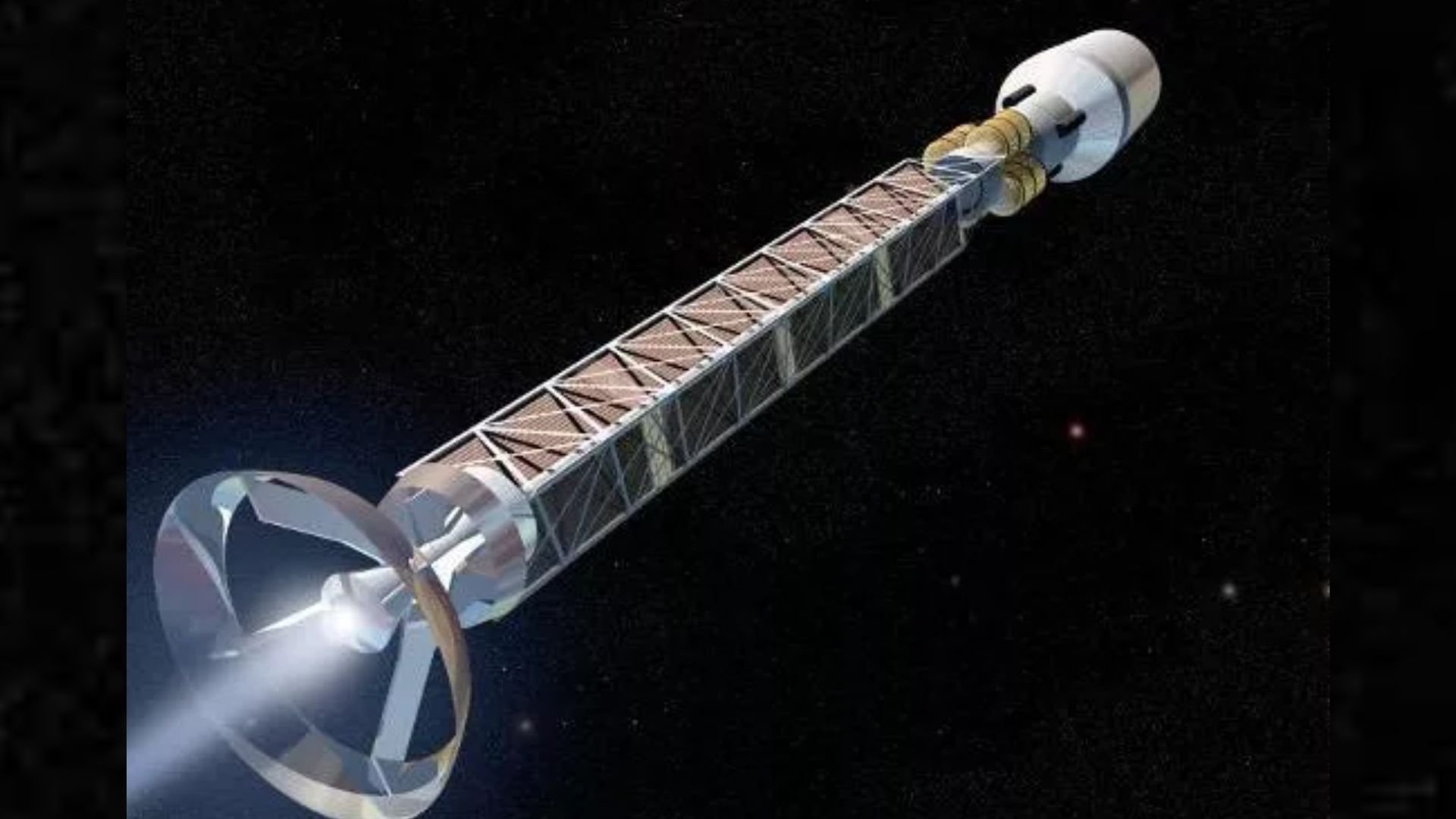

SpaceX Chief Executive Officer (CEO) Elon Musk and National Aeronautics and Space Administration (NASA) Administrator Jared Isaacman publicly expressed support for antimatter propulsion research. The endorsement occurred during a brief public exchange on the social media platform X.
The technology remains entirely theoretical but holds immense potential for deep spaceflight. Antimatter reactions could yield 10 billion times more energy per unit mass than conventional chemical rockets.
Musk noted that future civilizations will likely measure wealth in terms of mass and energy instead of traditional currency. He predicted that immense financial resources will eventually fund antimatter production to facilitate interstellar journeys.
Isaacman responded to the post by stating his direct support for the propulsion concept. The interaction has brought renewed attention to the physics of matter-antimatter annihilation within the international aerospace community.
An antimatter propulsion system relies on the collision between ordinary matter and its subatomic mirror twins. When a particle meets its corresponding antiparticle, they instantly annihilate, and they convert their entire rest mass directly into a high-energy flux.
This process achieves near-perfect mass-to-energy conversion efficiency. Current operational spacecraft engines rely on chemical combustion, which utilizes only a tiny fraction of the potential energy stored within available fuel mass.
Nuclear fusion offers an emerging propulsion strategy for space agencies, but it remains far less efficient than antimatter systems. Matter-antimatter annihilation produces about 300 times more energy per unit mass than nuclear fusion reactions.
The extreme energy density of antimatter could drastically alter space mission timelines. Journeys to Mars that currently require six to nine months could potentially be completed in a matter of weeks.
Interstellar travel across neighboring star systems might become achievable within a human lifetime using this technology. Current mechanical systems require tens of thousands of years to traverse those same cosmic distances.
The European Organization for Nuclear Research (CERN) routinely produces antimatter using large particle accelerators. However, these specialized laboratory facilities only create the substance in minuscule quantities, which are measured in nanograms.
Manufacturing a single gram of antimatter requires an extraordinary amount of electrical power and infrastructure. Historical estimates place the projected cost of producing one gram at tens of trillions of dollars.
Storage remains another severe engineering obstacle for planetary researchers. Because antimatter destroys itself upon contact with regular matter, it requires highly sophisticated and specialized electromagnetic containment systems under ultra-high vacuum conditions.
Spacecraft engineers must develop advanced magnetic traps to keep the volatile fuel isolated. Any structural containment failure would cause the immediate and catastrophic destruction of the vehicle.
Engineers are currently exploring multiple conceptual designs to safely harness this annihilation energy. One theoretical approach involves directing charged particles through magnetic nozzles to create direct, high-velocity exhaust thrust.
Another concept uses tiny amounts of antimatter to trigger larger nuclear fusion reactions, which reduces the total volume of antimatter required. A third method uses the reaction to heat a propellant.
While practical application remains decades away from reality, the public backing from prominent aerospace figures indicates a potential shift in long-term research priorities for future deep space exploration programs.
Comments (0)
Leave a Comment
No comments yet. Be the first to share your thoughts!