
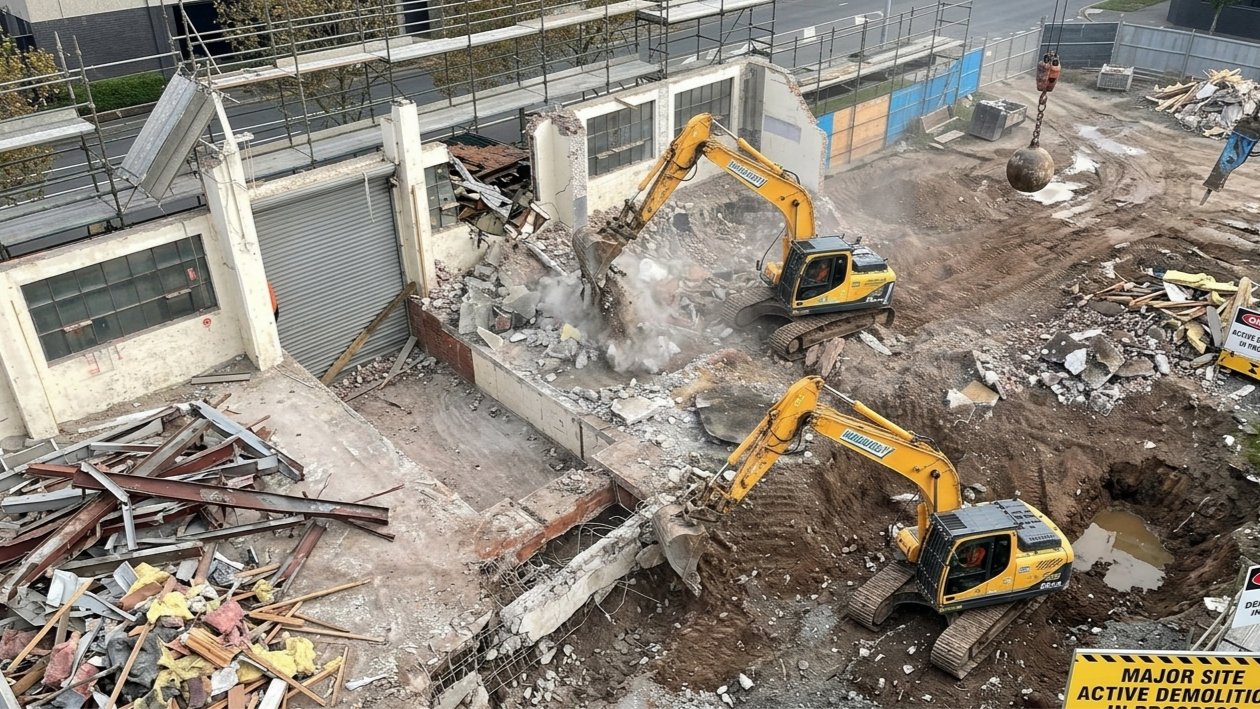

Demolition is often seen as the process of bringing down a building, but in practice, it is a carefully planned engineering activity. The choice of demolition method depends on several factors, including safety requirements, the condition of the structure, surrounding developments and environmental considerations. In many cases, protecting nearby people and property is more important than the speed of the demolition itself.
Before any demolition begins, engineers and contractors assess the building and its surroundings. They examine structural elements, utility connections, access routes, and nearby structures. This assessment helps determine the safest and most effective method to use while minimizing risks to workers, the public and neighboring properties.
Mechanical demolition is the most widely used approach for removing buildings. It involves the use of excavators fitted with specialized attachments such as hydraulic breakers, crushers and shears. These machines progressively dismantle structures, allowing operators to control the sequence of removal. The method is commonly used for reinforced concrete buildings and other structures where there is enough working space.
One of the advantages of mechanical demolition is its flexibility. Operators can remove sections of a building gradually while monitoring stability throughout the process. This makes it suitable for a wide range of projects, from residential buildings to larger commercial developments. However, adequate space is required for equipment movement and debris management.
Manual demolition remains important in situations where precision is necessary. Workers use hand tools and small equipment to remove specific sections of a structure. This method is often selected when only part of a building needs to be demolished or when access for heavy machinery is limited.
Manual demolition is also useful in densely built areas where nearby structures could be affected by larger equipment. Although it is slower than mechanical methods, it provides greater control over the removal process. This level of precision can reduce the risk of unintended damage to surrounding property.
Explosive demolition, commonly known as implosion, is among the most recognized demolition techniques. It uses carefully placed explosives to trigger a controlled collapse of a structure. Contrary to popular perception, implosion requires extensive planning, structural analysis and strict safety measures before any charges are detonated.
This method is generally reserved for large structures in areas where sufficient exclusion zones can be established. Engineers design precise timing sequences to ensure the building collapses in a predictable manner. While implosion can bring down a structure within seconds, preparation often takes weeks or even months.
Another increasingly important approach is deconstruction, sometimes referred to as selective dismantling. Instead of destroying a building rapidly, workers take it apart in the reverse order of its construction. Materials such as steel, timber, fixtures and concrete components can then be recovered for reuse or recycling.
Deconstruction is often chosen for projects with sustainability goals. Although the process requires more time and labor, it reduces waste sent to landfills and allows valuable materials to remain in circulation. Many organizations view this method as part of broader environmental responsibility efforts.
Hydraulic demolition tools have become essential in modern demolition work. Equipment such as pulverizers, concrete cutters, and hydraulic splitters enables contractors to break down structures while controlling vibration, dust and noise. These tools are particularly useful in urban environments where buildings stand close together.
The ability to limit vibration is important when nearby structures, underground utilities, or sensitive facilities could be affected. Hydraulic tools provide a controlled method of demolition that helps protect surrounding infrastructure while maintaining efficiency.
The wrecking ball method, once a common sight on demolition sites, is now used less frequently. Advances in hydraulic technology have provided more precise and safer alternatives. However, wrecking balls can still be found on some large-scale projects where open space allows their use.
Ultimately, demolition planning focuses on control rather than speed. Engineers must consider adjacent buildings, utility networks, public safety, traffic movement and environmental impacts. The structure being removed is only one part of the equation. The surrounding conditions often play a larger role in determining the most appropriate method.
Modern demolition projects demonstrate that bringing down a building is rarely a simple task. Every method is selected with specific objectives in mind, balancing efficiency, safety and protection of the environment and nearby infrastructure. The success of a demolition project is measured not only by what is removed, but also by what remains unaffected once the work is complete.
Comments (0)
Leave a Comment
No comments yet. Be the first to share your thoughts!