
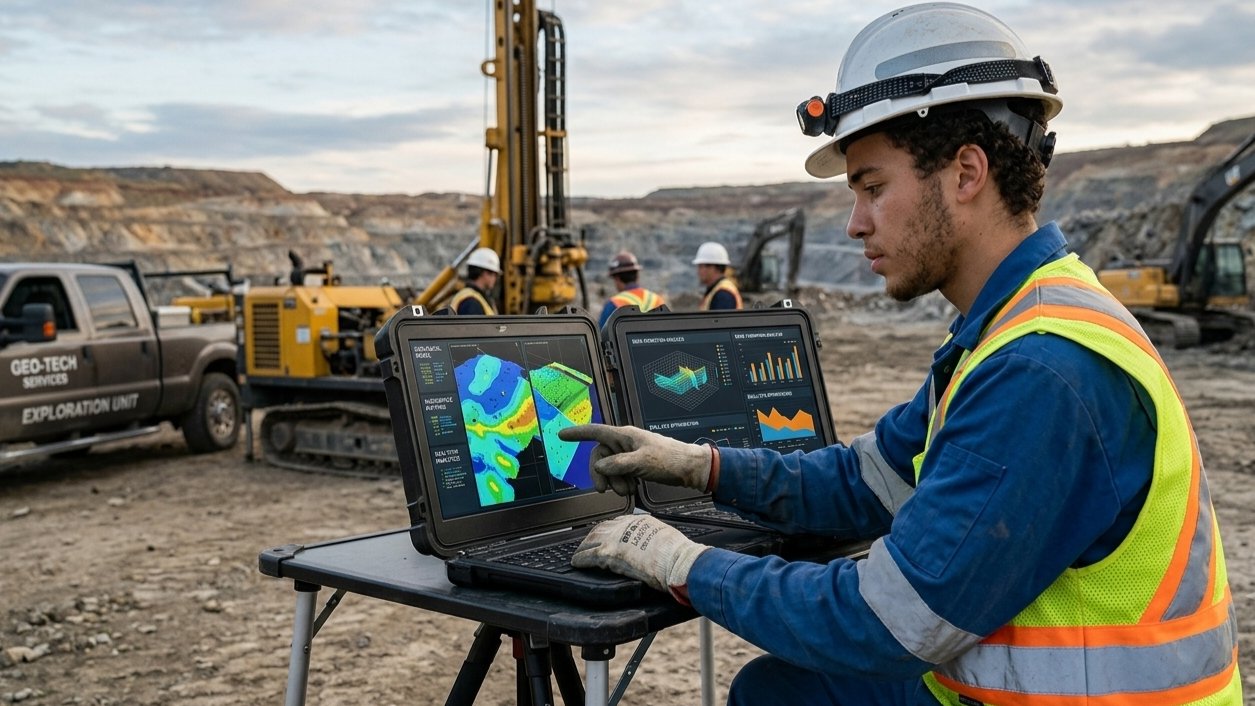

Artificial intelligence adoption across global mineral extraction could yield between 290 billion dollars and 390 billion dollars in annual operational savings by 2035, according to a report published by the Atlantic Council.
The analysis highlights how digital tools and predictive algorithms are reshaping traditional exploration models, particularly across resource-rich African nations where legacy data collection has historically slowed project execution.
Africa holds roughly 30 percent of the global critical mineral reserves needed for battery production, renewable power, and advanced hardware manufacturing.
Despite this concentration of natural wealth, the continent currently receives only 10 percent of global mineral exploration spending. Many mining jurisdictions still rely on geological surveys compiled during the colonial era, creating significant gaps in baseline data.
Artificial Intelligence (AI) technologies, including machine learning models, predictive spatial analytics, and digital twin simulations, offer a pathway to modernise these outdated records.
Recent field implementations demonstrate that data-driven algorithms can process geochemical records, satellite imagery, and historic drilling logs far faster than human analysts.
In complex geological settings, AI models can reduce exploration drilling schedules by up to 75 percent by pinpointing precise subterranean target areas.
Early adoption is already underway across several major African mining hubs. In Zambia, exploration teams are utilising satellite-enabled geophysical mapping platforms to refine deep drilling targets at major copper operations, including Konkola Copper Mines.
The AI system combines subsurface imaging with predictive analytics to fast-track resource definition, supporting national efforts to expand copper output.
Similar applications are expanding across Southern Africa, where automated monitoring systems, geospatial surveying, and drone mapping are gaining traction. In the Democratic Republic of the Congo, South Africa, and Botswana, mining firms are deploying data analytics to optimise mineral recovery rates and improve processing efficiency.
Analysts note that higher recovery rates allow producers to maximize output from existing operations without increasing raw material extraction.
Despite these developments, technology integration across the continent remains uneven. Most AI-driven exploration projects are concentrated in Southern Africa, leaving other mineral-rich regions behind.
To address this geographic imbalance, the Atlantic Council proposed establishing a 300 million dollar public-private smart mining fund. The proposed fund would support local technology firms, derisk private exploration investments, and finance digital infrastructure across the value chain.
Deploying digital tools allows African nations to add value to their mineral sectors without relying entirely on export restrictions or aggressive regulatory mandates.
Enhanced data collection improves transparency, helping governments better negotiate concession terms and attract institutional capital.
By transitioning from simple raw material extraction to technology-assisted processing, African mining jurisdictions can secure a larger share of the global critical minerals market.
Comments (0)
Leave a Comment
No comments yet. Be the first to share your thoughts!