
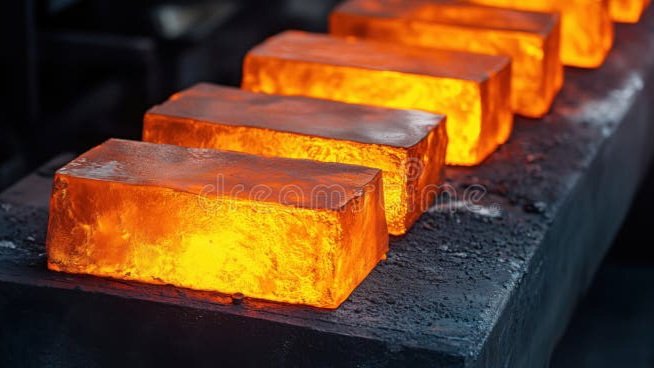

A fundamental pillar of metallurgy, which suggests that metals inevitably soften when exposed to heat, has been challenged by new research from the United States. Engineers at the Massachusetts Institute of Technology (MIT) have demonstrated that under specific, high-velocity conditions, certain pure metals actually become stronger as temperatures rise.
The study, published in the journal Nature Communications, focused on the behavior of copper and gold during micro-ballistic testing. Traditionally, construction and industrial processes rely on the understanding that heat increases the mobility of atoms, allowing metals to deform more easily. This is why blacksmiths heat iron to forge it, and why structural steel loses its load-bearing capacity during intense fires. However, when these metals are subjected to impacts at extreme speeds, the thermal response undergoes a dramatic reversal.
To reach these conclusions, the research team utilized a laser-induced projectile impact test. This setup allowed them to fire microscopic particles at metal surfaces at velocities reaching several hundred meters per second. By varying the temperature of the target metals, the researchers were able to observe how the material resisted penetration under high-speed stress.
The results showed that when copper was impacted at these high speeds, it became roughly 30 percent stronger when heated to 155 degrees Celsius compared to its performance at room temperature. This phenomenon contradicts the standard expectation that thermal energy would aid the movement of dislocations, which are the microscopic defects that allow metals to bend and flow.
This unexpected hardening is attributed to a mechanism the researchers call "drag-dominated" deformation. At conventional speeds, metal deformation is controlled by how easily dislocations can move through the crystal lattice. When heat is added, these dislocations move more freely, leading to softening. But at the extreme strain rates experienced during high-velocity impacts, the sheer speed of the event forces dislocations to move so fast that they encounter a form of internal friction or drag.
In this specific regime, increasing the temperature actually increases the drag effect on the dislocations. This makes it harder for the metal to deform, effectively making the material stiffer and more resilient against the impact. The team found that this effect was consistent across different pure metals, including gold, suggesting a universal physical principle that had previously been overlooked in materials science.
For the construction and aerospace industries, these findings carry significant implications for the development of protective shielding and high-wear components. Infrastructure that may be subject to debris impacts, or machinery parts that operate at high rotations and temperatures, could benefit from materials engineered to exploit this hardening effect. It suggests that in certain high-stress environments, the thermal load might actually be an asset rather than a liability to structural integrity.
The discovery also highlights the importance of testing materials under the exact conditions they will face in the field. Most standardized testing for construction materials occurs at relatively low speeds. If a material is intended for use in an environment where high-speed impacts are possible, such as in specialized industrial turbines or protective barriers, relying on low-speed data could lead to an underestimation of the material's true performance capabilities.
While the study focused on pure metals to isolate the physical mechanism, the researchers believe the findings will extend to alloys and more complex structural materials. This opens a new corridor for the design of next-generation armor and impact-resistant coatings. By understanding the transition point where heat begins to harden rather than soften, engineers can begin to fine-tune the composition of metals to perform optimally under extreme thermal and mechanical loads.
As global infrastructure projects face increasingly complex environmental and operational demands, such breakthroughs in fundamental physics provide the necessary data to build safer, more durable structures. The MIT study serves as a reminder that even the most established rules of engineering are subject to revision when pushed to the extremes of speed and temperature.
Comments (0)
Leave a Comment
No comments yet. Be the first to share your thoughts!