
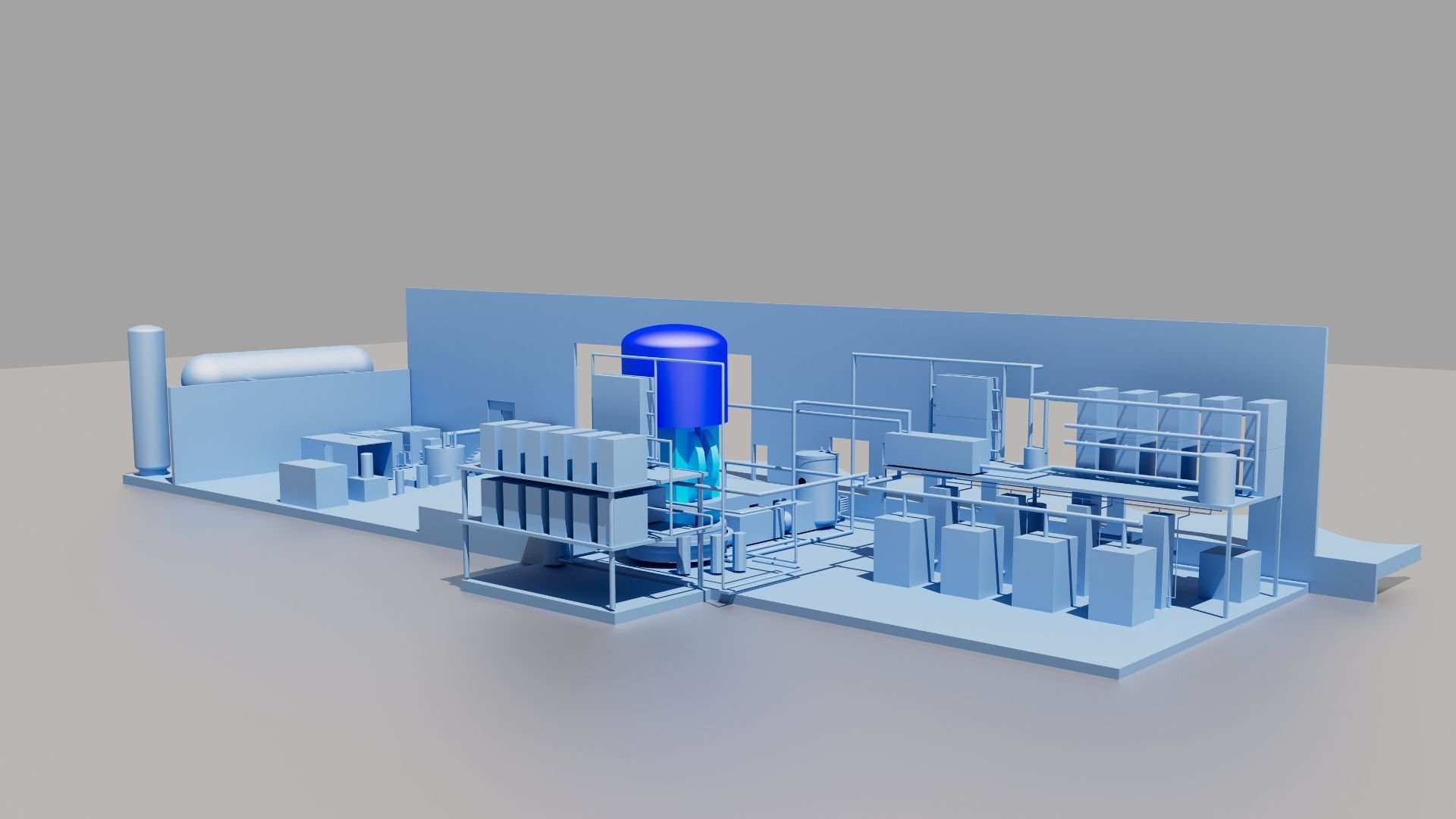

General Atomics (GA) has commenced the conceptual design for a specialized nuclear fusion research infrastructure project in San Diego, California. The initiative focuses on resolving a core engineering obstacle, which has historically slowed down the commercialization of clean energy reactors.
The American technology firm is collaborating with the United States Department of Energy (DOE) to design the Fusion Blanket Component Test Facility (BCTF). The plant will serve as a dedicated site to evaluate full-scale reactor containment systems.
As shown in the conceptual diagram file 276164.jpg, the facility intends to utilize existing corporate infrastructure. The development will leverage the Magnet Technologies Center (MTC), where the company previously manufactured advanced superconducting components for international physics projects.
The state government recently allocated a twenty million dollar tax credit to support the engineering design phase. The funding, which was approved by the California Competes Tax Credit Committee, reduces state income tax obligations.
Nuclear fusion relies on joining light atomic nuclei to release energy, which mimics the natural processes of the sun. Unlike traditional nuclear fission facilities, fusion reactors do not generate long-lived radioactive waste during their power generation cycles.
A primary challenge for developers involves the creation of breeding blankets, which line the interior of the vacuum vessels. These components must withstand extreme thermal conditions, but they must also capture kinetic energy to produce electricity efficiently.
The scarce hydrogen isotope known as tritium serves as the primary fuel source for most commercial reactor designs. Because tritium does not occur abundantly in nature, future power plants must generate their own operational supply internally.
Engineers plan to test specialized lithium-based materials within the new facility, which will include solid, liquid, and salt configurations. Testing at full scale allows researchers to observe how these materials interact under intense mechanical stress.
The facility operates under a public-private partnership model to assist multiple independent reactor developers. Institutional partners include the Idaho National Laboratory (INL), although several academic organizations are also contributing data.
Private engineering firms, including Japan-based Kyoto Fusioneering, are also participating in the preconceptual design work. The open-access framework allows diverse entities to validate component designs, although individual project timelines remain confidential.
According to corporate statements, no entity has previously evaluated integrated fusion blanket systems at a true commercial scale. Current testing remains limited to smaller experiments, which cannot replicate actual power plant fluid dynamics or structural stress.
The regional expansion coincides with legislative efforts to establish California as an industrial hub for advanced energy. Senate Bill 80 (SB 80) previously established the California Fusion Research and Development Innovation Initiative to accelerate technology.
The local testing framework is supplemented by the DIII-D National Fusion Facility, which the company operates for the federal government. The San Diego site currently stands as the largest magnetic fusion user testbed in the nation.
Engineers will use the upcoming facility to confirm that circulating liquids can successfully remove extreme heat. This verification step must occur, before facilities introduce complex radioactive neutron testing phases later in the schedule.
The initial project phase received financial backing via a seed investment directed to regional research institutions. This initial capital allowed engineers to establish the necessary structural collaborations, although full construction timelines are still under development.
The corporate communications team shared news of the project via digital channels. The announcement outlines the broader corporate strategy to transition proven experimental science into practical utility infrastructure.
Local economic groups, including the San Diego Regional Economic Development Council, are supporting the expansion. The organization aims to foster an advanced manufacturing workforce tailored to the emerging clean energy economy.
The facility will focus entirely on non-nuclear testing during its first phase. This approach allows engineers to isolate fluid dynamics from radiological variables, which simplifies the initial design validation process significantly.
Comments (0)
Leave a Comment
No comments yet. Be the first to share your thoughts!