


A version of this article appeared on LinkedIn by Derick Chebon.
The High Court of Kenya (HCK) delivered a decisive judgment against SBM Bank Kenya Limited (SBM), halting the financial institution from executing a statutory sale of a prime residential property located in the Karen suburb of Nairobi.
The decision, which emerged from Civil Suit 036 of 2022 as captured in the legal records protects a matrimonial home from an aggressive asset liquidation attempt.
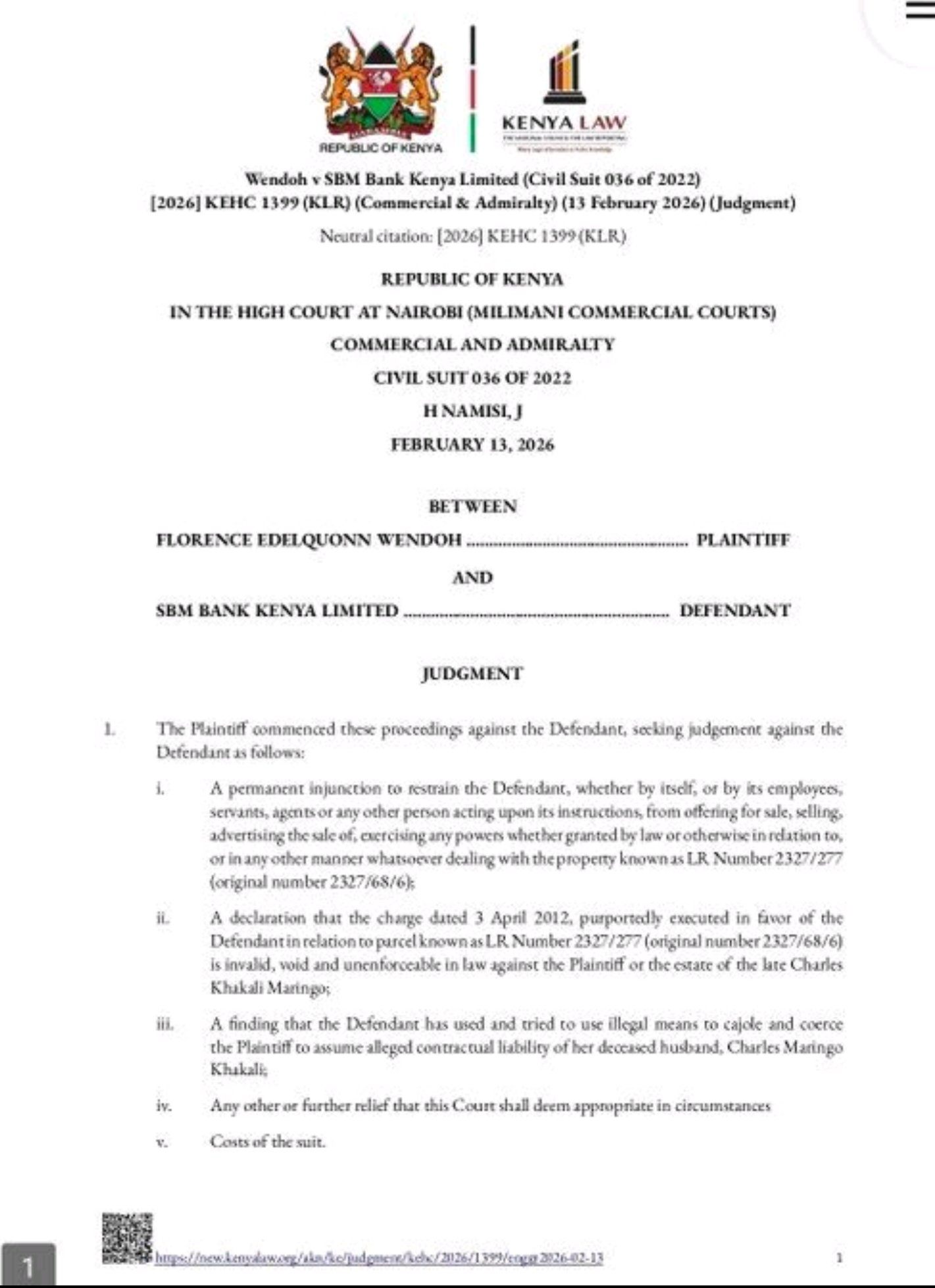
Justice H Namisi, sitting at the Milimani Commercial Courts, issued a permanent injunction restraining the lender from selling, advertising, or dealing with the property.
The property is registered as L.R. Number 2327/177.
The dispute pitted Florence Edelquinn Wendoh against the banking institution following the demise of her husband, Charles Mutai Mutegi.
The legal battle escalated when the lender attempted to enforce a charge dated April 3, 2013, to recover outstanding debt obligations incurred by the late businessman.
The plaintiff challenged the authenticity of the security documents, including the primary mortgage and the spousal consent forms, denouncing them on oath during the trial.
According to the judicial findings, the bank failed to provide substantive proof of execution once the plaintiff denied signing the instruments.
The court noted that the financial institution did not summon the attesting advocates to testify, a procedural omission that led the judge to draw an adverse inference against the lender.
The judgment highlighted a chronological impossibility within the paperwork, as the text of the mortgage document purported to rely on statutes that were not yet in force in Kenya at the time of its alleged execution.
The judge ruled that this statutory misalignment was not a minor technical irregularity, but a fundamental defect that rendered the document void ab initio.
The court also scrutinized the methods used by the debt recovery teams, ruling that the bank used illegal means to cajole and coerce the widow into assuming the personal contractual liabilities of her late husband.
Evidence presented during the proceedings indicated that the collection agents unethically approached the grieving plaintiff at a hospital bedside to secure admissions of liability.
Justice H Namisi affirmed that hospital bedsides do not constitute lawful or ethical debt-collection venues.
The lender argued that even if the formal mortgage faced structural challenges, the transaction created an informal charge over the Karen property.
The High Court rejected this line of defense, clarifying that an informal charge does not grant a financial institution an automatic statutory power of sale without a specific court order.
This ruling sends a clear signal to the banking industry regarding security documentation.
The judgment emphasizes four core principles for commercial lenders:
* Matrimonial homes require iron-clad spousal consent.
* Formal execution must be verifiable through attesting advocates.
* Informal charges do not allow automatic property auctions.
* Debt collection must adhere to ethical boundaries.
The decree effectively nullified the security interest of the lender, leaving the bank with a worthless legal instrument.
The financial institution must now bear the full costs of the suit, while the widow retains unencumbered possession of her family home.
Comments (0)
Leave a Comment
No comments yet. Be the first to share your thoughts!