
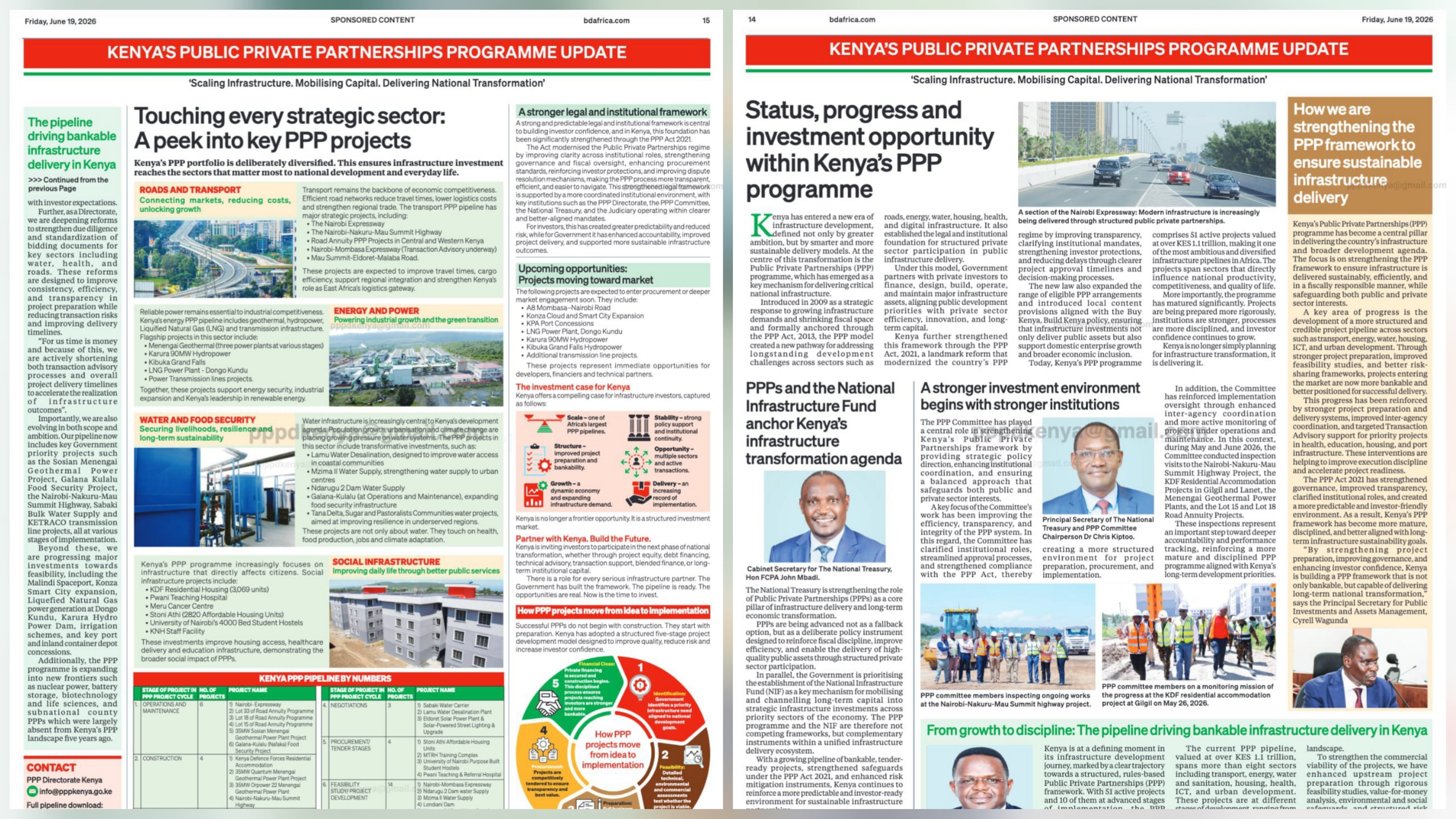

The National Treasury and the Public Private Partnerships (PPP) Directorate have introduced an updated institutional framework, aiming to streamline the delivery of mega-projects through private capital.
The strategy emphasizes financial discipline and institutional strength to attract long-term investments, moving away from fully state-funded procurement models.
According to the state announcement published in national newspapers, the revised framework introduces tighter oversight, faster approval processes, and a clear pipeline of bankable opportunities.
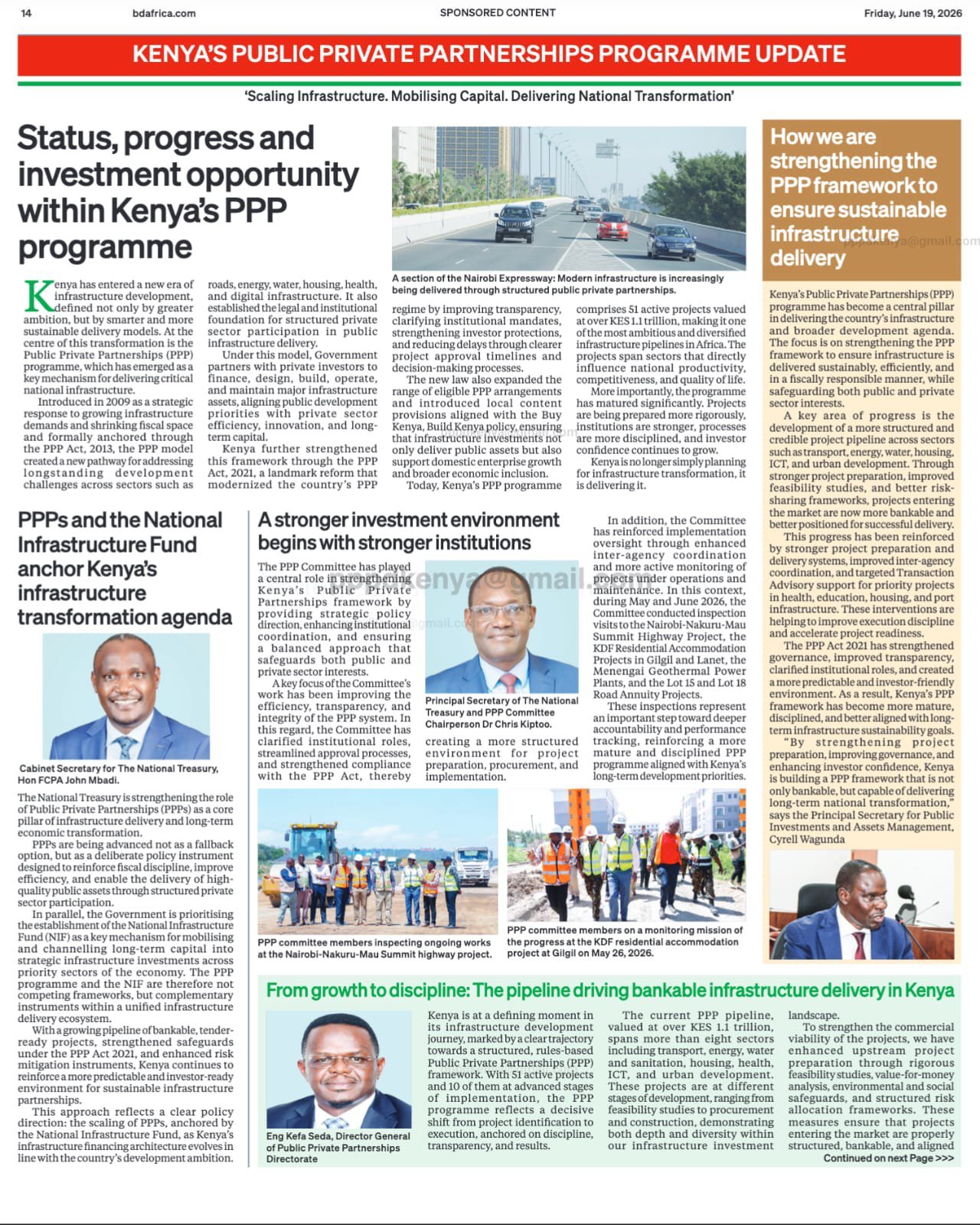
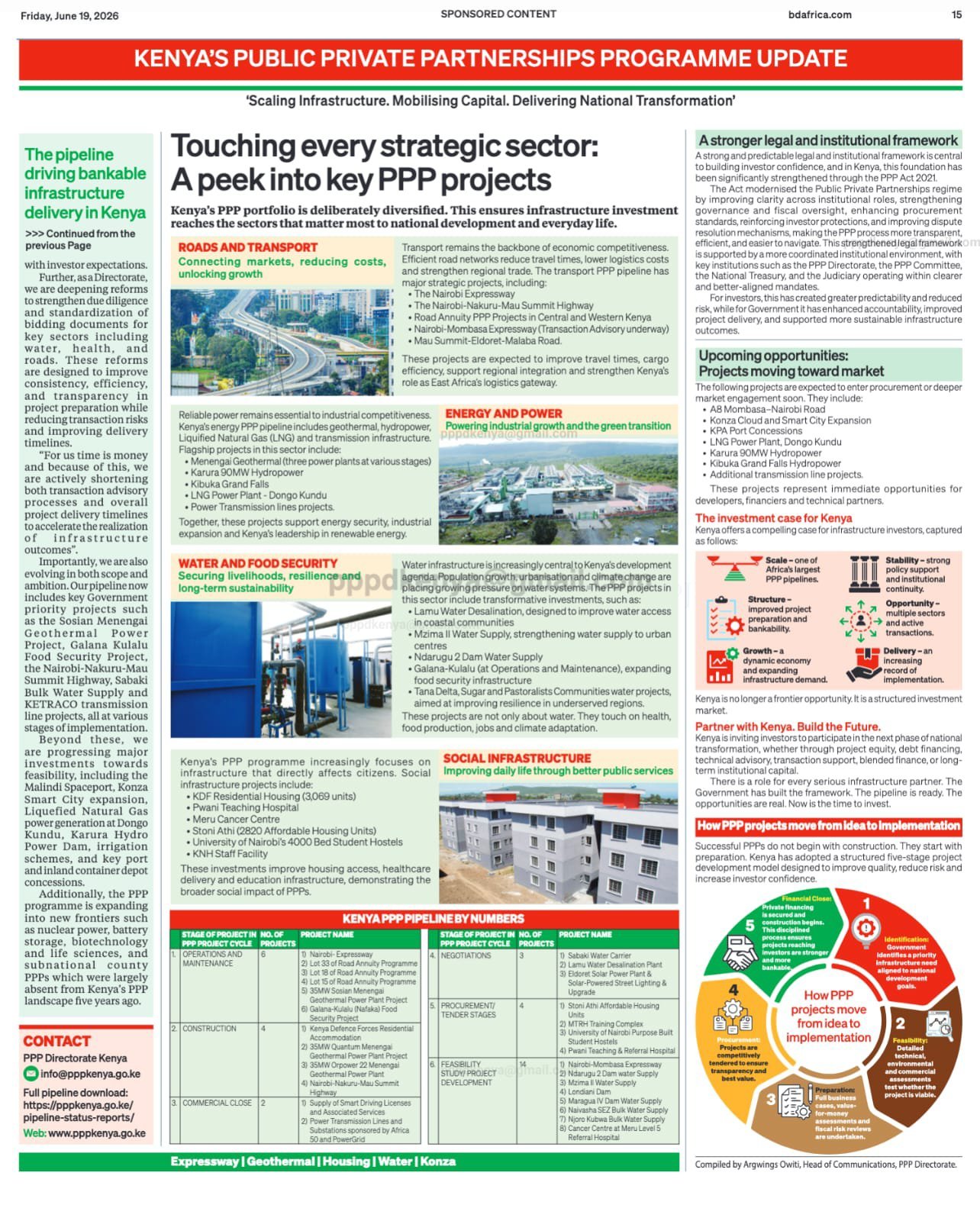
The state intends to anchor these developments using the National Infrastructure Fund (NIF) to provide a solid financial backing for large-scale utility and transport assets.
A central component of this strategy involves shifting public development from budgetary allocations to structured private capital arrangements.
This model allows private firms to design, finance, construct, and operate public assets before transferring them back to the state after a specified concession window.
The updated programme touches several strategic sectors including roads, transport, renewable energy, power, water, and sanitation.
By scaling up these partnerships, the government aims to close the national infrastructure deficit without expanding public debt.
In the transport sector, agencies like the Kenya National Highways Authority (KeNHA), the Kenya Urban Roads Authority (KURA), and the Kenya Rural Roads Authority (KeRRA) are harmonizing their project pipelines under the new guidelines.
Lessons from the operations of the Nairobi Expressway, managed under Moja Expressway Company, continue to guide the financial structuring of upcoming toll road concessions.
The Ministry of Roads and Transport is preparing additional highway corridors for private concessions, targeting high-traffic arteries that can generate sustainable toll revenues.
Similar asset-monetization and expansion plans are being evaluated for the aviation and maritime sectors through the Kenya Airports Authority (KAA) and the Kenya Ports Authority (KPA).
In the energy sector, the Ministry of Energy and Petroleum, alongside the Energy and Petroleum Regulatory Authority (EPRA), is utilizing the framework to expand the grid.
The Geothermal Development Company (GDC) and other state utilities are focusing on scaling up green energy generation through independent power producers.
These energy partnerships are designed to incorporate private capital into geothermal exploration, transmission line construction, and grid stabilization systems.
Water infrastructure is also receiving significant focus under the updated program, as urban demand outpaces available public capital.
The Ministry of Water, Sanitation and Irrigation, along with the Athi Water Works Development Agency (AWWDA), is structuring bulk water supply and wastewater treatment concessions.
These projects aim to deliver sustainable water processing plants through long-term off-take agreements with county water companies.
The regulatory changes also address social infrastructure, extending the PPP model to the Ministry of Health (MOH) and the Ministry of Education.
The government plans to leverage private developers for university accommodation, specialized medical equipment leasing, and digital learning infrastructure.
To ensure transparency, the PPP Directorate has standardized the procurement pipeline, enforcing strict competitive bidding processes for all proposed concessions.
The National Treasury maintains that tighter institutional alignment will shield the public from fiscal contingent liabilities often associated with poorly structured long-term contracts.
By enforcing strict bankability criteria, the state expects to filter out non-viable projects early in the appraisal phase.
The revised framework marks a deliberate pivot toward private sector self-sustainability in public utility delivery.
Comments (0)
Leave a Comment
No comments yet. Be the first to share your thoughts!