

There is an almost spiritual joy in staking out a new plot of land in Kenya, whether it’s a family home in the fertile plains of Kiambu or an ambitious commercial block rising in Nairobi’s concrete heart. This act of creation, however, begins not with the roof or the walls, but in a silent, often overlooked choice of a foundation. This decision is the very core of structural integrity, a covenant with the earth that determines the life and longevity of your investment.
For many, the first instinct is to embrace the simplicity and cost-effectiveness of the shallow foundation. This is the method of choice when the earth is a willing and capable partner. Shallow foundations rest close to the surface, typically within the first three meters, confidently carrying the structure’s weight when the near-surface soil is uniformly competent. Think of the humble, strong strips running under the perimeter walls of a house in Nakuru, or the discrete pads supporting the columns of a warehouse in Athi River. These are built on solid, trustworthy soil that readily agrees to bear the load without drama. This approach is profoundly appealing to the Kenyan investor, as it is faster to execute, significantly easier to inspect and offers a welcome relief on the project budget. When the soil on top is well-compacted and reliable, the shallow design is the sensible winner, spreading the building's load gently and keeping utility services simple and accessible. It feels like an honest, straightforward deal with the land.
Yet, our diverse landscape demands that we acknowledge its challenging side. The earth in certain areas of Kenya is stubborn, even rebellious. Imagine the soft, expansive clays and high water tables that plague developers in parts of Mombasa, or the deep, unstable sand fill that makes building a skyscraper in Upper Hill, Nairobi, a high-stakes gamble. This is the realm where the earth says no to a superficial touch, demanding instead the deep commitment of a deep foundation.
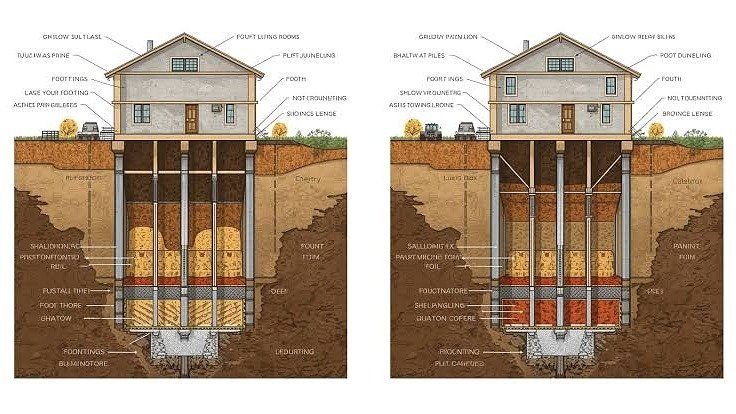
This engineering solution is reserved for heavy structures, unstable sites, or whenever weak top layers must be bypassed to deliver the load to a layer of bedrock or strong stratum far below. It necessitates the use of piles, whether driven deep into the ground or bored and filled with concrete, all tied together by powerful pile caps and ground beams. This process is inherently more complicated, demanding extensive geotechnical testing and meticulous planning. It costs significantly more and takes longer, often causing a nervous flutter in the heart of the project manager. However, this expense is not a luxury; it is the price of peace, the essential insurance against the fear of settlement cracks, or worse, catastrophic structural failure. In high-density coastal areas, for example, choosing a deep pile foundation is the only way to ensure the building and the capricious, sandy soil can finally reach a permanent agreement.
The crucial lesson for any owner or investor is that this choice must never be based on guesswork or a desperate attempt to cut costs. The land itself must speak, and its voice is captured in the geotechnical report, which provides a clear and objective measure of its capacity. This report, combined with the detailed load calculations from the structural engineer, makes the correct foundation type glaringly obvious. When the numbers say you can build shallow, you save time and money. When the ground forcefully says you cannot, you commit to the deep solution to save the building itself. The simple rule is to fund the foundation that precisely fits the soil's nature and the building's weight, thereby avoiding the costly mistake of overkill on one site or the heartbreaking tragedy of settlement headaches on the next.
If you need any construction services, including plans, drawings, design and build, or plugging materials suppliers, contact us directly on 0701951682. Email is mjengohubltd@gmail.com.
Have a great day!
Comments (0)
Leave a Comment
No comments yet. Be the first to share your thoughts!