
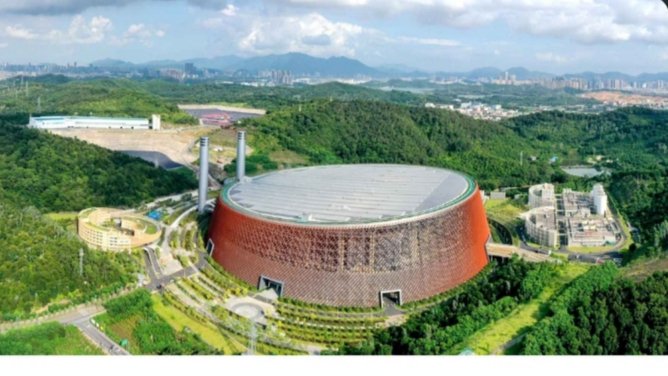

In urban planning and civil engineering, landfills have long been viewed as the final destination for waste. Once sealed, they are treated as dormant spaces, fenced off and forgotten beneath layers of soil. China is now challenging that assumption. Instead of seeing old landfill sites as environmental burdens, the country is reimagining them as energy reserves that can support modern infrastructure.
As 2026 begins, China is pursuing an ambitious strategy to excavate decades-old landfills and use the recovered waste to supply its vast network of waste-to-energy incineration plants. Over the past decade, the country constructed more than 1,000 such facilities, with the capacity to process roughly one million tonnes of waste per day. These plants were designed to reduce dependence on traditional dumping while generating electricity for growing urban populations.
At the time, the expansion made sense. Rapid urbanization and rising consumption were producing enormous volumes of municipal waste. Incineration offered a cleaner alternative to uncontrolled dumping and provided an additional source of power for industrializing cities. However, a new challenge has emerged.
China is now facing what analysts call a garbage gap. Improved waste-sorting systems and stricter recycling programs have reduced the amount of combustible household waste. Demographic shifts, including an aging population and slower economic growth, have also lowered consumption in some regions. As a result, many incineration plants are operating at about sixty percent capacity. Underused facilities struggle to remain financially viable, and inconsistent energy output complicates local power planning.
To address this shortfall, authorities are turning to landfill mining. Instead of letting old refuse remain buried, engineers are reopening landfill sites and using screening equipment to separate combustible material from soil and debris. Excavators dig through compacted layers of waste, which are then sorted, treated, and prepared as feedstock for incineration plants. What was once considered unusable trash is now being treated as stored fuel.
The approach offers several benefits. First, excavated waste provides the caloric material necessary to keep turbines running efficiently, protecting major infrastructure investments. Second, landfill mining creates opportunities for land reclamation. In densely populated cities such as Shenzhen, recovering landfill space can unlock valuable land for housing, commercial projects, or public parks. Third, reopening older sites allows environmental remediation. Many legacy landfills leak harmful leachate into the surrounding soil and groundwater. Excavation enables proper treatment of contaminated materials and reduces long term ecological risks.
For construction professionals and urban planners worldwide, China’s experience offers important lessons. Infrastructure planning must remain flexible as waste patterns and policies evolve. Building facilities based only on current demand can create stranded assets if recycling improves or consumption declines. Adaptability should be built into the design from the start.
China is responding by adjusting plant operations to handle a broader mix of materials, including industrial sludge and selected construction debris alongside excavated landfill waste. This shift reflects a deeper move toward circular economy principles, where yesterday’s waste becomes tomorrow’s resource.
For the built environment sector, the message is clear. The end of life for infrastructure does not always mean the end of value. Whether it is recycled concrete or decades-old refuse transformed into energy, cities must learn to mine the assets they have already created. In an era of land scarcity and resource pressure, the mines of the future may lie within the infrastructure we have already built.
Comments (0)
Leave a Comment
No comments yet. Be the first to share your thoughts!