
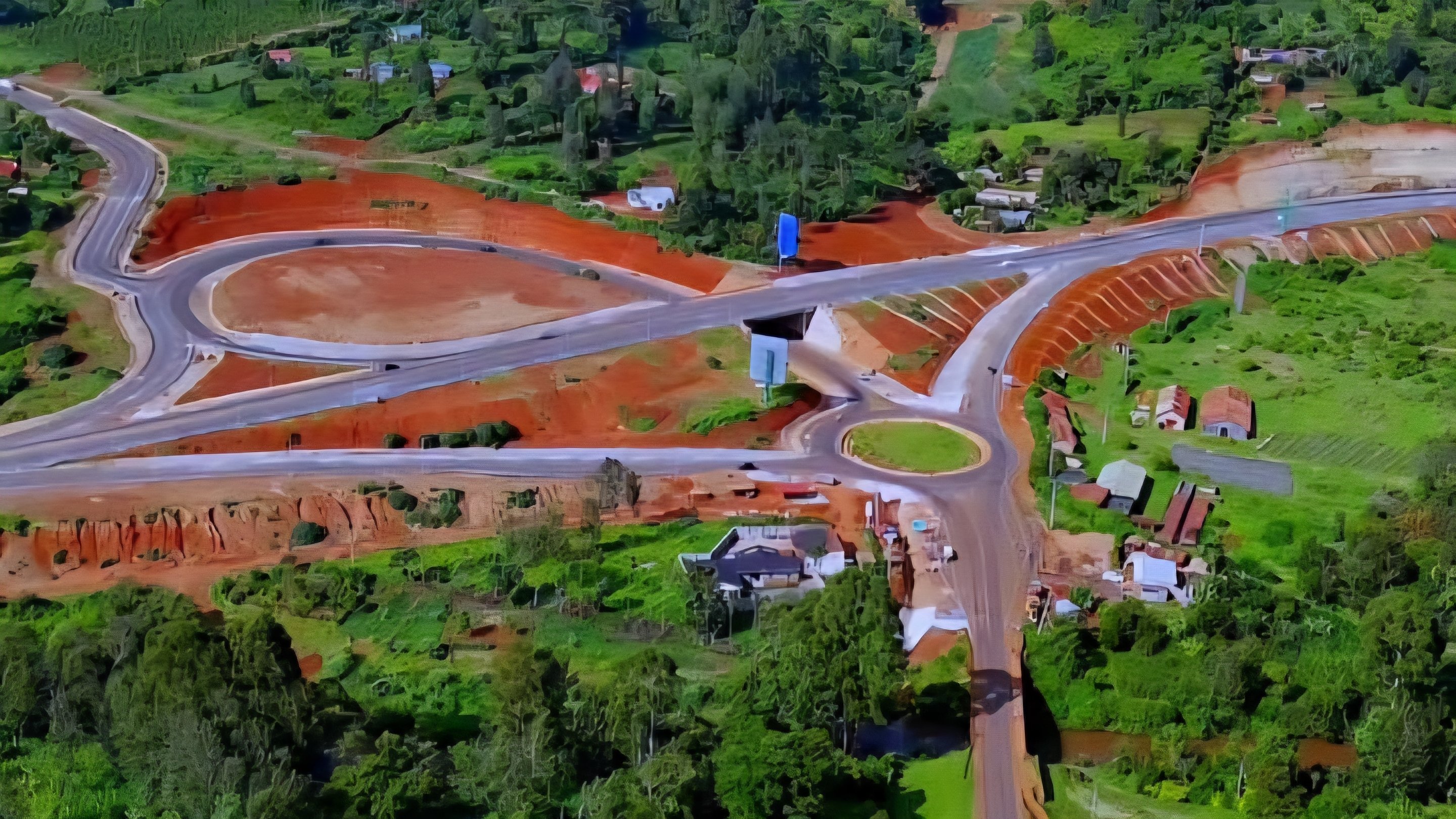

Aerial images shared on social media by observers show advanced construction progress at the Marua Interchange in Nyeri County. The multi-level junction forms a critical component of the ongoing Kenol to Marua capacity upgrade.
The project is managed by the Kenya National Highways Authority (KeNHA). It aims to eliminate a notorious bottleneck where several regional transit trunks converge.
The original configuration relied on a single-lane trunk infrastructure. This layout frequently struggled under the weight of commercial transport moving toward northern economic hubs.

This design avoids cross-traffic friction entirely. Vehicles heading toward Nanyuki or Nyeri town can now bypass the lower roundabout.
The civil works fall under the second phase of the wider 84-kilometer transport corridor project. Financing for the expansion is provided by the African Development Bank (AfDB), alongside the national government.
The structural footprint requires extensive earthworks, as seen in the wide red-soil cut slopes bordering the main alignment. Labor crews have focused on stabilizing these embankments to prevent erosion during seasonal rains.
Bitumen laying is well advanced across the primary loops. Current efforts are centering on the final structural links and approach sections.
The completed junction will serve as an international connection point. It links the port network of Kenya with the international boundary at Moyale.
Local logistics operators expect the dual lanes to lower vehicle operation costs. The modern engineering layout will also reduce travel times through the central highlands.
Once KeNHA inspectors approve the final asphalt layers and safety installations, the interchange will fully open. This will mark the conclusion of major heavy civil engineering works in the area.
Comments (0)
Leave a Comment
No comments yet. Be the first to share your thoughts!