
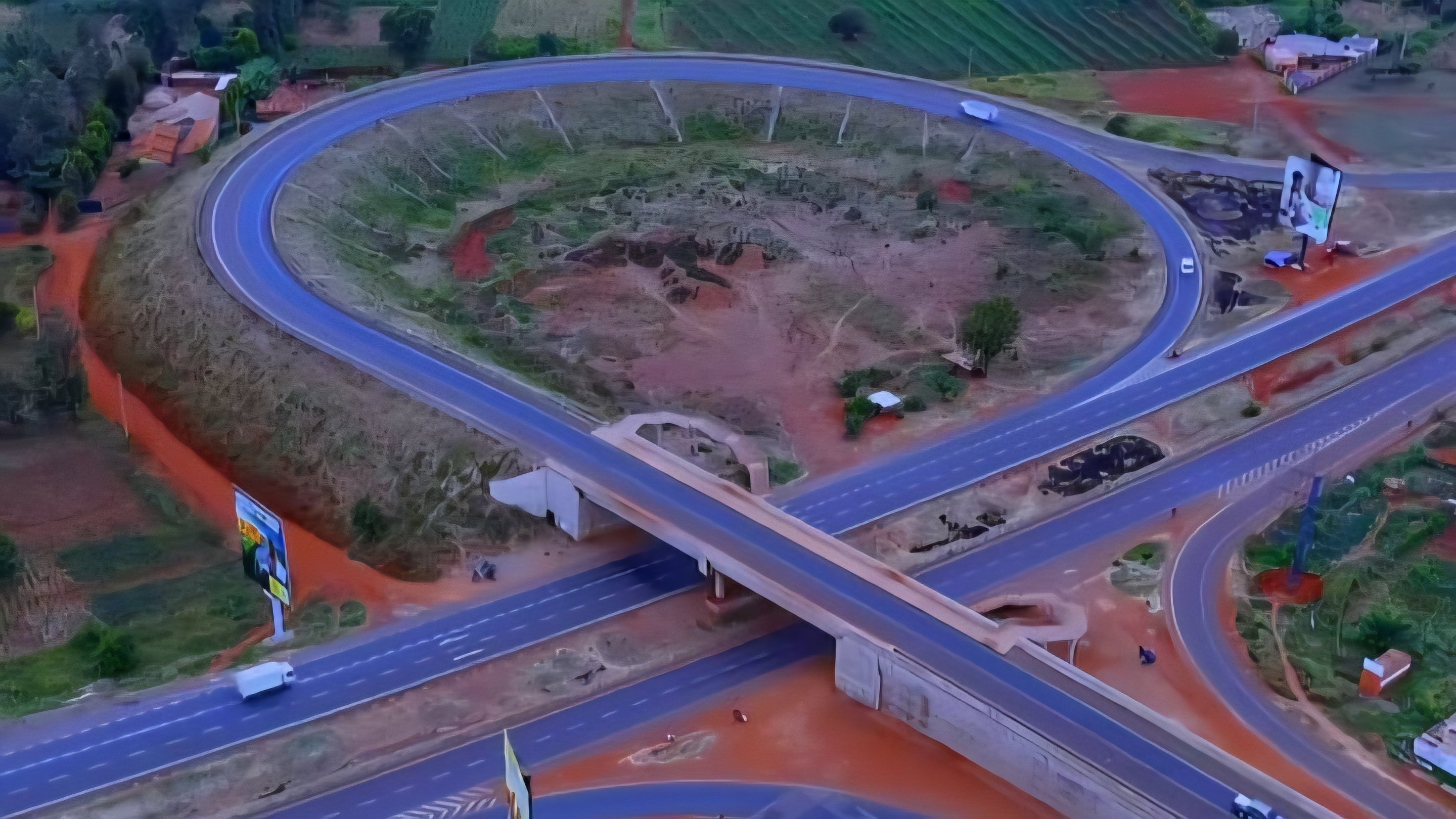

The construction of the modern Makutano Interchange stands out as a critical component of the ongoing upgrade of the Kenol to Marua highway. This engineering development forms a vital part of the international trunk road expansion project in Kenya.
The junction sits at a highly strategic position where major regional routes converge. Drivers previously faced long delays at the old intersection, which connects heavily populated farming zones to capital markets.
The Kenya National Highways Authority (KeNHA) prioritized this section to resolve severe traffic constraints. The agency targeted the elimination of bottlenecks that slowed down the transportation of agricultural goods from the central region.
The design features a grade-separated junction that separates local traffic from long-distance transit. This layout allows vehicles on the main highway to pass over the intersecting roads without stopping.
The entire highway improvement project spans 84 kilometers from Kenol through Sagana to Marua town. Engineers divided the extensive civil works into two distinct contract packages to manage execution efficiently.
The first lot covers 48 kilometers between Kenol and Sagana, which explicitly includes the construction zone of the Makutano Interchange. The second package encompasses the 36-kilometer section continuing up to Marua.
Financing for this massive regional transport asset involves multi-agency international cooperation. The total cost for the highway improvement corridor reaches an estimated 257.68 million Euros.
The African Development Bank (AfDB) provides the primary financial backing, contributing 69 percent of the total project funding. This institutional support ensures steady progress on large-scale structural installations.
Additional financing comes from the Africa Growing Together Fund (AGTF), which supplies 12 percent of the capital requirement. The Government of Kenya provides the remaining 19 percent from internal infrastructure budgets.
The project team required extensive land planning before earthworks could commence. Officials from the National Land Commission (NLC) managed the sensitive process of property acquisition and community compensation.
The existing road reserve between Kenol and Sagana measured 60 meters in width, which reduced the need for extensive displacement. Most structural works for the interchange fit within this pre-existing public allocation.
The civil engineering team applied international design standards to ensure long-term structural pavement durability. The specifications required a 150-millimeter dense bitumen macadam base layer to withstand heavy axle loads.
Beneath this surface, workers placed a 150-millimeter cement or lime-improved gravel sub-base. A variable thickness of improved natural material forms the foundation subgrade to support the overlying road structures.
The main carriageway features a pavement width of 7.0 meters. Engineers added 2-meter shoulders on the outer sides, and 1-meter shoulders on the inner sides to improve safety margins.
The project team also integrated pedestrian footbridges, street lighting systems, and dedicated transport sheds into the design. These auxiliary additions protect local communities, who live alongside the high-speed transit lanes.
The physical footprint of the infrastructure is visible in regional aerial imagery. The photograph highlights the looping ramps and concrete bridge structures that define the completed junction layout.
The broader corridor serves as a segment of the Trans-Africa Highway (TAH4), a major trade route connecting Cairo to Cape Town. It links commercial hubs from Nairobi through Moyale to the Ethiopian border.
The local impact centers on the primary agricultural economies of Murang'a, Kirinyaga, and Nyeri counties. Over one million residents within the direct zone of influence benefit from the improved transport system.
Travel times through the busy corridor are projected to decrease significantly as final completions near. Reduced vehicle operating costs will lower overhead expenses for regional logistics companies and small-scale farmers.
Comments (0)
Leave a Comment
No comments yet. Be the first to share your thoughts!