
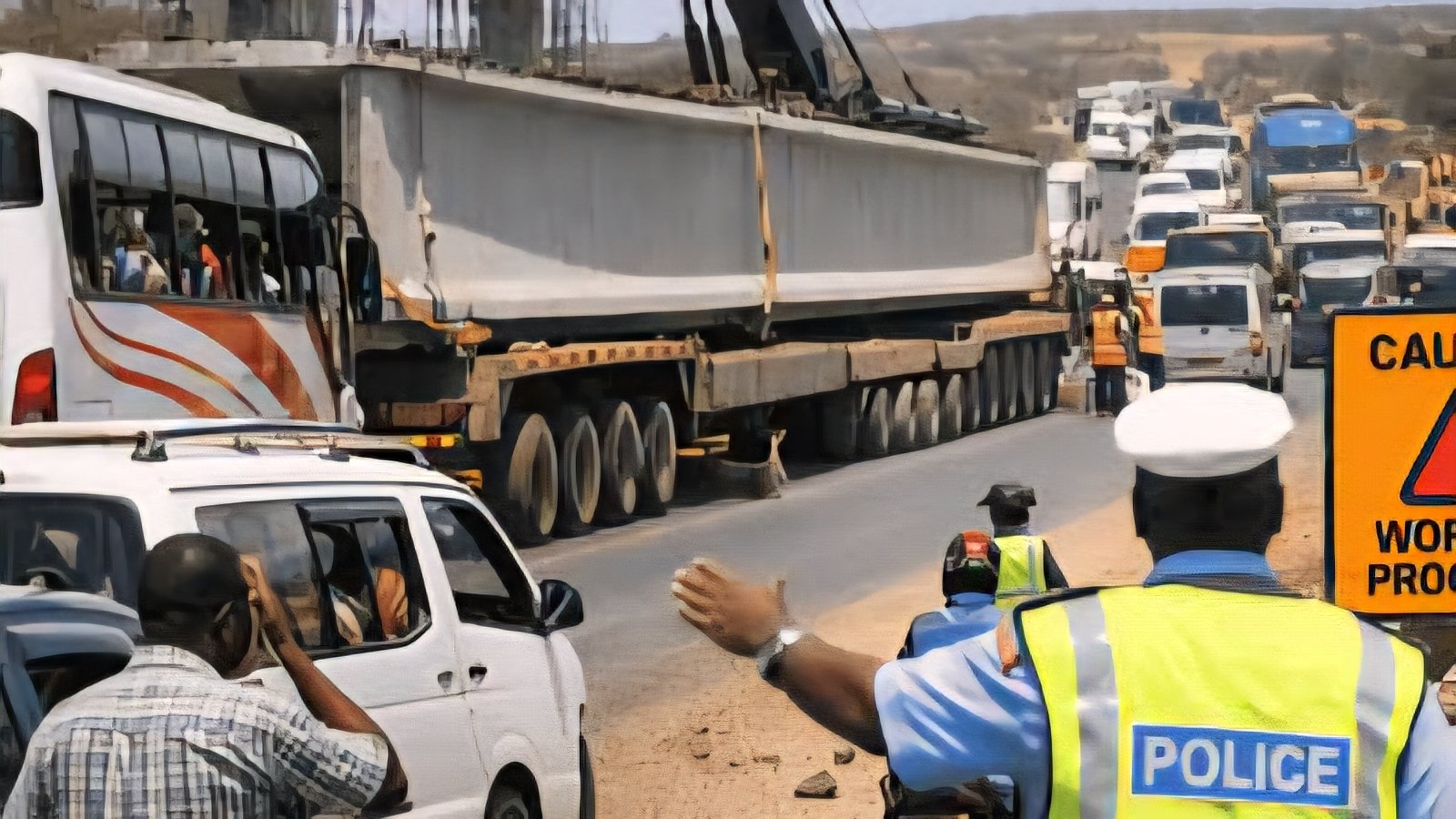

The Kenya National Highways Authority is entering the final phases of construction on the new 150-metre Tana River Bridge, a project designed to resolve long-standing logistical bottlenecks between Garissa and the North Eastern region. Situated along the Ukasi-Garissa-Modika road, the Sh1.77 billion infrastructure development is intended to replace the operational role of the existing 43-year-old crossing, which has struggled to accommodate modern traffic volumes and diverse user groups.
Recent engineering work has focused on the installation of precast concrete girders, a technical phase that required managing of traffic disruptions throughout December and into January. These activities involved the transportation and launching of heavy structural beams that form the primary deck of the new bridge. During this period, the authority restricted transit during off-peak hours to allow heavy machinery to position the components, a move that highlighted the complexity of maintaining a live transport corridor while erecting a major river crossing.
The new bridge serves as a primary gateway for three counties: Garissa, Wajir, and Mandera. For decades, the existing bridge has been the only reliable point of transit for commercial haulage, passenger buses, and local movement. However, the shared use of the narrow structure by heavy trucks, motorcycles, and livestock has frequently led to severe congestion and safety concerns. Upon the commissioning of the new structure, vehicular traffic will be diverted to the modern facility, while the 1982 bridge will be repurposed specifically for pedestrians, cyclists, and livestock.
Safety is a primary driver behind the investment. During the rainy season, the Tana River frequently experiences rising water levels that can threaten low-lying crossings, making a high-clearance, modern bridge essential for year-round reliability. The North Eastern region relies heavily on this link for the delivery of essential supplies and the outward transport of livestock, which remains the cornerstone of the local economy. By separating high-speed motor vehicles from non-motorized traffic, the authority expects a sharp decline in the risk of accidents at the river approach.
Government officials, including those from the Regional Implementation, Coordination and Management Committee, recently inspected the site to verify the status of the girder launching. The committee noted that the bridge is currently one of the most significant state-funded infrastructure projects in the region. The project also aligns with wider efforts to improve the A3 road, which is a critical link for trade with neighboring countries and the development of the Lamu Port-South Sudan-Ethiopia Transport corridor.
The project represents a shift in how infrastructure is managed at critical junctions in Kenya. By opting to maintain the old bridge for lighter use rather than demolishing it, the authority is effectively doubling the capacity of the crossing point without the environmental impact of a completely new site footprint. Local leadership has urged residents to cooperate with the remaining traffic management measures as the project moves into the final surfacing and safety installation stages.
Comments (0)
Leave a Comment
No comments yet. Be the first to share your thoughts!