
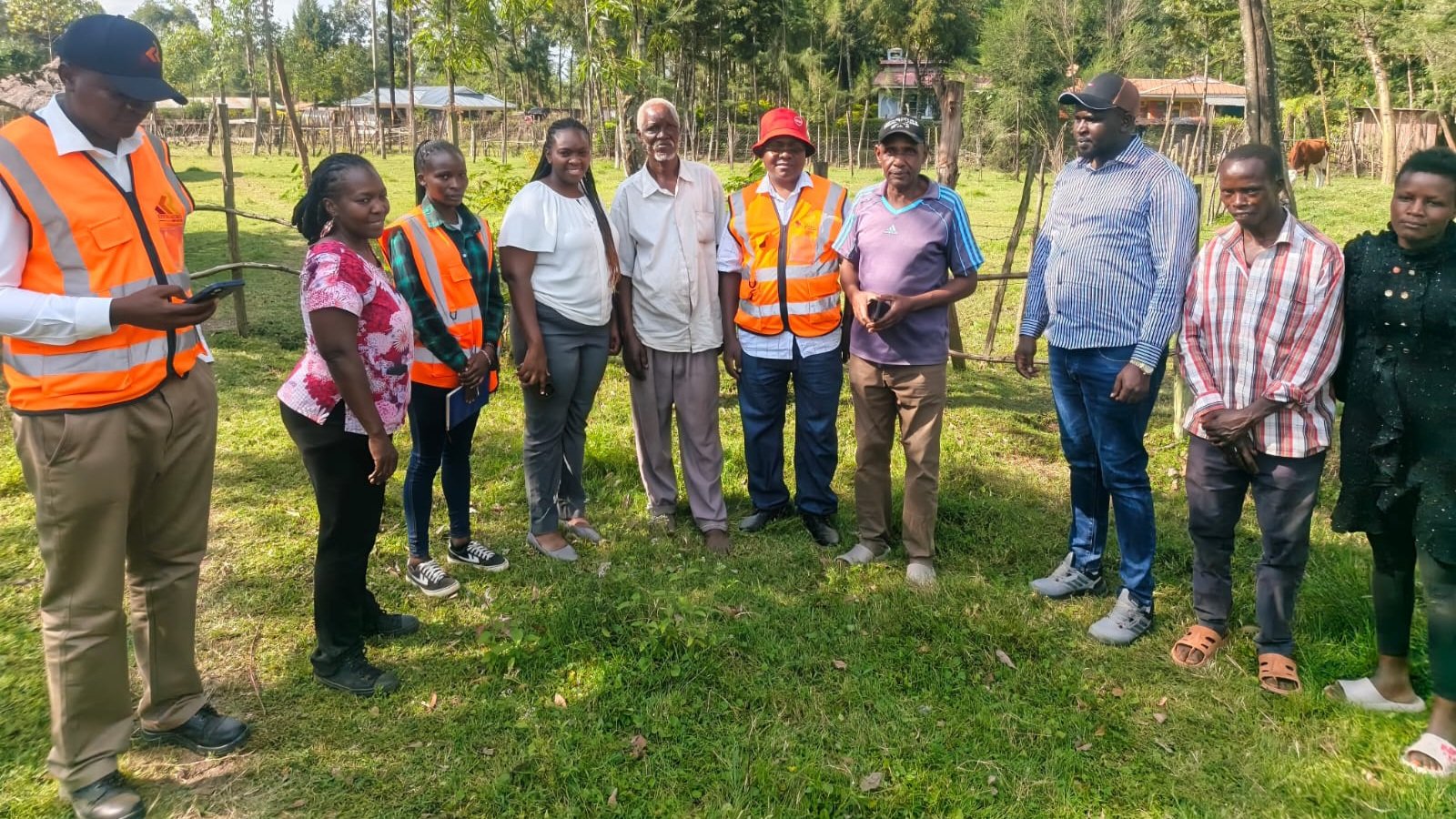

Officials from Kenya Railways (KR) have intensified field engagements in Bomet County as part of advanced preparations for the construction of the Naivasha to Kisumu to Malaba Standard Gauge Railway (SGR) project.
The state-backed public sensitisation drive involves identifying and inspecting lands earmarked for acquisition along the corridor, which will pave the way for the multi-billion-shilling western line expansion.
This field exercise follows the formal launch of the massive infrastructure project by President Ruto earlier this year, setting the stage for major engineering works across Western Kenya.
The state corporation works in close collaboration with the National Land Commission (NLC) to manage property assessments and compensation frameworks.
According to project documentation, route planning and validation exercises were completed, establishing the final alignment for the alignment.
Kenya Railways Managing Director Philip Mainga previously led a high-level technical delegation to Narok County, inspecting the proposed route corridor for immediate readiness.
The new line represents an extension of the existing network, which currently terminates at Suswa near Naivasha.
President Ruto noted during the launch, that the network modernises transport, replacing the old colonial railway line, which ran towards the lake region.
The original line from Mombasa to Naivasha is already operational, but the government now moves to complete the western circuit.
According to the project blueprint, the western extension is split into two main sections to ease execution.
Phase 2B will run from Naivasha to Kisumu, covering a total distance of 264 kilometres.
It will start from Emurtoto in Narok County, before cutting through several agricultural regions to reach a new terminal in Kisumu.
A separate 8.69-kilometre branch line will link the main line directly to the new Kisumu Port, supporting local maritime logistics.
The subsequent Phase 2C will connect Kisumu to the Malaba border town, adding another 107 kilometres of track to link seamlessly with Uganda.
In total, the full alignment traverses nine counties, including Narok, Bomet, Nyamira, Kericho, Kisumu, Siaya, Vihiga, Kakamega, and Busia.
The government plans to spend between 500 billion and 700 billion Kenyan Shillings on the entire 371-kilometre mainline extension.
Engineering procurement and construction responsibilities were assigned to China Road and Bridge Corporation (CRBC) and China Communications Construction Company (CCCC).
The technical scope of the western corridor is substantial, and it involves the construction of 13 tunnels, 23 bridges, and 376 culverts.
Bomet County will host an essential section of Phase 2B, which features intermediate transit stations planned for Mulot, Bomet town, and Sotik.
Other intermediate stations along the Naivasha to Kisumu route include Narok, Sondu, and Ahero, before the line reaches the final terminal.
Further ahead on Phase 2C, intermediate stations will be constructed at Yala and Mumias to facilitate passenger access.
Crossing stations will also be built at Kisian West, Ramala, Musanda, Manyulia, and Amukura to manage traffic safely.
The railway is designed for operational speeds of 120 kilometres per hour for passenger trains, which will carry up to 1,096 passengers per trip.
Freight trains will operate at 80 kilometres per hour, and each train will have a haulage capacity of 4,000 tonnes.
The design allows the transport of up to 216 Twenty-Foot Equivalent Units (TEUs) per single trip along the line.
The network aims for an annual freight capacity of 22 million tonnes, which will significantly lower transit overheads.
Kenya Railways has targeted mid-2027 for the completion of the line, which aims to shift bulk cargo away from the national road network.
President Ruto held discussions with regional leaders, including Ugandan President Yoweri Museveni, to ensure cross-border design uniformity for smooth operations.
Comments (0)
Leave a Comment
No comments yet. Be the first to share your thoughts!