
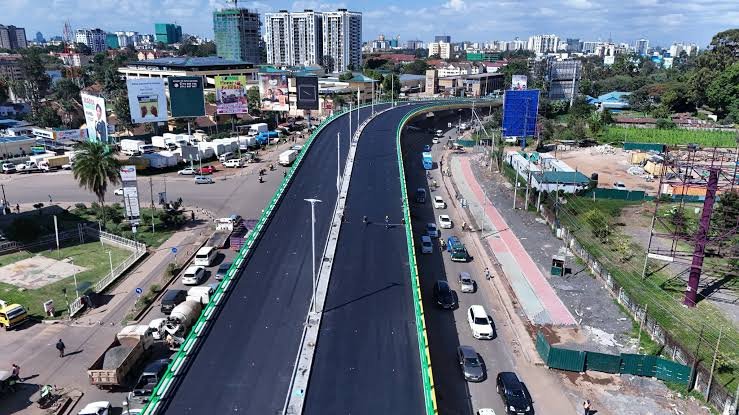

The Kenya Urban Roads Authority (KURA) has unveiled engineering plans to construct two new flyovers along the busy Ngong Road, aiming to eliminate persistent traffic bottlenecks that plague commuters daily.
The new overpasses are scheduled for construction at Prestige Junction and the Daystar University roundabout, where severe gridlock frequently brings vehicular movement to a complete standstill.
According to project disclosures visible in a recent social media brief filed under 291888.png from public infrastructure observers, this specific intervention will fundamentally alter the existing geometric design of the corridor.
The scope of work extends far beyond these two grade-separation structures, incorporating a massive technological modernization program for the entire capital.
Engineers expect to install smart traffic systems and execute comprehensive road upgrades at more than 400 critical intersections across Nairobi.
This massive grid modernization will deploy intelligent transport technologies, such as demand-responsive traffic signals, vehicle detectors, and digital enforcement cameras.
The infrastructure initiative aligns with recent state-backed mobility investments, following the commissioning of the 3.58-billion-shilling Ngong Road and Naivasha Road flyover by President William Ruto.
That previous project, financed through the Spain Corporate International Fund (FIEM), introduced dedicated Non-Motorized Transport (NMT) lanes alongside regular vehicular lanes.
The newly planned Ngong Road flyovers are expected to complement these existing structures, creating a seamless flow of traffic from residential zones to the urban core.
By removing the Daystar University roundabout, KURA plans to minimize vehicular conflict points that currently cause long tailbacks during morning and evening peak hours.
The broader intelligent transport rollout involves substantial financing, drawing from international development partners like the Export-Import Bank of Korea under the Economic Development Cooperation Fund (EDCF).
The second phase of the smart traffic deployment alone is backed by an 10.8-billion-shilling facility, targeting sixty key junctions for immediate civil works and system configuration.
Central to this technological transformation is the establishment of a modern Traffic Management Centre (TMC), which serves as the central hub for monitoring citywide mobility.
Engineers, system specialists, and traffic police officers will sit within the TMC, reviewing real-time data feeds captured by high-definition cameras installed at the intersections.
The artificial intelligence software embedded within the system allows individual junctions to communicate with one another, adjusting signal timings dynamically based on real-time traffic volume.
This network-wide approach represents a departure from traditional fixed-time signals, which often fail to respond to sudden changes in traffic density on major roads.
The Ministry of Roads and Transport has emphasized that automated enforcement measures, including speed limit tracking and signal violation logging, will be active under the new framework.
Bidding processes for the multi-billion-shilling contracts require international consortia to partner with local entities, ensuring a structured transfer of technical skills to Kenyan engineers.
The selected contractors must manage a comprehensive post-construction warranty period, during which they will support operations and optimize the smart software algorithms.
Chronic traffic delays cost the Nairobi economy billions of shillings annually in lost productivity, making these structural and technological investments vital for urban productivity.
As procurement steps advance, the capital city is transitioning toward a highly technical infrastructure model where civil works and digital systems combine to streamline urban transport.
Comments (0)
Leave a Comment
No comments yet. Be the first to share your thoughts!