
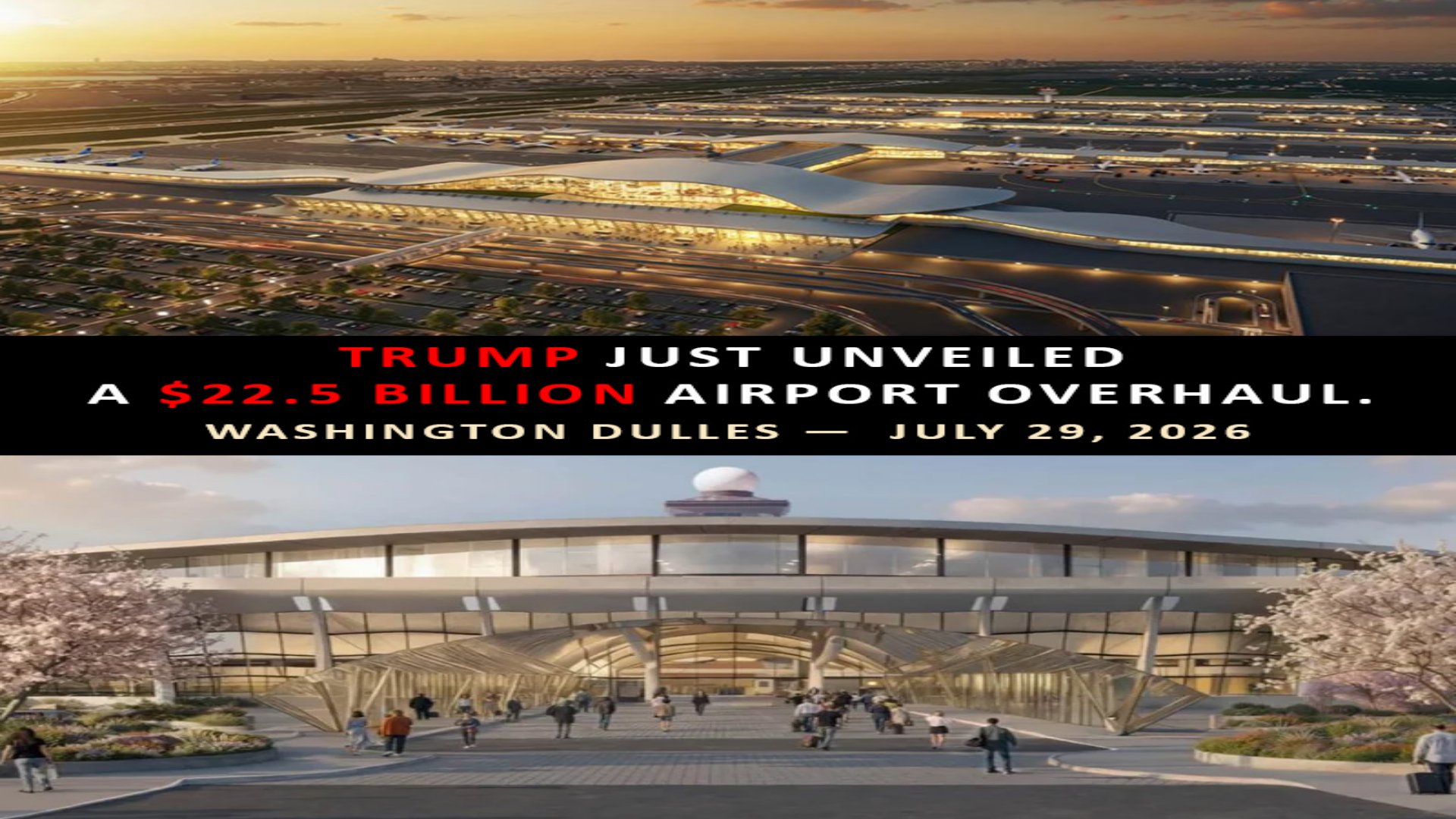

United States President Donald Trump unveiled a $22.5 billion plan to reconstruct Washington Dulles International Airport (IAD) during an Oval Office briefing. The extensive initiative aims to overhaul major terminal infrastructure at the regional aviation hub.
United States Department of Transportation (USDOT) Secretary Sean Duffy joined President Trump alongside airline executives to present architectural renderings. The proposal replaces outdated concourses while expanding existing passenger facilities across the complex.
Under the project design, contractors will replace aging C and D concourses constructed four decades ago. Builders will construct five modern concourses to improve passenger operations, but workers will preserve the original historic main terminal.
The project eliminates traditional mobile lounge shuttles, which carried travelers across the tarmac since 1962. Engineers plan to install a new U-shaped passenger rail system, a central pedestrian walking tunnel, and automated walkways.
Development plans include adding over five million square feet of space across the primary facility. Builders will construct a massive multi-level parking garage featuring 32,000 parking spaces positioned just yards from the terminal entrance.
Plans also incorporate expanded check-in areas, modernized security checkpoints, and additional gate capacity for commercial flights. A new hotel, premium lounge spaces, upgraded baggage handling systems, and additional retail options form part of the structural layout.
Financing for the $22.5 billion capital investment relies on municipal bonds and private airline contributions. Metropolitan Washington Airports Authority (MWAA) will issue municipal bonds, so direct federal taxpayer money will not fund construction work.
United Airlines, which operates its primary East Coast hub at the site and handles roughly 70 percent of total passenger traffic, serves as a primary financial partner. Other commercial airlines operating at the facility will contribute toward long-term development costs.
President Trump noted that travelers face long walking distances in the current layout, which he publicly criticized as highly inefficient. The updated interior design incorporates glass walls, large windows, and gold-mirrored ceilings throughout the passenger concourses.
Virginia Governor Abigail Spanberger stated that the facility serves as a vital international trade gateway for the region. She emphasized that physical expansion supports local employment opportunities and attracts commercial investment into surrounding regional communities.
Safety concerns accelerated discussions to retire the older mobile shuttles after a shuttle collision injured 18 travelers last year. MWAA board members subsequently advocated for permanent rail transit connections to replace tarmac shuttle operations permanently.
Officials evaluated more than 30 architecture proposals submitted following a USDOT call for design concepts. Construction activity is scheduled to begin next spring, with phased delivery expected to span several years of active field development.
The airport recorded 29 million passengers last year, reflecting a 6.4 percent annual increase in travel volume. This project represents the largest airport modernization effort in the capital region since Denver International Airport opened in 1995.
MWAA will oversee phased construction to maintain continuous flight operations throughout active building stages. Federal aviation officials expect the overall project to streamline international connections and accommodate growing passenger demand for decades to come.
Comments (0)
Leave a Comment
No comments yet. Be the first to share your thoughts!