
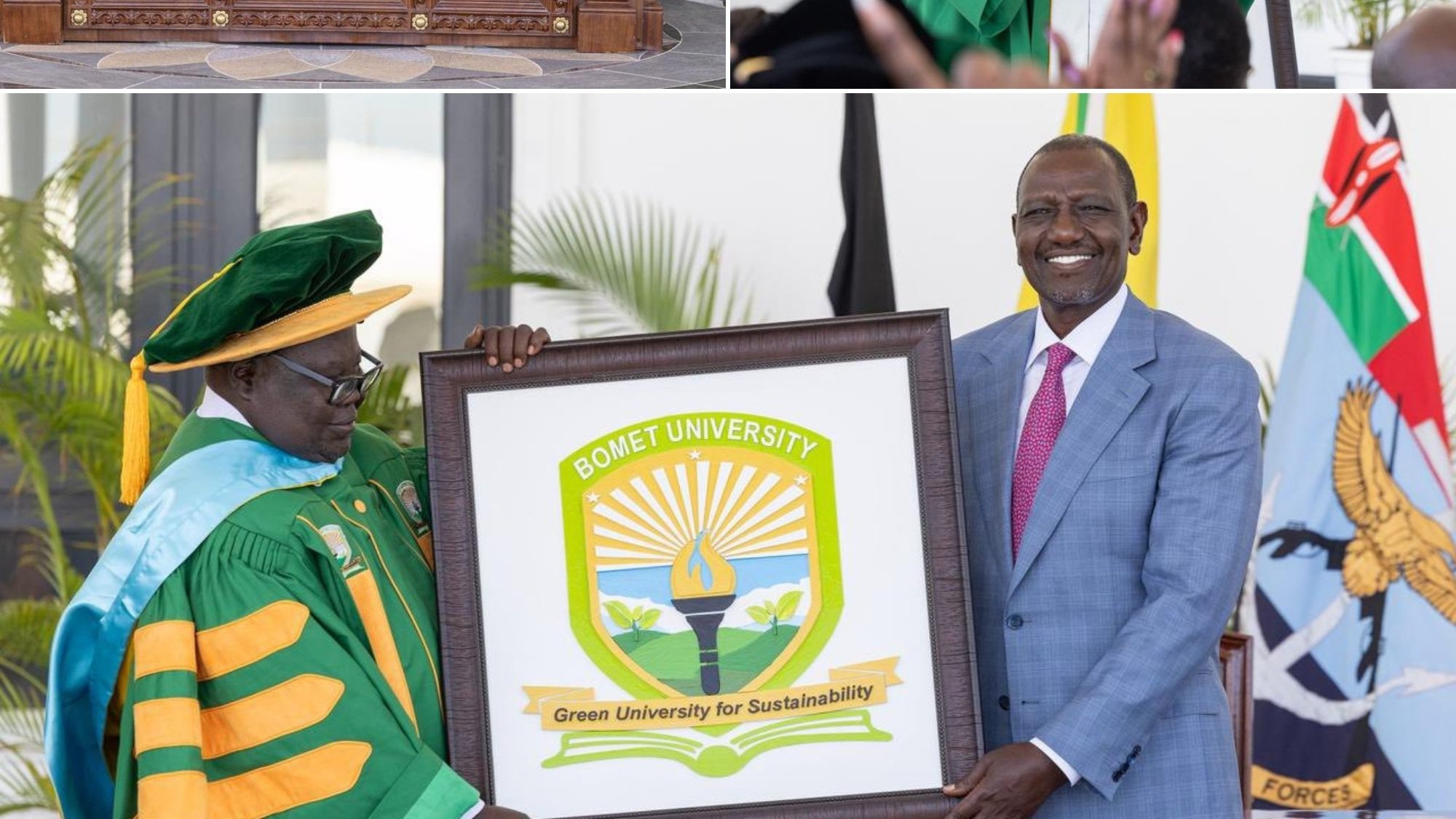

President William Ruto handed over the official charter to Bomet University College during a ceremony held at State House, Nairobi. The document, signed in the presence of university officials, academic leaders and government representatives, removes the institution's status as a constituent college of Moi University and establishes it as a fully independent public university.
The charter ceremony took place in the State House conference room, where traditional symbols of academic authority were on display. Photos from the event show the President at the signing table, flanked by the presidential standard, while a mace-bearer and other dignitaries stand nearby. The framed charter bears the university's logo, a torch set against a green landscape, and confirms the institution's legal right to confer its own degrees, appoint staff, and manage finances without oversight from its former parent university.
Bomet University College opened its doors in 2017 on a 500-acre campus in Bomet County. From the beginning it concentrated on fields tied to the region's economy and environment: agriculture, environmental sciences, natural resource management, and related disciplines. Student numbers have grown steadily to around 2,000, supported by lecture theatres, science laboratories, a modern library completed in 2023, and hostels. Solar power supplies a large share of the campus electricity, and rainwater harvesting systems feed demonstration plots for sustainable farming techniques.
The transition to full university status follows several years of preparation. The Commission for University Education carried out inspections covering governance structures, qualified academic staff, physical facilities, library resources, and financial viability. Once those standards were met, the recommendation went to Cabinet and then to the President for final approval under the Universities Act. The process mirrors upgrades granted to other former constituent colleges in recent years, including Garissa University College and Koitalel Samoei University.
The new university sits in one of Kenya's key tea-growing and dairy-producing counties. Its academic focus aligns closely with local needs, research into climate-smart agriculture, soil conservation, value addition for farm produce, and renewable energy solutions. County leaders have long argued for a dedicated higher education institution in the South Rift to reduce travel distances for students from Bomet, Kericho, Narok and parts of Nakuru. With the charter in hand, the university can now expand course offerings, seek international partnerships, and compete for research grants on its own terms.
Infrastructure improvements have kept pace with enrolment growth. Government funding since 2017 has covered the construction of administration blocks, additional classrooms, a multi-purpose hall, and specialised labs for soil testing and renewable energy experiments. The campus master plan includes future phases for an innovation hub, sports facilities, and expanded student accommodation. Local contractors handled much of the recent work, injecting money directly into the Bomet economy.
Kenya's public university landscape has expanded rapidly. The country now has 39 public universities compared with just seven two decades ago. This growth aims to absorb more of the increasing number of secondary school leavers, over 900,000 sat the 2025 KCSE, and to meet skills demands in agriculture, technology, and environmental management. At the same time, the sector faces ongoing pressures: delayed capitation, staff union disputes over pay, and questions about quality assurance. Bomet's smaller size and specialised mandate may help it avoid some of the overcrowding issues seen at larger campuses.
The charter presentation fits within the government's wider education agenda. The 2025/26 financial year set aside KES 150 billion for the sector, with money earmarked for university infrastructure, student loans through HELB, and TVET expansion. In the Rift Valley, similar investments have gone into upgrades at institutions such as Laikipia University and South Eastern Kenya University satellite campuses.
Community expectations run high. Residents and leaders in Bomet view the university as an anchor for long-term development, more local jobs in teaching and administration, spin-off businesses supplying food and services, and research that directly benefits smallholder farmers. Early signs of impact already exist: extension services linked to the university have introduced drought-resistant crop varieties in nearby wards.
Looking forward, the university council will take full responsibility for strategic direction. Recruitment for the next academic year is underway, with marketing focused on programmes that address Kenya's climate and food security challenges. Partnerships with bodies such as the African Development Bank, which has previously supported green campus initiatives, could accelerate planned expansions.
The State House event carried added symbolism. Charters are rarely handed over personally by the head of state, and the choice of venue underlined national recognition of the milestone. For Bomet University, the charter marks the end of one phase and the start of another, one in which it stands alone, accountable for its performance, and positioned to contribute to both regional and national development goals.
Comments (0)
Leave a Comment
No comments yet. Be the first to share your thoughts!