
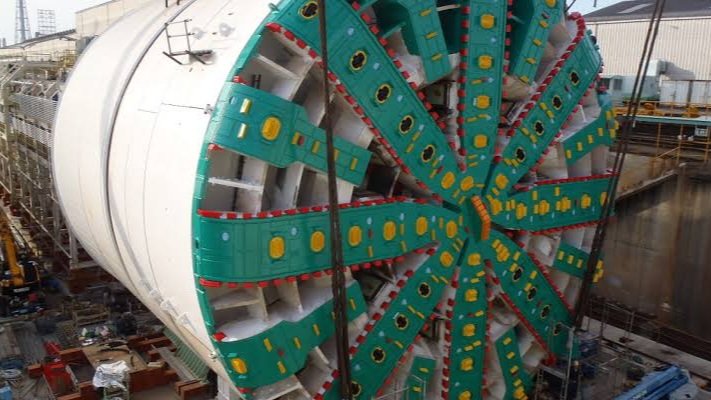

China now commands the global underground equipment manufacturing sector, producing the majority of heavy excavation hardware used worldwide. Public posts shared by industry observer Li Zexin highlight how national industrial policies shaped this expansion.
State statistical references indicate that Chinese factories manufacture roughly 70 percent of all active heavy tunneling equipment globally. Domestic manufacturing plants have assembled over 4,000 units to support expanding municipal transportation projects.
Chinese manufacturers produce the world's largest Tunnel Boring Machine (TBM) units, which process earth during subsurface transit construction. These massive machines replace traditional excavation techniques on complex urban infrastructure contracts across several continents.
The rapid scale of domestic deployment allowed equipment fabricators to refine heavy cutterhead engineering, when state rail networks expanded rapidly. Massive domestic demand provided continuous capital for factory tooling, automated assembly, and field research.
These engineering achievements helped Chinese firms capture significant market share across international civil engineering markets, when tenders opened overseas. Global contractors increasingly procure Chinese TBM units for large transit and underground utility projects.
However, industry discussions note that long-term sector dominance presents distinct technical and commercial challenges, as competition intensifies globally. Maintaining global leadership requires continuous investment in specialized cutterhead metallurgy and automated control systems.
Key mechanical components like high-capacity main bearings and hydraulic drives often require specialized fabrication, which remains highly competitive worldwide. International suppliers continue to compete vigorously on high-torque drive systems and specialized rock-cutting technology.
Overseas equipment buyers evaluate long-term maintenance logistics, component durability, and local technical support, when making purchasing decisions. Chinese manufacturers are expanding international service centers to support operational machinery in foreign markets.
Geopolitical trade shifts also influence how international transport agencies structure their infrastructure procurement tenders, if supply lines face disruption. Import tariffs, local content requirements, and trade policies alter equipment selection strategies for mega projects.
In East Africa, major civil engineering projects depend on imported heavy equipment, as rail and road tunnels require specialized machinery. Infrastructure authorities in Kenya monitor global equipment supply chains to manage delivery schedules and capital budgets.
President Ruto has highlighted the importance of cost-effective infrastructure development, when commissioning regional transportation corridors. Access to affordable tunneling technology directly affects total capital expenditure on large public works projects across the region.
Contractors operating in Nairobi and across major African metropolitan areas weigh equipment purchasing costs against operational reliability, as underground utility networks expand. Sourcing choices directly impact overall construction timelines and project financing structures.
Industry analysts continue to track how Chinese equipment fabricators adjust to evolving international technical standards, while maintaining high production capacity. Global competition in underground construction machinery remains centered on operational efficiency and component longevity.
Advanced digital monitoring systems are increasingly integrated into modern boring units, which improves real-time geological tracking during excavation. These technological refinements assist operators in predicting soil conditions, although geological uncertainty remains an inherent engineering challenge.
As global underground transit construction expands, equipment manufacturers face ongoing pressure to innovate cutterhead designs and energy efficiency. The future distribution of market share will depend on operational performance across diverse and complex geological environments worldwide.
Comments (0)
Leave a Comment
No comments yet. Be the first to share your thoughts!