
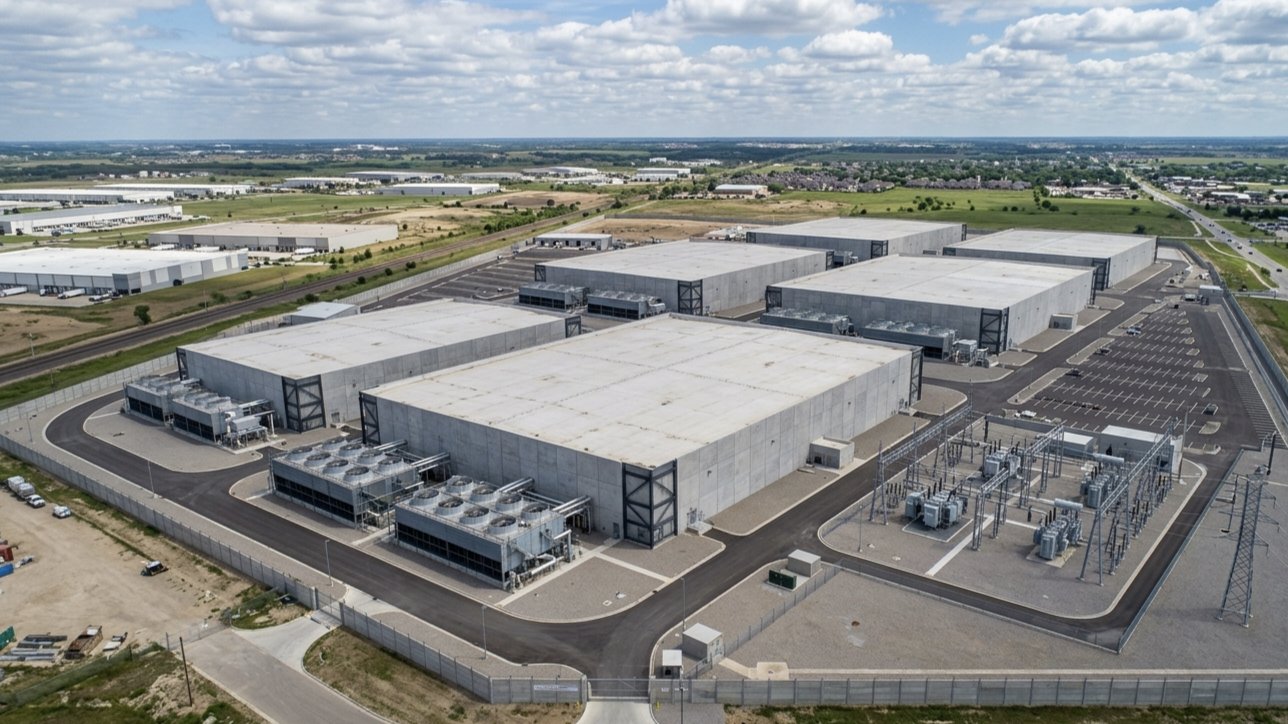

The most consequential construction boom of 2026 has no skyline. No landmark. No ribbon-cutting ceremony that anyone will attend. It is happening inside windowless buildings on the outskirts of cities, and it is rewriting the economics of the entire construction industry.
Data center construction spending in the United States reached $46.9 billion on an annualized basis by January 2026, surpassing office construction at $43.7 billion for the first time in recorded history. That crossover is not a blip. Monthly data center spending has increased by over 600 percent in two years. Year to date through March 2026, the sector had already logged $46.5 billion in starts, compared to $7.3 billion at the same point in 2025.
To put that in context, without data center investment, total US nonresidential construction spending would be declining by an estimated 3.8 percent this year. The sector is, in the words of industry analysts, holding up the entire nonresidential construction market.
The driver is artificial intelligence. Five technology companies alone announced approximately $700 billion in capital expenditure for data infrastructure in 2026. Amazon has already topped $100 billion in data center spending this year. Meta broke ground on a 900 megawatt facility in Wisconsin. OpenAI's Stargate project, with its first two buildings covering 980,000 square feet at 200 megawatts of capacity, went online in late 2024, with six additional buildings under construction targeting over four million square feet and 1.2 gigawatts of power by mid-2026.
Globally, the picture is even larger. JLL projects that nearly 100 gigawatts of new data center capacity will come online between 2026 and 2030, representing $1.2 trillion in real estate asset value. Total global investment through 2030 is estimated at between $3 trillion and $7 trillion, depending on the forecast model used.
The construction cost of building these facilities has risen sharply. The average global cost per megawatt of capacity reached $10.7 million in 2025 and is projected to climb to $11.3 million in 2026. For hyperscale AI infrastructure, the fit-out cost alone can reach $25 million per megawatt on top of the base build. A single large campus can exceed $20 billion in total investment.
None of this is without constraint. Power is the binding problem. A hyperscale campus can consume as much electricity as a mid-sized city. Grid operators in the United States now require non-refundable deposits of up to $200 million before interconnection studies even begin. Transformer lead times that averaged 40 weeks before 2020 now stretch up to four years for large models. Arizona froze new data center connections to its power grid in late 2024. Developers are now funding their own power generation on site, including natural gas plants, solar arrays and, increasingly, small modular nuclear reactors.
For Africa and Kenya, the data center story is arriving later, but it is arriving. Kenya already positions itself as East Africa's digital infrastructure hub. Nairobi hosts the region's most significant concentration of colocation facilities. The same dynamics driving hyperscale construction in Virginia and Ohio, cloud expansion, AI workload growth, and latency requirements, are beginning to shape investment decisions in African markets. The scale is different. The direction of travel is the same.
The building type that defines the next decade of construction may not be a tower, a stadium or a bridge. It may be a climate-controlled box in an industrial park, consuming the power of a small city, and built faster than almost anything else in the history of construction.
Comments (0)
Leave a Comment
No comments yet. Be the first to share your thoughts!