

A version of this article was posted on X by Massimo.
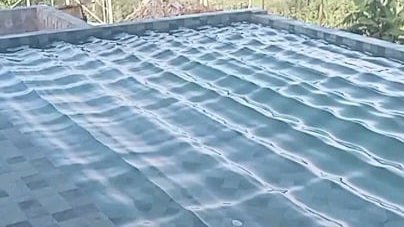
Dramatic footage circulating online shows water in a swimming pool forming structured square grid patterns during a magnitude 7.4 earthquake in Colombia. The viral video recorded by a bystander depicts the surface of the pool oscillating into precise geometric cross waves as seismic energy passes through the ground.
These distinct visual patterns occur when seismic energy transfers directly into contained bodies of water, causing liquid to slosh back and forth rapidly. As traveling waves bounce off the rigid concrete walls of the pool enclosure, they collide with incoming wave fronts moving in the opposite direction.
When these opposing water movements meet at identical wavelengths and frequencies, they trigger a physical phenomenon known as standing wave interference. Instead of rolling in a single direction like typical ocean surf, the intersecting wave crests and troughs cancel each other out in some spots while doubling in height in others.
The resulting constructive interference creates a two-dimensional grid lattice across the liquid surface. Hydraulic engineers refer to this specific sloshing behavior within rigid rectangular basins as a two-dimensional standing wave mode.
Seismic shockwaves moving through the earth consist of both longitudinal waves, known as Primary Waves (P-waves), and transverse waves, known as Secondary Waves (S-waves). S-waves move ground particles side to side perpendicular to the direction of the traveling earthquake energy, which pushes liquid away from the pool boundaries.
Structural engineers frequently study sloshing dynamics in storage tanks and swimming pools to evaluate how dynamic seismic loads impact surrounding concrete foundations. Liquid movement during severe ground shaking exerts enormous lateral forces against structural walls, increasing the risk of cracking or outright structural failure.
While swimming pools rarely suffer catastrophic collapse purely from wave action, liquid motion provides visible evidence of hidden ground accelerations occurring beneath nearby buildings. Civil structures must be constructed to withstand these exact multi-directional ground displacements during sudden earthquake events.
The video serves as a rare, clear demonstration of wave superposition and fluid mechanics occurring in real time during a major seismic disturbance. Ground movements from powerful tremors continue to offer vital observational data for engineers designing earthquake-resistant civil infrastructure.
Comments (0)
Leave a Comment
No comments yet. Be the first to share your thoughts!