
Work at the Galana Kulalu Food Security Project has entered a new phase of physical expansion, with the government and private sector partners aiming to have 6,400 acres under active irrigation by June 2026. This development follows the successful implementation of an initial pilot phase that utilized 1,500 acres for seed maize production.
The project, situated across Kilifi and Tana River counties, is being managed under a public-private partnership model involving the National Irrigation Authority and Selu Limited. The private investor has already deployed advanced irrigation technologies, including nine operational center pivot systems, to stabilize yields in the arid region. Current plans involve increasing the number of center pivots to 23 to cover an initial 3,000-acre block before scaling further.
Infrastructure development remains a primary focus to support this acreage. The National Irrigation Authority recently completed a 600,000-cubic-meter water reservoir, which was funded by the National Treasury at a cost of 519 million shillings. This reservoir, alongside a 20,000-cubic-meter intake well and a two-kilometer water canal, provides the necessary water storage to sustain year-round farming independent of seasonal rainfall.
Beyond the field, logistics and energy infrastructure are also being addressed. The Galana Kulalu Bridge, a vital link between the two host counties, is reportedly 90 percent complete. Work is currently concentrated on the bridge deck, with approximately 120 personnel on site to finalize the structure. This bridge is expected to streamline the movement of agricultural produce and equipment across the expansive ranch.
The project is also moving toward energy self-sufficiency to lower operational costs. The Rural Electrification and Renewable Energy Corporation is currently establishing a power plant at the site, which is scheduled to be operational by mid-2026. This facility is intended to replace expensive diesel-powered pumps with a more reliable and cost-effective energy supply, further improving the commercial viability of the scheme.
In the long term, the government intends to expand the project to 20,000 acres in its initial phase, with the potential to eventually reach 200,000 acres.
This larger scale would require the construction of the proposed Athi Dam on the Galana River, a project conceptualized to hold 305 million cubic meters of water. While the immediate focus remains on the 6,400-acre target, the existing infrastructure is already supporting the cultivation of maize, onions, and cassava.
By transitioning from rain-fed agriculture to intensive irrigation, the scheme seeks to reduce Kenya’s reliance on food imports. The use of fertigation as a method where water-soluble fertilizers are applied through the irrigation system has already been introduced to maximize nutrient efficiency. This technical approach, combined with private sector capital, is part of a broader strategy to de-risk large-scale farming in Kenya’s arid and semi-arid lands.
Galana Kulalu Scheme Targets 6,400 Acres of Irrigated Land by June 2026
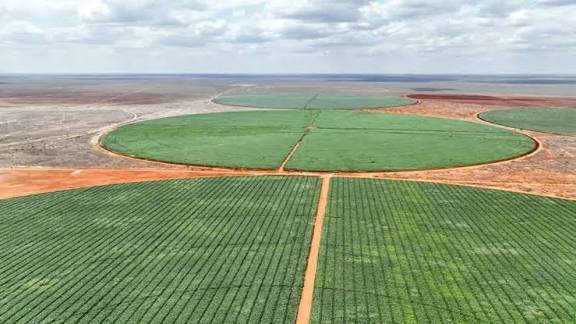
The Galana Kulalu Food Security Project utilizes center pivot irrigation and a 600,000-cubic-meter reservoir to support large-scale maize production
|
Mjengo Hub

The Galana Kulalu Food Security Project is expanding its irrigation footprint to 6,400 acres by June 2026 through a public-private partnership aimed at increasing national maize and grain production.
Comments (0)
Leave a Comment
No comments yet. Be the first to share your thoughts!