
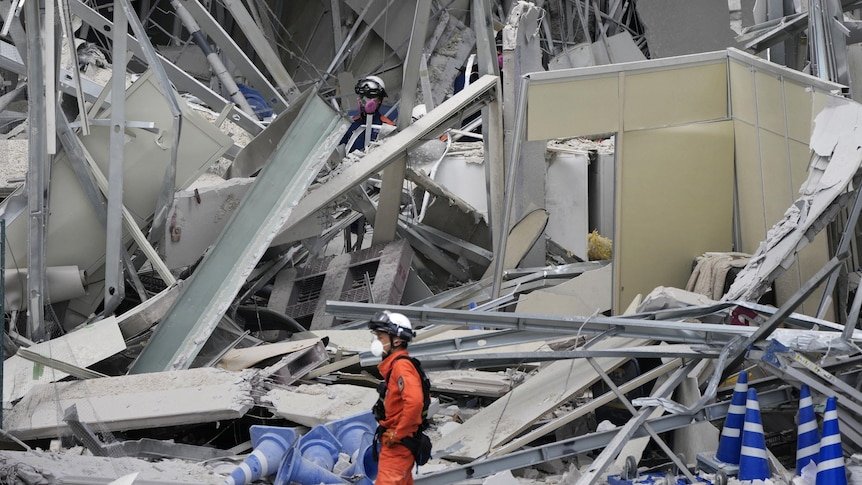

Emergency teams in southwestern Japan continue clearing debris and searching collapsed structures following a powerful 7.1-magnitude tremor that struck Kumamoto Prefecture.
Prime Minister Sanae Takaichi confirmed on Thursday that the death toll reached 30. Search operations remain active across several damaged industrial and commercial sites.
Disaster management crews are operating under severe environmental pressure as a relentless summer heatwave pushes local temperatures up to 35 degrees Celsius.
The elevated heat creates extreme working conditions for responders trying to reach people trapped under heavy building materials.
Officials warned that high humidity further accelerates dehydration risks for both rescue personnel and displaced residents staying in temporary shelters.
Thousands of displaced citizens are occupying designated evacuation centers across the region. Basic municipal utility services face widespread disruptions.
Water main ruptures left tens of thousands of households without clean running water, forcing emergency crews to set up temporary sanitation units over public sewer manholes. Electric utility providers are working to restore power lines knocked out during the initial ground movement.
Structural failures were reported across multiple municipalities, affecting residential units, commercial properties, and manufacturing plants.
Heavy machinery and emergency workers concentrated recovery efforts on a collapsed shopping mall where an explosion occurred post-quake, as well as an industrial facility where a large chimney collapsed onto nearby work zones.
The structural integrity of surrounding transportation corridors remains compromised. High-speed rail connections, including the Kyushu Shinkansen Line, faced service suspensions between major stations while engineers inspect tracks and structural elevated piers.
Preliminary engineering assessments indicate that a significant portion of the heavily damaged structures were built prior to updated seismic building code revisions. Inspecting authorities noted that older construction methods lacked the structural flexibility seen in modern designs.
Government agencies indicated plans to accelerate seismic retrofitting programs for legacy buildings to prevent similar failures during future seismic events.
Emergency military personnel deployed by the Self-Defense Forces (SDF) continue assisting civil authorities with heavy equipment clearance, logistical support, and water supply distribution.
Disaster management officials noted that repair work on fractured underground water distribution systems could take weeks to resolve completely.
Regional authorities maintain active monitoring for secondary aftershocks while emergency crews clear unstable concrete and fallen tile roofs across the affected zone.
Comments (0)
Leave a Comment
No comments yet. Be the first to share your thoughts!